
America Six Parties Quiz
How the Scales are Structured
Who Usually Takes This Test?
See How You Compare
Below is a preview of how scores are typically distributed across each scale.
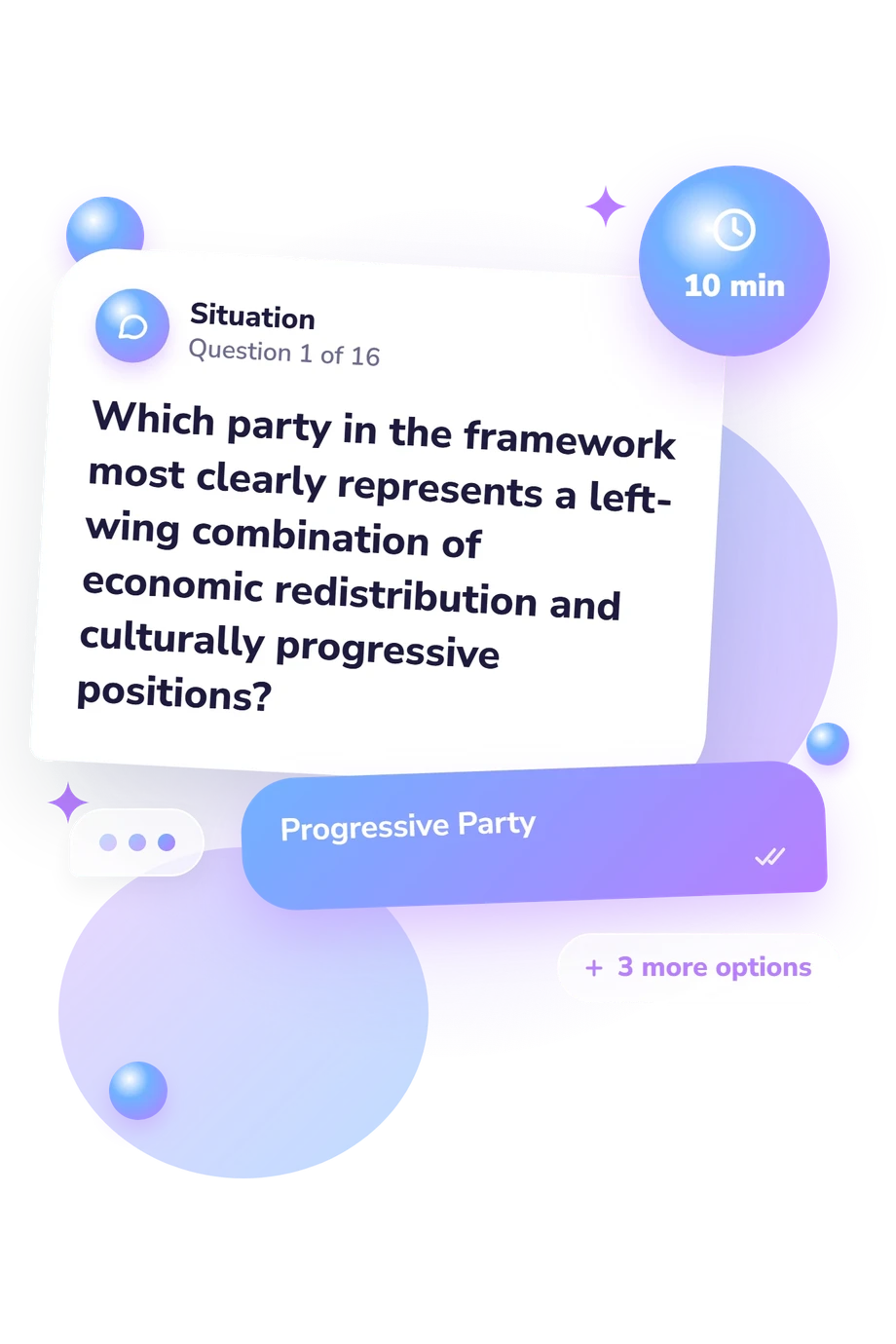
Example Questions From the Test
- Patriot Party
- Progressive Party
- Christian Conservative Party
- American Labor Party
- Christian Conservative Party
- Growth and Opportunity Party
- New Liberal Party
- Patriot Party
- Progressive Party
- Patriot Party
- American Labor Party
- Growth and Opportunity Party
America Six Parties Quiz - Description and methodology of the test
Readers deciding whether to take the assessment can use the America Six Parties Quiz to test their grasp of political distinctions rather than disclose personal allegiance. It suits students, civics learners, and anyone sorting out whether unfamiliar party profiles are understood or merely recognized by name. People considering an if America had six parties quiz can judge whether this structured knowledge check fits their purpose.
What This Assessment Explores
This assessment measures knowledge of a hypothetical six-party arrangement, not personal party membership. Items ask readers to connect economic priorities, social values, nationalism, immigration, institutional reform, and coalition behavior with the profile that fits best. Questions in a quiz if America had 6 parties can clarify how voter blocs may divide into coherent tendencies.
The six profiles represented in the framework are:
- The Progressive Party combines redistribution with consistently progressive social policy.
- The New Liberal Party joins socially liberal reform to greater comfort with markets and gradual change.
- The American Labor Party pairs worker protections with a more moderate cultural outlook.
- The Christian Conservative Party links traditional religious values with right-leaning economics.
- The Patriot Party combines nationalism, immigration restriction, anti-elite politics, and working-class populism.
- The Growth and Opportunity Party favors pro-business economics and moderate social policies.
Methodology and Evidence Base
Each item presents a short political scenario or framework question with four answer choices. The task is recognition: the respondent selects the party or distinction that best matches the model, rather than rating personal agreement on a continuous attitude scale. The result therefore reflects knowledge of this framework.
Conceptually, the questionnaire is consistent with the six-party coalition analysis associated with Drutman’s 2020 book, which explains how distinct factions within the two major U.S. coalitions might form more coherent groupings. McAlister, Crosson, Furnas, and Lorenz (2023) provide a general multidimensional comparison of political preferences, not evidence for these six profiles. Neither source makes this online questionnaire a standardized adaptation of a published instrument.
For interpretation, the result from this quiz about the hypothetical six-party model reports America’s Six Parties Knowledge (0-16) in three bands: Foundation 0-6, Developing 7-12, and Strong 13-16. The bands describe command of the hypothetical model and coalition logic, not identity or voting eligibility. Attention, prior exposure, and ambiguous scenarios can affect performance, and no external norms or clinical interpretation are provided.
- Drutman, Lee. “Quiz: If America Had Six Parties, Which Would You Belong To?” The New York Times, September 8, 2021.
- Drutman, Lee. Breaking the Two-Party Doom Loop: The Case for Multiparty Democracy in America. Oxford University Press, 2020. 10.1093/oso/9780190913854.001.0001
- McAlister, Kevin, Jesse Crosson, Alexander Furnas, and Geoffrey Lorenz. “The Multiplicity of Factions: Multi-Dimensional Ideal Points for Interest Groups & Members of Congress.” SSRN Electronic Journal, 2023. 10.2139/ssrn.4388918
Updated: