
Am I Fruity Quiz
How the Scales are Structured
Who Usually Takes This Test?
See How You Compare
Below is a preview of how scores are typically distributed across each scale.
Example Questions From the Test
- Choose something manageable and sing it without much performance.
- Pick a dramatic favorite and fully commit to gestures, attitude, and audience interaction.
- Add a few playful flourishes once I feel comfortable.
- Choose a showy song and enjoy giving the room a performance.
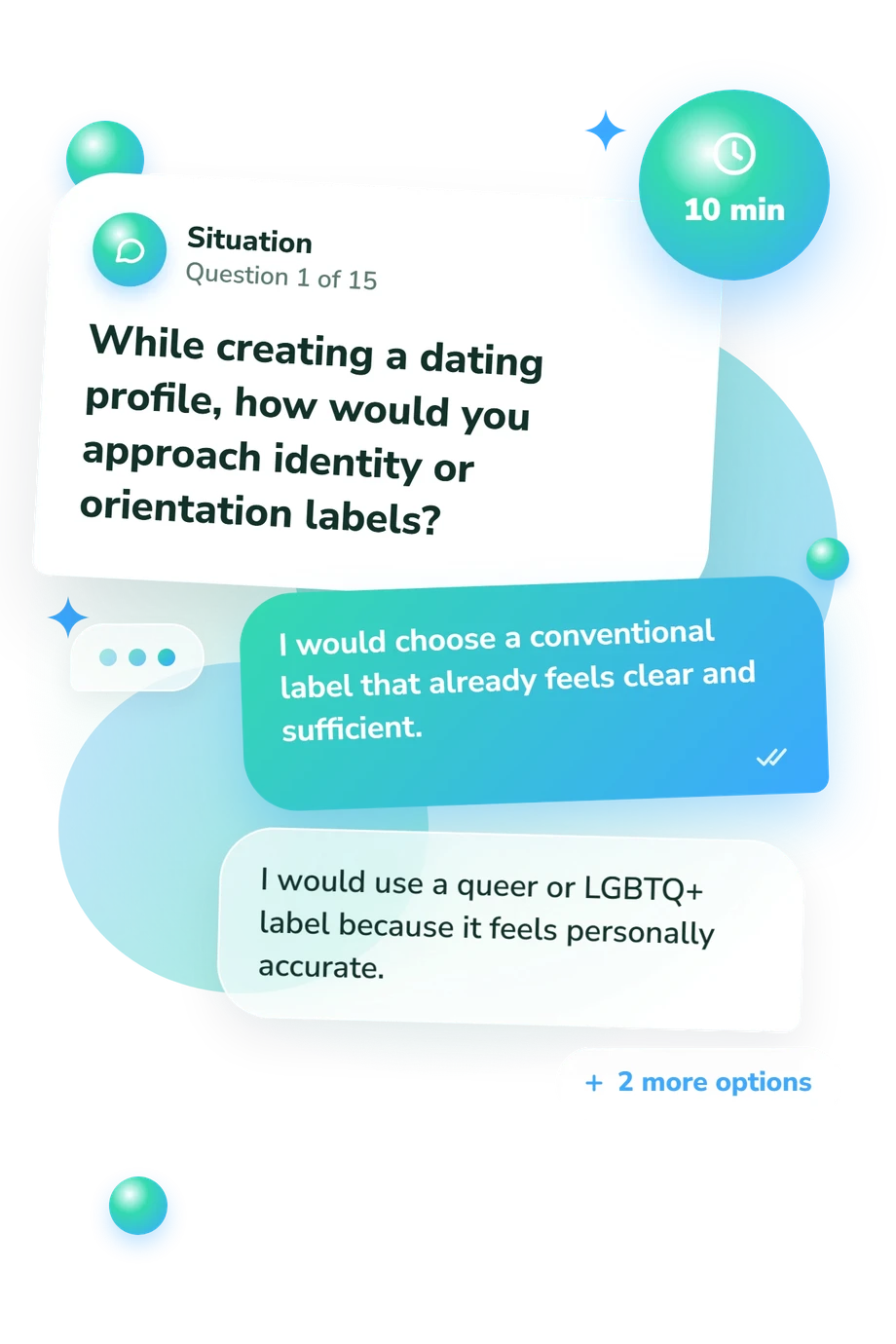
- I would choose a conventional label that already feels clear and sufficient.
- I would use a queer or LGBTQ+ label because it feels personally accurate.
- I would leave the field open because I am somewhat curious but uncertain.
- I would choose questioning, fluid, or another flexible label while I explore.
- It might fit, and I am interested in exploring it further.
- It does not feel like a description of me.
- It feels strongly aligned with how I understand myself.
- I can imagine the possibility, but it has little pull right now.
Am I Fruity Quiz - Description and methodology of the test
People questioning whether the word “fruity” fits their experience, or simply curious about their reactions to it, may find the Am I Fruity Quiz a useful starting point. Readers can treat this quiz as a how fruity are you quiz, using it to explore their reactions without treating a score as a verdict. Its result offers a perspective to consider alongside lived experience, rather than assigning a fixed identity.
What This Assessment Explores
The prompts cover clothing, performance, media, attraction, labels, Pride, and LGBTQ+ spaces. They separate expressive style, cultural connection, and personal resonance of queer language, making the exercise useful for queer self-reflection without assigning identity.
The result is organized around three dimensions:
- Playful Self-Expression (0-15) measures enjoyment of colorful or theatrical presentation: Understated expression (0-5) is subtle, Selective play (6-10) is situational, and Expressive play (11-15) is recurring boldness; none is more authentic.
- Queer Culture and Community Connection (0-15) measures personal connection with LGBTQ+ culture and spaces: Limited connection (0-5), Growing connection (6-10), and Strong resonance (11-15) move from low involvement to meaningful cultural connection, not identity or supportiveness.
- Queer Identity Resonance (0-15) measures the current pull of queer identity language: Little resonance (0-5), Open or exploring (6-10), and Strong resonance (11-15) describe increasing personal meaning without determining orientation.
Methodology and Evidence Base
The self-report format presents each item as a social, aesthetic, relational, or identity situation with four response options. Choices range from low-key or conventional to expressive, culturally connected, or exploratory; they describe experiences rather than rank authenticity.
Results are reported across the three displayed scales, but the questionnaire does not specify how many points any option adds, so its point-allocation method is unspecified. Readers should not reverse-engineer a formula or treat one high dimension as a global verdict. Read as a self-reflection quiz, the three-dimensional profile is more useful as a pattern across contexts than as a presumed total.
The structure is conceptually consistent with LGBIS, Frost and Meyer’s community-connectedness work, and Lehavot, King, and Simoni’s gender-expression measure. These sources supply relevant constructs for identity resonance, belonging, and presentation; this questionnaire is not a direct administration or validated adaptation.
Interpretation remains descriptive: this questionnaire has no standardized norms, reliability estimates, or clinical cutoffs, and its scoring describes patterns rather than establishing a clinical category. Answers can shift with context, self-awareness, and candor, so the result is best used as a focused reflection prompt rather than a fixed identity statement.
- Jonathan J. Mohr and Matthew S. Kendra (2011). Revision and extension of a multidimensional measure of sexual minority identity: The Lesbian, Gay, and Bisexual Identity Scale. Journal of Counseling Psychology, 58(2), 234-245. 10.1037/a0022858
- David M. Frost and Ilan H. Meyer (2012). Measuring Community Connectedness among Diverse Sexual Minority Populations. Journal of Sex Research, 49(1), 36-49. 10.1080/00224499.2011.565427
- Keren Lehavot, Kevin M. King, and Jane M. Simoni (2011). Development and validation of a gender expression measure among sexual minority women. Psychology of Women Quarterly, 35(3), 381-400. 10.1177/0361684311413554
Updated: