
Am I Better Off Single Quiz
How the Scales are Structured
Who Usually Takes This Test?
See How You Compare
Below is a preview of how scores are typically distributed across each scale.
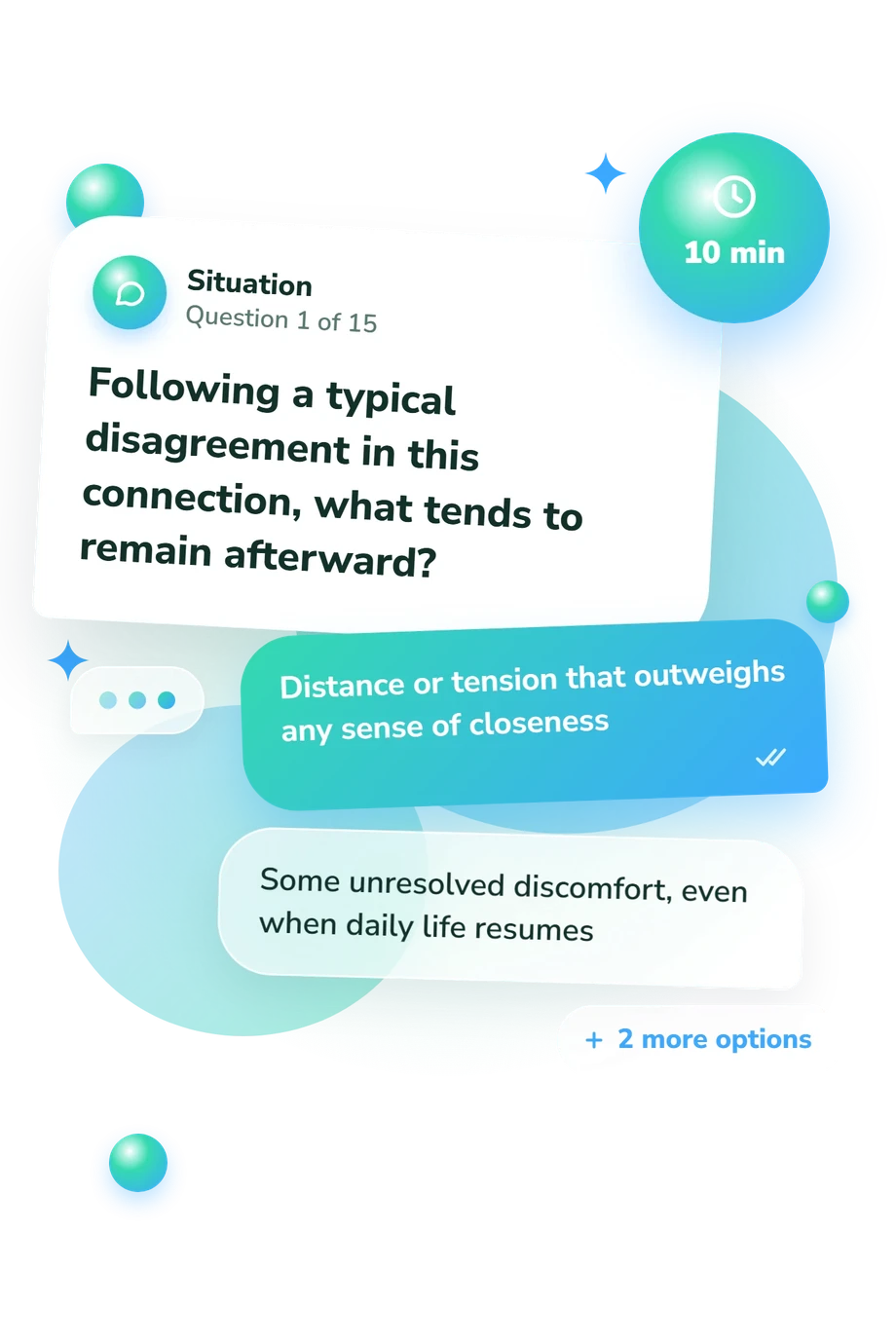
Example Questions From the Test
- More ongoing strain than meaningful benefit
- A few valued moments, but the costs often dominate
- A fairly even mix of support and difficulty
- A dependable source of connection, enjoyment, or mutual support
- Spending most of it with a partner or romantic interest
- Making shared plans but keeping a little time for myself
- Splitting the day fairly evenly between connection and solo time
- Following my own interests without coordinating with anyone
- I would rather process it alone or tell someone else
- I might tell them later, but they are not my natural first choice
- I would probably tell them, depending on the news and timing
- I strongly want them to be among the first people who know
Am I Better Off Single Quiz - Description and methodology of the test
For anyone weighing a current relationship against the freedom of independent living, the Am I Better Off Single Quiz offers a structured pause. It suits people reflecting on partnership, dating, or a recent meaningful connection, and places the Am I Better Off Alone Quiz question in present context. The profile helps readers examine what they want from connection or solitude.
What This Assessment Explores
The items ask about partnership, support, and coordination. They suit someone evaluating a relationship or a recent meaningful connection. The questionnaire provides a single-life assessment of capacity, value, and autonomy without judging relationship skill.
These are the three dimensions shown in the result:
- Relationship Investment Capacity (0-15) shows current partnership bandwidth: Limited Bandwidth (0-5) protects energy, Conditional Bandwidth (6-10) permits manageable investment, and Strong Capacity (11-15) supports communication and adjustment.
- Relationship Nourishment (0-15) describes experienced value in a current or recent connection: Limited Nourishment (0-5) brings little comfort or self-expression, Mixed Value (6-10) combines benefit with strain, and Strong Nourishment (11-15) supports closeness and authenticity.
- Single-Life Alignment (0-15) reflects autonomy’s appeal: Shared-Life Lean (0-5) favors shared decisions, Flexible Autonomy (6-10) balances freedom and partnership, and Strong Single-Life Pull (11-15) favors independent routines without deciding a relationship must end.
Methodology and Scientific Basis
Each item presents a relationship situation with four ordered choices. Direction varies by construct: one may move from protecting autonomy toward shared engagement, while another may favor independence. Prompts cover disagreement, compromise, emotional availability, self-expression, time, and recurring problems. Answer from present circumstances, not an idealized self.
The questionnaire reports three descriptive scales with named bands; it does not document how individual answers are assigned to them. Its structure is conceptually consistent with the Brief Measure of Relationship Importance (Watkins & Beckmeyer, 2020), Leach and colleagues’ (2013) relationship-quality findings, Rusbult, Martz, and Agnew’s (1998) investment concepts, and Knee and colleagues’ (2005) self-determination work. Results frame the Should I Get Married or Stay Single Quiz question as reflection on partnership and independence, not a fixed answer.
This questionnaire is a self-reflection measure rather than an administration or adaptation of a published instrument; no validation or norms are documented for this 15-question format, so its bands are descriptive for this questionnaire. Self-report and context matter: stress, health, caregiving, or recent relationship change can alter the profile, so compare it with lived experience.
- Watkins, Nicole K., and Jonathon J. Beckmeyer. "Assessing Young Adults’ Beliefs Regarding the Importance of Romantic Relationships." Journal of Family Issues, 41(2), 2020, 158-182. 10.1177/0192513X19871080
- Leach, Liana S., Peter Butterworth, Sarah C. Olesen, and Andrew Mackinnon. "Relationship quality and levels of depression and anxiety in a large population-based survey." Social Psychiatry and Psychiatric Epidemiology, 48(3), 2013, 417-425. 10.1007/s00127-012-0559-9
- Rusbult, Caryl E., John M. Martz, and Christopher R. Agnew. "The Investment Model Scale: Measuring commitment level, satisfaction level, quality of alternatives, and investment size." Personal Relationships, 5(4), 1998, 357-387. 10.1111/j.1475-6811.1998.tb00177.x
- Knee, C. Raymond, Cynthia Lonsbary, Amy Canevello, and Heather Patrick. "Self-Determination and Conflict in Romantic Relationships." Journal of Personality and Social Psychology, 89(6), 2005, 997-1009. 10.1037/0022-3514.89.6.997
Updated: