
Arabic Quiz
How the Scales are Structured
Who Usually Takes This Test?
See How You Compare
Below is a preview of how scores are typically distributed across each scale.
Example Questions From the Test
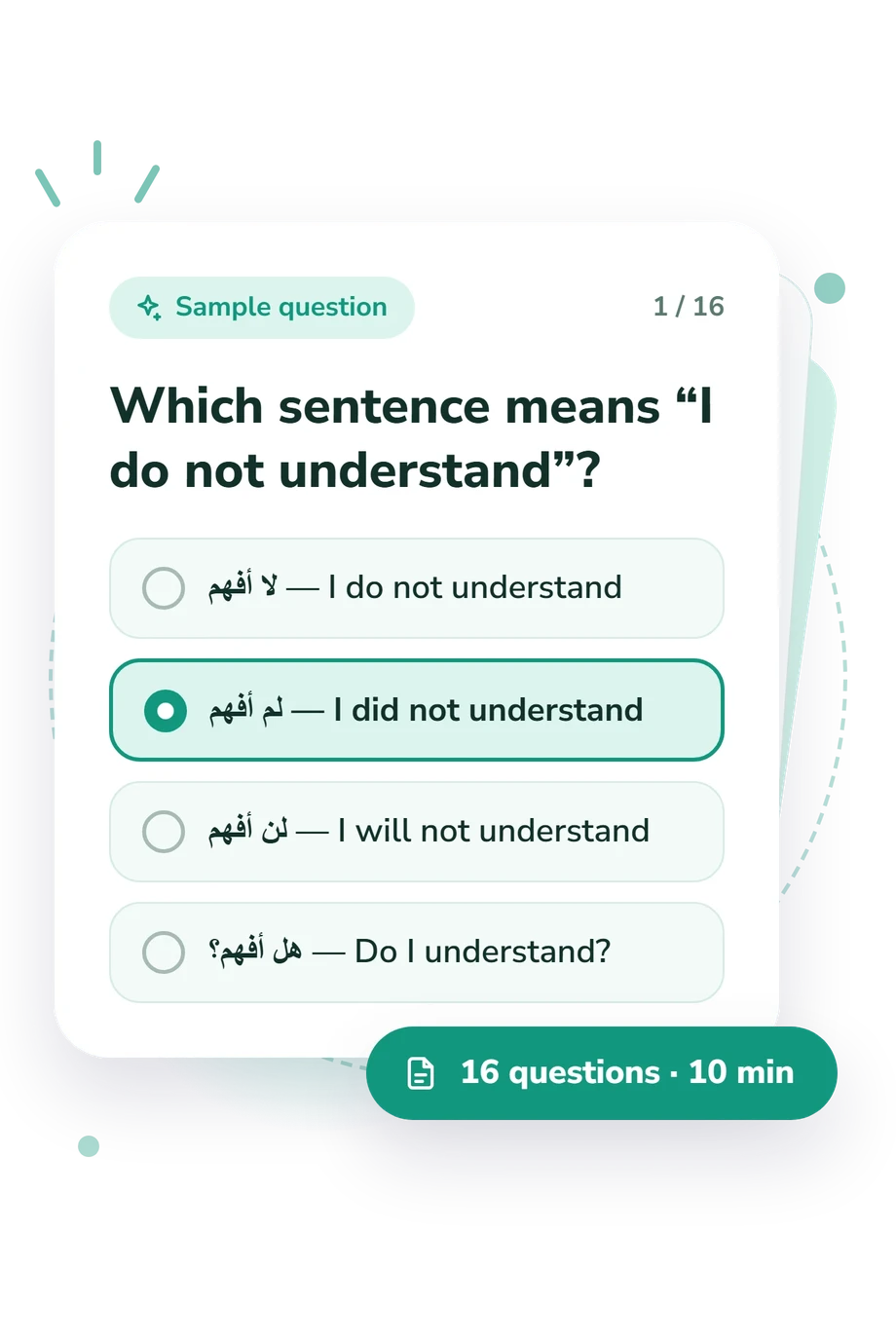
- لا أفهم — I do not understand
- لم أفهم — I did not understand
- لن أفهم — I will not understand
- هل أفهم؟ — Do I understand?
- ب — baa, representing /b/
- ن — noon, representing /n/
- ل — laam, representing /l/
- م — meem, representing /m/
- كتاب — one book
- كاتبان — two male writers
- كُتُب — books, plural
- كتابان — two books
Arabic Quiz - Description and methodology of the test
Designed for learners who want to check their starting point, this arabic quiz samples practical knowledge of Arabic script, words, sentences, and everyday expressions rather than asking for a broad personal rating. It can help a student, traveler, or independent learner identify which basics feel secure and which deserve focused review. The result shows how well learners handle sampled concepts, so this Arabic language test can guide focused review.
What This Assessment Measures
The questionnaire examines recognition, meaning, grammar, and contextual interpretation. Learners who want to check foundational knowledge can use this quiz in Arabic before choosing what to practise next.
Tasks move from letters, vowel marks, and common words to sentence meaning, agreement, number, roots, and everyday expressions. They require learners to connect forms with meanings and use context to infer what sentences communicate.
Results are reported on the Arabic Knowledge scale (0-16), with the catalogue’s three result bands describing the strength of sampled knowledge:
- Foundations to build (0-6) indicates that the alphabet, core vocabulary, and basic sentence patterns need review.
- Developing knowledge (7-12) shows that many essentials are recognized, while grammar and contextual meaning may still need practice.
- Strong foundation (13-16) shows solid command of the Arabic concepts sampled here, without implying comprehensive fluency or a formal placement level.
Methodology and Evidence Base
Each item uses a short prompt and four answer choices, asking the learner to identify a meaning, form, sound, or grammatical function. Together, the questions sample script, vocabulary, sentence comprehension, morphology, agreement, and contextual inference. Tasks also distinguish gender, number, direction, articles, and everyday social phrases. The displayed score summarizes performance on these items; no separate weighting, guessing penalty, or extra cutoff rule is stated.
The questionnaire is conceptually consistent with the Arabic Placement Test, which includes vocabulary, reading comprehension, and grammar in placement content, but it is not presented as an adaptation of that instrument. Vocabulary-recognition items can be compared with the relevant component of LexArabic, while related validation work by Norrbom and Al-Shamrani addresses Arabic assessment.
This questionnaire indicates performance on sampled concepts, not a formal placement level. It is not an Arabic proficiency test; its bands describe performance on these items rather than comprehensive ability. Guessing, translation familiarity, and recent exposure can affect performance; the items do not assess listening, speaking, extended writing, or comprehensive reading.
- Ali, Hussein Mohamed Gameil, Wan Ahmad Rahiman Wan Husain, and Azlan Saif Baharum. (2014). The Suitability and Validity of the Items Used for the Arabic Placement Test: An Analysis of Vocabulary, Reading Comprehension, and Grammar. At-Tajdid - Intellectual Refereed Journal, 18(36), 212-235.
- Alzahrani, Alaa. (2024). LexArabic: A receptive vocabulary size test to estimate Arabic proficiency. Behavior Research Methods, 56(6), 5529-5556. 10.3758/s13428-023-02286-z
- Norrbom, Bjorn, and Abdulrahman Al-Shamrani. (2017). The development and validation of an Arabic language test in Saudi Arabia. In Atta Gebril (Ed.), Applied Linguistics in the Middle East and North Africa: Current Practices and Future Directions (pp. 203-225). John Benjamins Publishing Company. 10.1075/aals.15.09nor
Updated: