
Nursery Rhyme Quiz
How the Scales are Structured
Who Usually Takes This Test?
See How You Compare
Below is a preview of how scores are typically distributed across each scale.
Example Questions From the Test
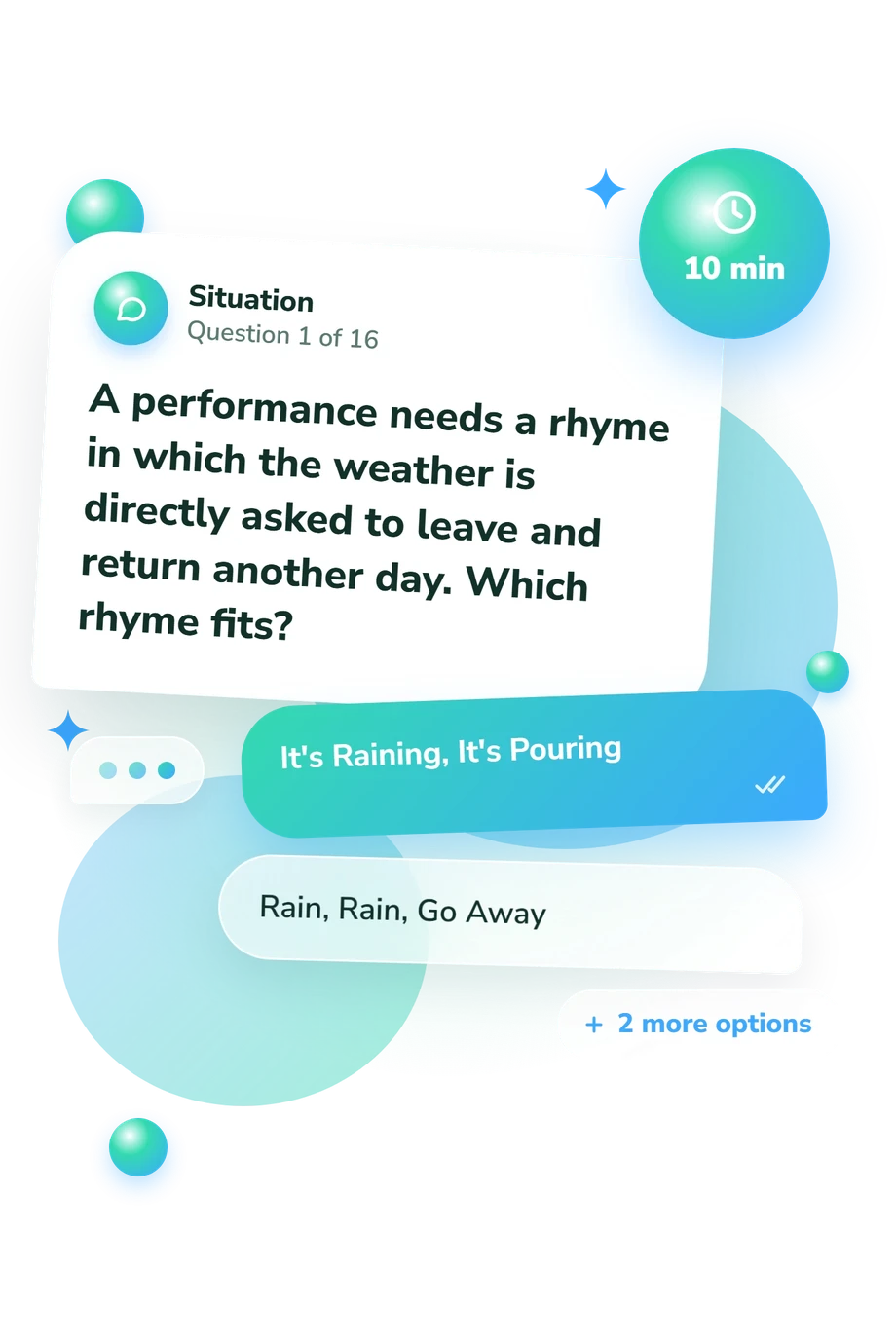
- It's Raining, It's Pouring
- Rain, Rain, Go Away
- Doctor Foster
- The Itsy Bitsy Spider
- Twelve
- Two
- One
- Three
- The sun comes out and dries up the rain
- The spider hides inside a shoe
- The wind blows the waterspout down
- Another spider begins climbing
Nursery Rhyme Quiz - Description and methodology of the test
Designed for readers who enjoy classic verses, this nursery rhyme quiz checks whether you can identify familiar lyrics, characters, sequences, and story clues from common versions. This quiz about nursery rhymes for adults offers a light self-test, a classroom-style recall exercise, or a way to revisit childhood material. The result summarizes the knowledge you demonstrate across recognition and memory tasks.
What This Quiz Measures
Rather than measuring personality or reading ability, the questionnaire tests recall of familiar nursery-rhyme content. Its prompts ask you to identify verses, characters, sequences, and lines from story clues. Questions and answers about nursery rhymes therefore sample verbal memory without requiring literary analysis.
The main content groups are:
- Rhyme identification shows whether a situation leads you to the correct verse.
- Character recall indicates how well names connect with roles, places, and objects.
- Sequence memory reflects whether you remember the order of familiar events.
- Wording clues reveal recognition of lines, endings, and story details.
Results use the Nursery Rhyme Knowledge scale (0-16): Early Recall (0-6) means some familiar details; Developing Knowledge (7-12) means broad recall with gaps; Rhyme Expert (13-16) means strong knowledge of common lyrics, sequences, and clues. These bands describe performance on the versions used here.
Methodology and Evidence Base
Each item presents a short prompt with four answer choices. Scoring awards one point for each correct answer, producing a transparent total rather than a personality profile. As a quiz about nursery rhymes with answers built into its options, the format separates precise recall from nearby but incorrect details.
Content selection is anchored in the common versions collected and compared by Opie and Opie (1997), with the earlier Opie and Opie (1955) collection providing complementary coverage of traditional rhymes. The questionnaire is conceptually consistent with those reference works, but it is not presented as a standardized adaptation of them. Bryant, Bradley, Maclean, and Crossland (1989) provide related evidence linking nursery-rhyme knowledge with phonological skills and reading development; that study does not validate this online quiz.
Interpret the total as a snapshot of recognition for the wording and story patterns used in the test. Regional versions may change a line, sequence, or detail, so familiarity with one tradition can affect performance. The result uses descriptive bands rather than established population norms, and self-administered recall remains sensitive to attention, memory, and current context.
- Opie, Iona, and Peter Opie. The Oxford Dictionary of Nursery Rhymes. 2nd ed. Oxford University Press, 1997. ISBN 0198600887.
- Opie, Iona, and Peter Opie. The Oxford Nursery Rhyme Book. Oxford University Press, 1955. ISBN 0198691122.
- Bryant, P. E., Bradley, Lynette, Maclean, M., and Crossland, J. Nursery rhymes, phonological skills and reading. Journal of Child Language 16, no. 2 (1989): 407-428. 10.1017/S0305000900010485.
Updated: