
French Vocab Quiz
How the Scales are Structured
Who Usually Takes This Test?
See How You Compare
Below is a preview of how scores are typically distributed across each scale.
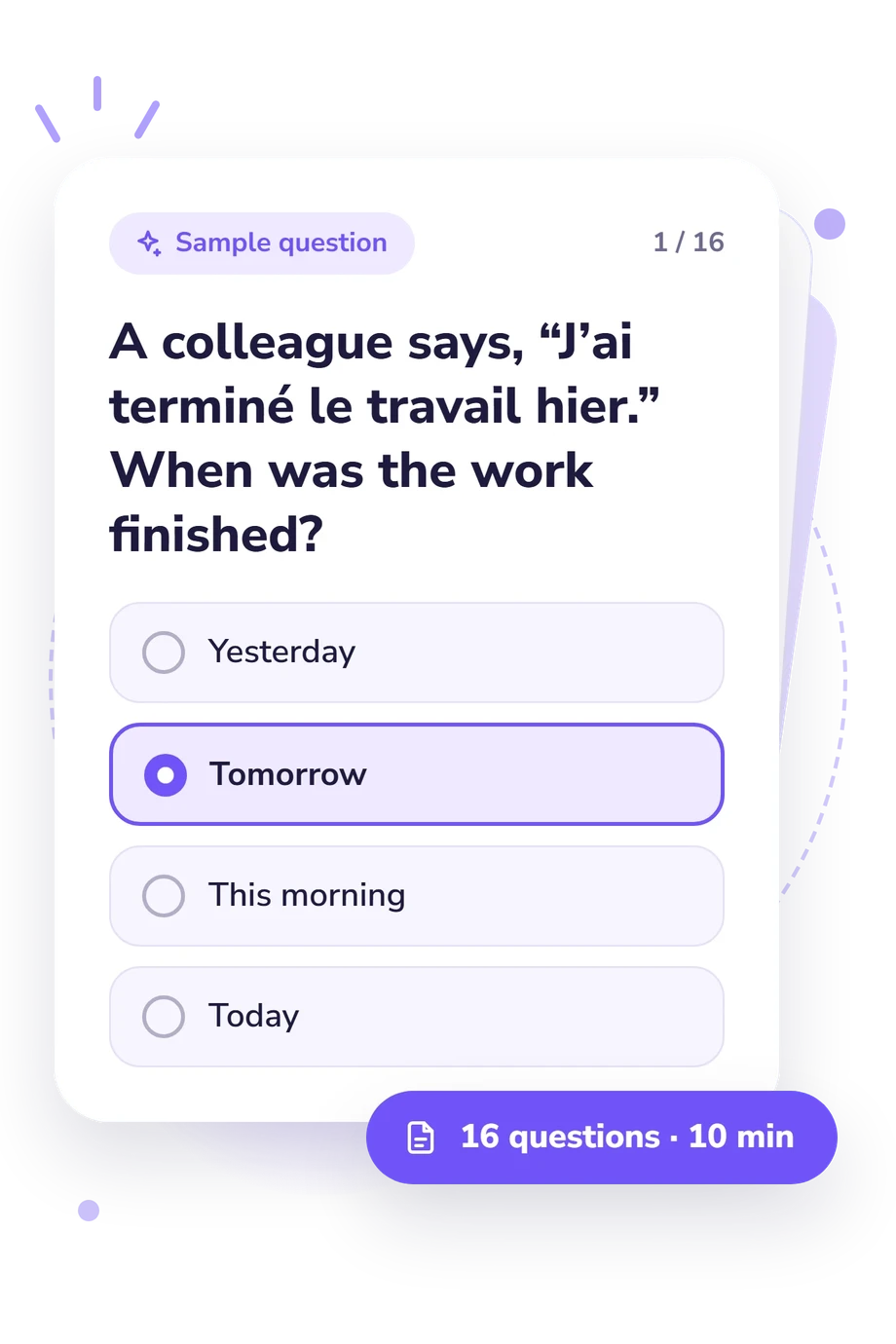
Example Questions From the Test
- Yesterday
- Tomorrow
- This morning
- Today
- They have already found the way
- They want to take a break
- They are offering help
- They need help
- Cold
- Dry
- Heavy
- Hot
French Vocab Quiz - Description and methodology of the test
People who want a quick check of practical French word knowledge can use the French Vocab Quiz to see how comfortably they recognize meaning in familiar situations. It suits learners, travelers, and anyone reviewing everyday vocabulary before further study. As a French vocabulary assessment, its primary focus is recognition of vocabulary and meaning; sentence context supports interpretation, while pronunciation, speaking fluency, and overall language level remain outside its scope.
What This Test Measures
Everyday contexts anchor the assessment. The questions ask whether you can connect French words with meaning and action in situations involving time, needs, feelings, food, travel, places, instructions, comparisons, and linking ideas. Some require an English equivalent; others ask you to infer a sentence’s practical meaning.
The thematic groups below describe what your result on this French vocabulary quiz can tell you:
- Everyday vocabulary shows recognition of common words for objects, food, places, and people.
- Situational comprehension shows how context supports interpretation of expressions.
- Functional language reflects understanding of requests, instructions, needs, and transactions.
- Sentence meaning shows how connectors, comparisons, and simple verb phrases shape interpretation.
Overall, the result reports French Vocabulary Knowledge on a 0-16 scale. Foundation (0-6) indicates a need to reinforce common words; Developing (7-12) reflects an everyday range; Strong (13-16) reflects confident knowledge across varied situations.
Methodology and Evidence Base
Each item presents a short French sentence, phrase, or vocabulary prompt with four answer choices. Because this French word quiz uses four-choice items, it measures receptive knowledge rather than spoken production; sentence context supports interpretation alongside individual words. Context matters alongside individual words, although guessing can affect the result.
The evidence base is conceptually consistent with receptive French vocabulary assessment. TTV (Batista and Horst, 2016) is the closest named source. Peters, Velghe, and Van Rompaey (2019), together with Dudley, Marsden, and Bovolenta (2024), also emphasize high-frequency vocabulary, contextual interpretation, and proficiency-sensitive design. Those studies support the questionnaire’s themes, but this online version is not a direct adaptation or restandardized form of any of them.
Interpret the displayed total as a descriptive summary of performance across these items. The outcome can guide review of foundational words, broader everyday vocabulary, or already strong recognition. This format offers a focused snapshot rather than a full measure of language ability. Guessing, prior exposure, and concentration can influence scores, so consider the result alongside listening, speaking, reading, and grammar evidence.
- Batista, Roselene, and Marlise Horst. "A New Receptive Vocabulary Size Test for French." The Canadian Modern Language Review, vol. 72, no. 2, 2016, pp. 211-233. 10.3138/cmlr.2820
- Peters, Elke, Tom Velghe, and Tinne Van Rompaey. "The VocabLab Tests: The Development of an English and French Vocabulary Test." ITL-International Journal of Applied Linguistics, vol. 170, no. 1, 2019, pp. 53-78. 10.1075/itl.17029.pet
- Dudley, Amber, Emma Marsden, and Giulia Bovolenta. "A Context-Aligned Two Thousand Test: Toward Estimating High-Frequency French Vocabulary Knowledge for Beginner-to-Low Intermediate Proficiency Adolescent Learners in England." Language Testing, vol. 41, no. 4, 2024, pp. 759-791. 10.1177/02655322241261415
Updated: