
Makeup Quiz for Guys
How the Scales are Structured
Who Usually Takes This Test?
See How You Compare
Below is a preview of how scores are typically distributed across each scale.
Example Questions From the Test
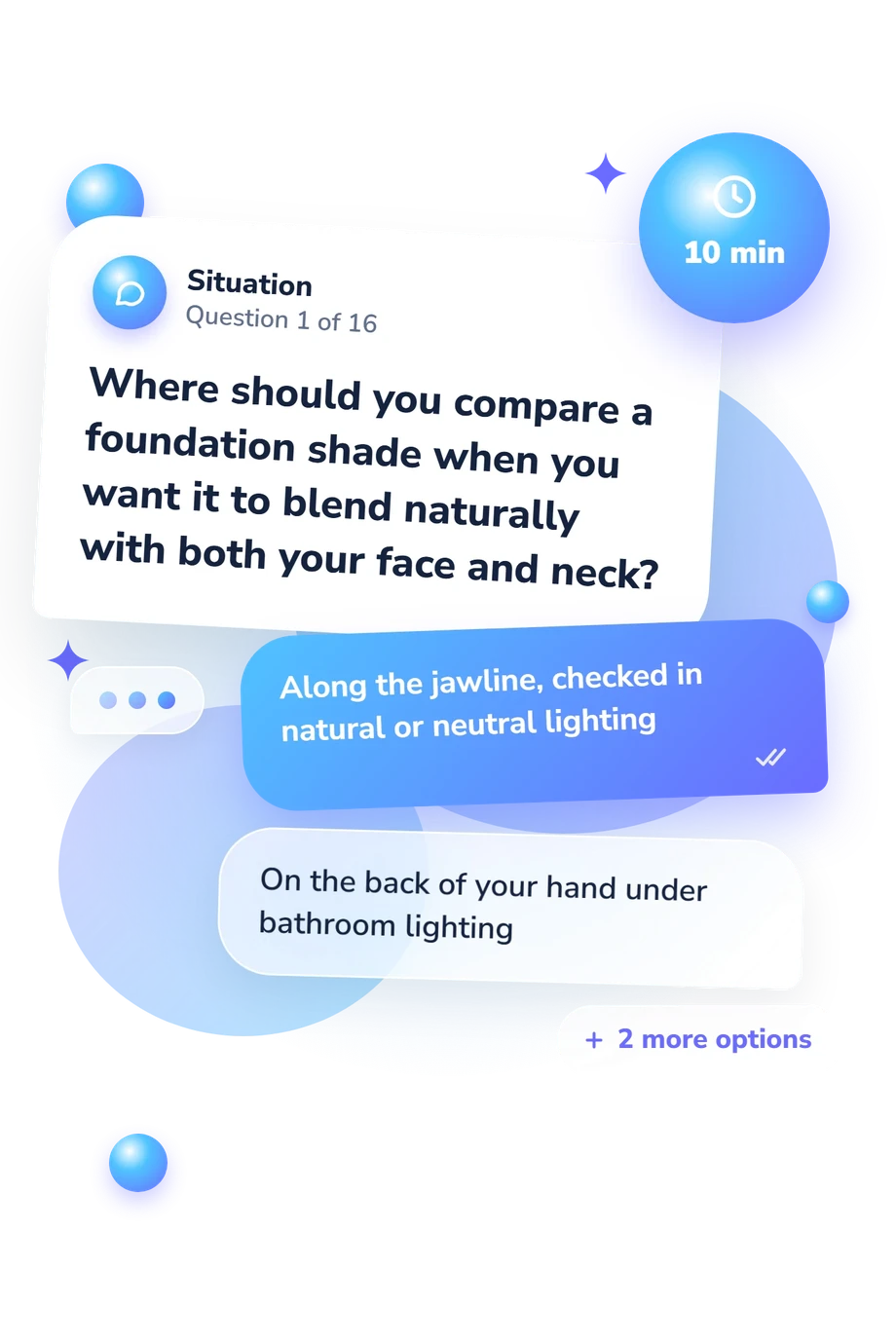
- Along the jawline, checked in natural or neutral lighting
- On the back of your hand under bathroom lighting
- On the reddest area in the center of your face
- On your inner wrist after applying powder
- A shade noticeably lighter than your skin
- A deep contour shade
- A shade that closely matches your skin or foundation
- A brightening shade with strong shimmer
- Peach
- Green
- Lavender
- Yellow-gold shimmer
Makeup Quiz for Guys - Description and methodology of the test
For men and other beginners, the makeup quiz for guys offers a general knowledge self-check for everyday product and technique decisions. It suits anyone who wants to understand common makeup principles without treating personal style as a requirement. The makeup quiz questions present familiar situations and ask the reader to identify the most appropriate response.
What This Assessment Explores
The questionnaire addresses practical decisions, not personal style or appearance ideals. It asks how products are chosen, layered, applied, protected, and removed.
The assessment is a makeup knowledge quiz that reports one Makeup Knowledge result on a 0-16 range. Foundation Builder (0-6) reflects beginning recognition of core products and techniques; Developing Technique (7-12) reflects understanding many essentials and potential benefit from targeted practice with powder use, facial-hair application, color correction, and formula layering; Makeup Fluent (13-16) reflects strong practical knowledge and readiness to refine finishes, compare formulas, and experiment while maintaining sound hygiene and skin protection.
The question themes are:
- Complexion and shade matching ask you to recognize undertone and coverage.
- Preparation and layering test skincare, formula order, and product amounts.
- Detail work covers facial hair, eyes, brows, and contour.
- Hygiene, sun protection, and removal address safer handling and aftercare.
Methodology and Evidence Base
Each item presents a practical makeup situation with four response choices, asking for the most appropriate action rather than personal preference. The item groups cover complexion, facial hair, eyes, brows, skincare, sun protection, hygiene, and removal. The questionnaire reports a displayed result with supplied bands; the score is a descriptive self-reflection measure of the knowledge represented by the selected answers.
Content is conceptually consistent with Caisey et al. (2006) on skin color, shade matching, and makeup strategies, but this questionnaire is not an adaptation of that study. Guichard et al. (2022) supports the foundation guidance, Ricarte et al. (2022) the eye-product focus, and Bashir and Lambert (2020) the hygiene emphasis.
The questionnaire is an online makeup skills quiz for recognizing principles in everyday situations, not a record of observed performance. Guessing, interpretation of the wording, and familiarity with the situations can affect responses. A result is most useful for identifying principles to revisit, while it does not show how consistently the respondent applies techniques in practice.
- Caisey, L., Grangeat, F., Lemasson, A., Talabot, J., and Voirin, A. 2006. Skin color and makeup strategies of women from different ethnic groups. International Journal of Cosmetic Science 28: 427-437. DOI 10.1111/j.1467-2494.2006.00329.x
- Guichard, S., Roulier, V., Bodnar, B., and Ricard, A. 2022. Facial Foundation. In Cosmetic Dermatology: Products and Procedures, 3rd ed., edited by Zoe Diana Draelos, 231-243. John Wiley & Sons. DOI 10.1002/9781119676881.ch24
- Amreen Bashir and Peter Lambert. 2020. Microbiological study of used cosmetic products: highlighting possible impact on consumer health. Journal of Applied Microbiology 128(2): 598-605. DOI 10.1111/jam.14479
- Ricarte, F., Singh, D., Wong-Putnam, P., and Vickery, S. A. 2022. Eye Cosmetics. In Cosmetic Dermatology: Products and Procedures, 3rd ed., edited by Zoe Diana Draelos, 259-268. John Wiley & Sons. DOI 10.1002/9781119676881.ch27
Updated: