
1960s Quiz
How the Scales are Structured
Who Usually Takes This Test?
See How You Compare
Below is a preview of how scores are typically distributed across each scale.
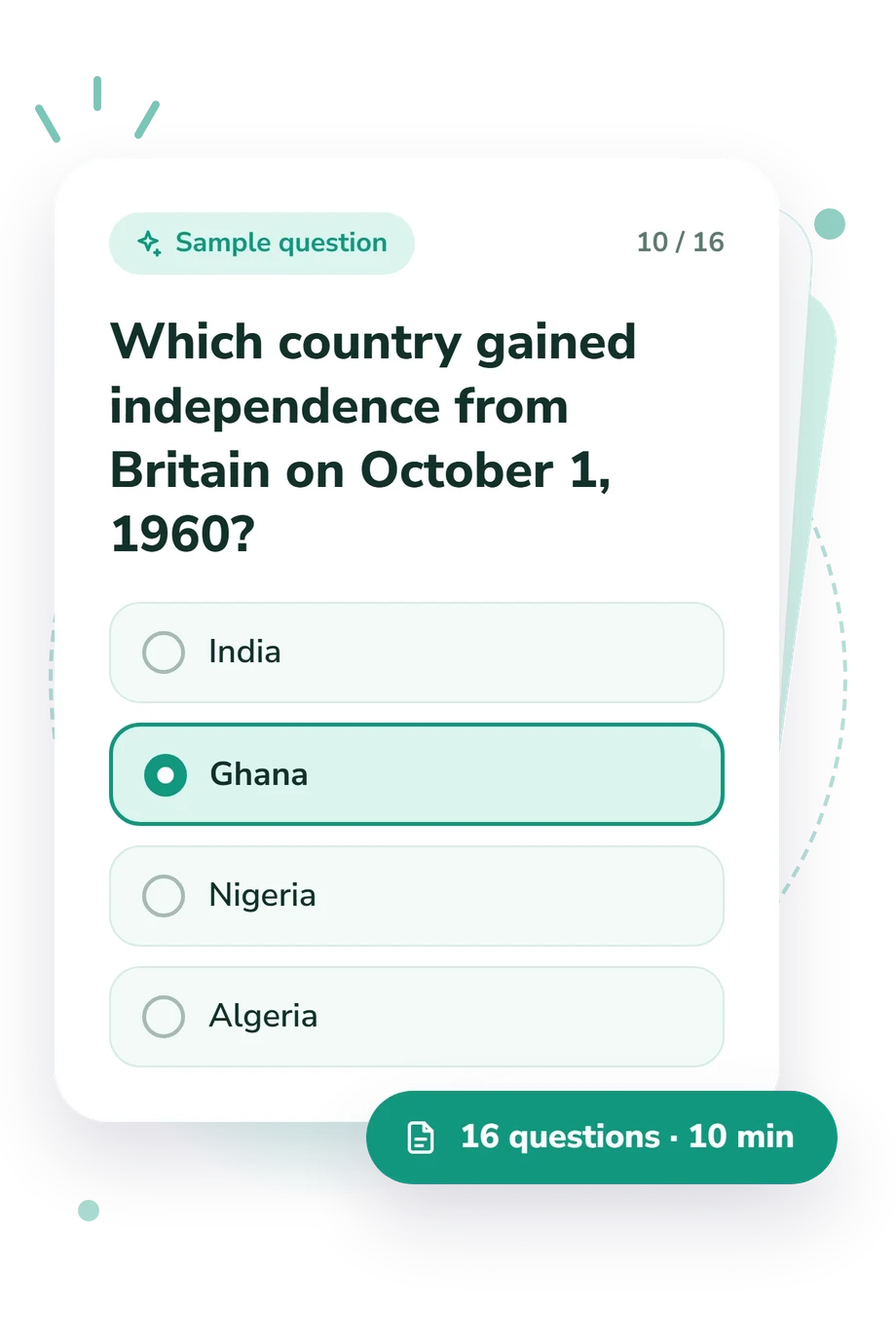
Example Questions From the Test
- An 8-track tape
- A compact cassette
- A vinyl LP
- A compact disc
- The Selma to Montgomery march
- The Freedom Rides
- The March on Washington for Jobs and Freedom
- The Poor People’s Campaign
- The Bay of Pigs invasion
- The Berlin Blockade
- The Prague Spring
- The Cuban Missile Crisis
1960s Quiz - Description and methodology of the test
For readers who want to place the decade’s headline events in context, this 1960s quiz offers a focused check of historical and cultural recall. Anyone curious about the era can use this sixties quiz to review broad themes or revisit familiar stories. The result gives an overall indication of your knowledge across the decade and encourages broader review.
What This Quiz Measures
The questionnaire samples public history and everyday culture that made the 1960s distinctive. It suits readers checking recall across politics, social change, entertainment, science, and international affairs. The questionnaire works as a 1960s history quiz, connecting memorable media references with events that shaped later decades.
The main thematic groups are:
- Civil rights and law show how legislation, court decisions, and protest changed public life.
- Cold War and space exploration measure recognition of major confrontations, missions, structures, and figures.
- Music and television reflect how genres, performers, and programs defined shared culture.
- Global events and social movements show whether knowledge reaches beyond a national story, including independence, war, environmental writing, and demonstrations.
The 1960s Knowledge scale runs from 0-16 points. Emerging (0-6) reflects recognition of some features; Developing (7-12) indicates a solid grasp with details to strengthen; Strong (13-16) signals broad, accurate knowledge.
Methodology and Evidence Base
Each item presents a short historical or cultural prompt with four answer choices. You select the best-supported response, and the displayed result counts correct answers at one point each. No published psychological instrument or theoretical model is being administered; this is an objective knowledge format rather than a personality or emotional self-report. As a 1960s trivia quiz, it rewards recall of names, dates, places, decisions, works, and cultural forms.
The questions draw on documented historical and cultural content discussed by Chaplin and Pieper Mooney, Farber and Bailey, and Ward: global conflict, convention, and counterculture; American political and social change; documentary perspectives on the period; and environmental concerns represented by Carson’s 1962 work. These sources support factual context, not psychometric validation of this online questionnaire.
The questionnaire has no stated population norms or reliability evidence, so the bands describe performance on this selected question set rather than general historical expertise; results may also reflect education, cultural familiarity, memory, or guessing.
- Chaplin, Tamara, and Jadwiga E. Pieper Mooney, eds. The global 1960s: Convention, contest and counterculture. Routledge, 2017. 10.4324/9781315200828.
- Farber, David, and Beth Bailey. The Columbia Guide to America in the 1960s. Columbia University Press, 2001.
- Ward, Brian, ed. The 1960s: A Documentary Reader. Wiley-Blackwell, 2009.
- Carson, Rachel. Silent Spring. Houghton Mifflin, 1962.
Updated: