
Frog Anatomy Quiz
How the Scales are Structured
Who Usually Takes This Test?
See How You Compare
Below is a preview of how scores are typically distributed across each scale.
Example Questions From the Test
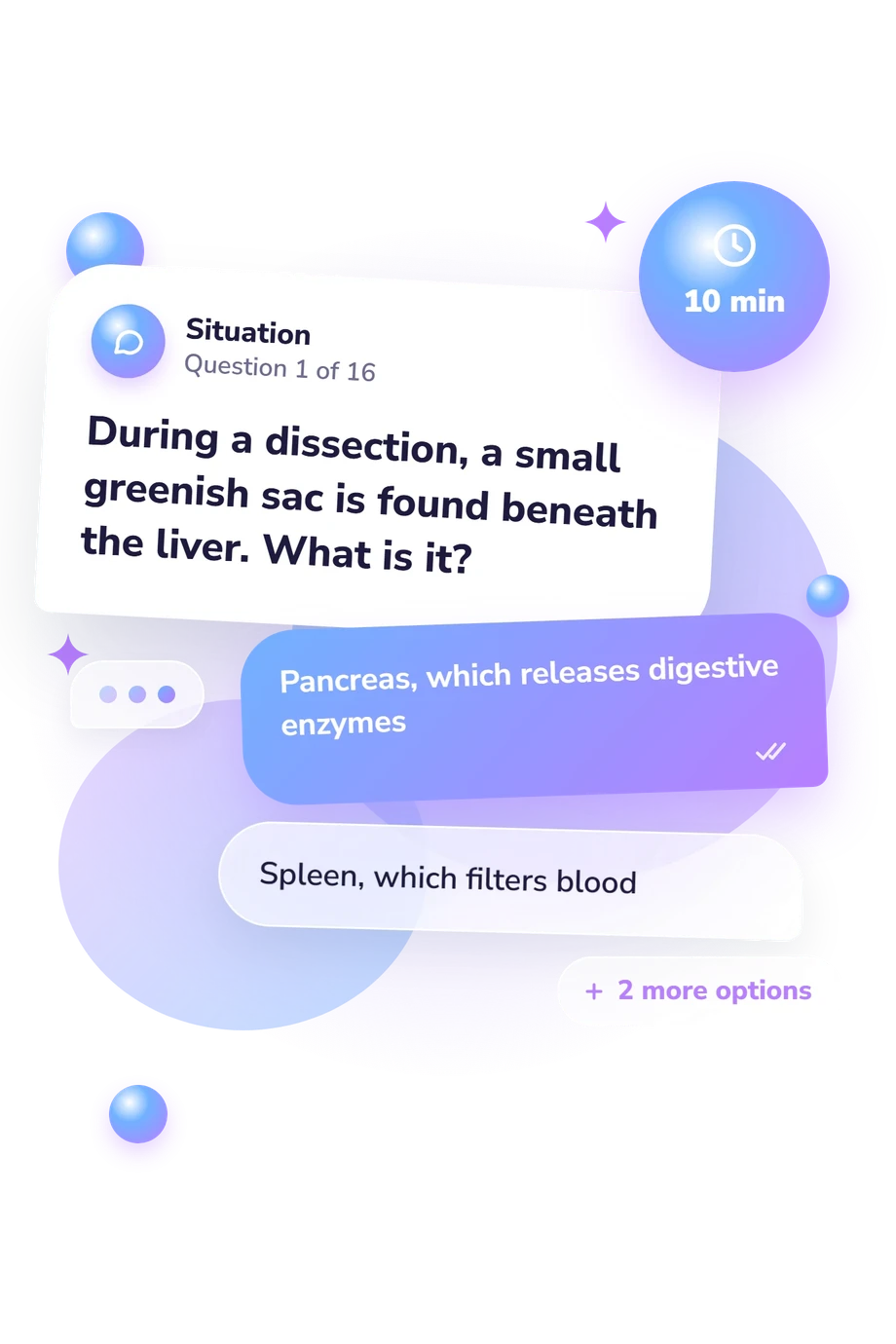
- Pancreas, which releases digestive enzymes
- Spleen, which filters blood
- Gallbladder, which stores bile
- Urinary bladder, which stores urine
- Bile ducts
- Vasa efferentia
- Oviducts
- Ureters
- Liver
- Kidneys
- Fat bodies
- Moist skin
Frog Anatomy Quiz - Description and methodology of the test
Students, laboratory learners, and curious readers can use this assessment to check how well they identify frog structures and connect them with basic functions. The frog anatomy quiz is useful before a practical class, while reviewing diagrams, or after studying a specimen. A frog anatomy test result can help you plan a practical session, organize notes, or focus a study period.
What This Assessment Explores
Questions cover organs, body-cavity location, and links among digestion, respiration, circulation, excretion, and reproduction. Several prompts require interpretation of a dissection observation rather than an isolated label.
For limited dissection preparation, this frog dissection quiz uses text-based scenarios that ask learners to infer structures from described location, shape, or tissue connections. The result summarizes overall knowledge rather than separate system scores.
Frog Anatomy Knowledge ranges from 0-16: Foundations to build (0-6), Developing knowledge (7-12), or Strong knowledge (13-16).
These items cover four connected areas:
- Organ recognition shows whether you match structures with names and positions.
- Functional anatomy shows whether you link organs with biological roles.
- Body-system relationships show whether you understand how major systems interact.
- Dissection interpretation shows whether you use shape, location, and tissue connections.
Methodology and Scientific Basis
Each prompt presents a short anatomical or functional scenario with four answer choices. The learner selects the option that best identifies a structure, location, pathway, or biological role. This format emphasizes recognition and applied recall, including interpretation of visible features in a dissection context.
Recognition and applied recall, rather than extended written explanations, shape the frog anatomy questions. Scoring produces one overall knowledge result, and no item-weighting rule or separate system subscores are displayed, so the result stays a broad summary across the tested topics.
The content is conceptually consistent with Minkoff (1975) and with the comparative dissection approach described by De Iuliis and Pulerà (2019). It is not presented as a standardized adaptation of either source. Kerr (1939) is especially relevant to the cloaca-related material, while the remaining items reflect conventional laboratory anatomy relationships.
Performance can also reflect prior classroom exposure, terminology familiarity, guessing, and attention on the day. No standardized norms are indicated for this online questionnaire, so the result is descriptive study guidance. The overall result can help target further study, but it does not establish practical dissection skill.
- Minkoff, Eli C. A Laboratory Guide to Frog Anatomy. New York: Pergamon Press, 1975. 10.1016/C2013-0-05684-8.
- De Iuliis, Gerardo, and Dino Pulerà. The Dissection of Vertebrates: A Laboratory Manual. 3rd ed. Academic Press, 2019.
- Kerr, T. “The Structure and Function of the Cloaca of the Common Frog: 4. On the Structure and Function of the Cloaca of the Common Frog (Rana t. temporaries).” Proceedings of the Zoological Society of London B 109, no. 1 (1939): 63-73. 10.1111/j.1469-7998.1939.tb00024.x.
Updated: