
What Kind of Drunk Are You Quiz
How the Scales are Structured
Who Usually Takes This Test?
See How You Compare
Below is a preview of how scores are typically distributed across each scale.
Example Questions From the Test
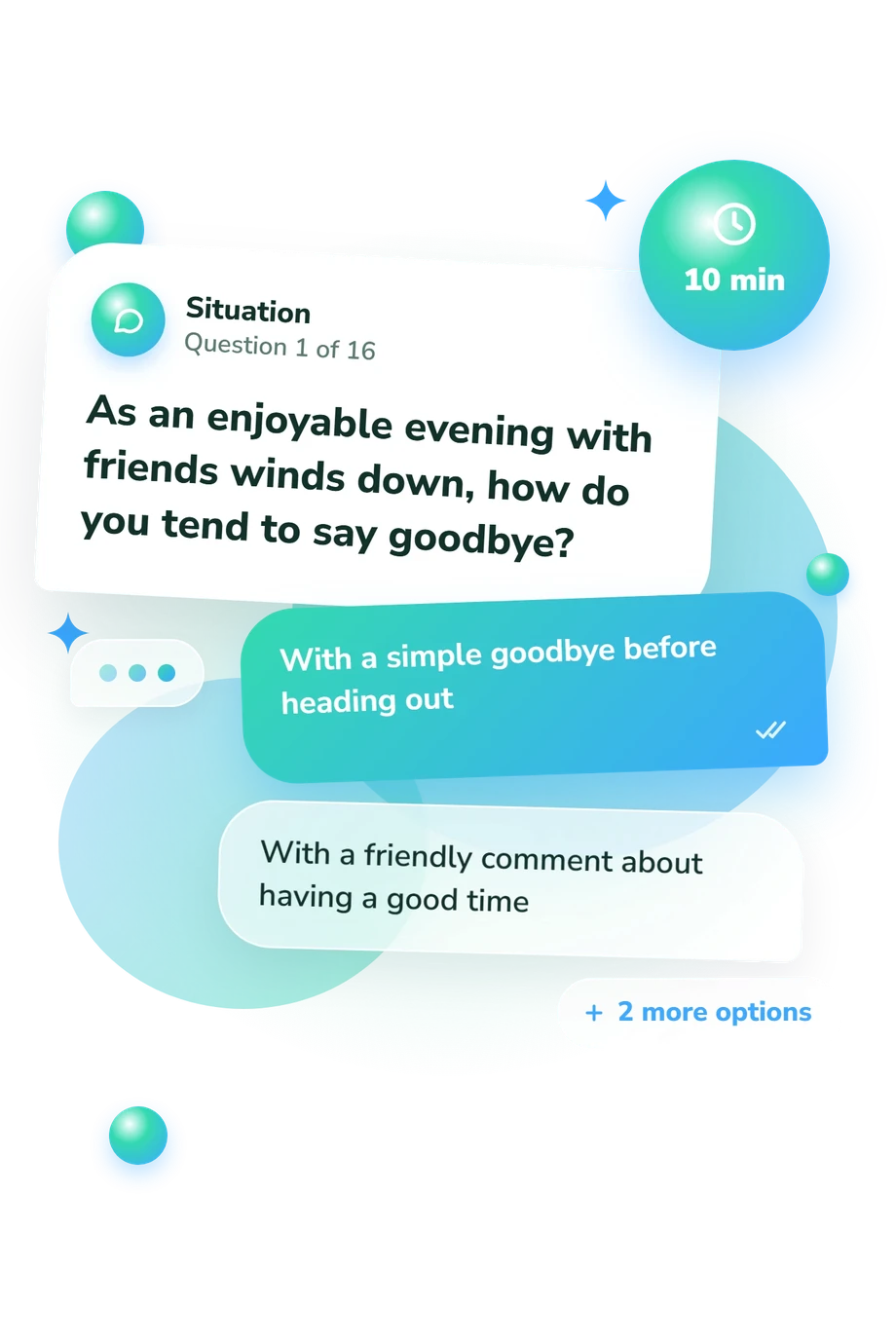
- With a simple goodbye before heading out
- With a friendly comment about having a good time
- With warm individual goodbyes and plans to reconnect
- With affectionate, sentimental goodbyes that can take a while
- Very little; I focus on the immediate issue
- I acknowledge that the situation bothers me
- I explain the feelings beneath my reaction
- I bring up deeper emotions or unresolved concerns connected to it
- I remain fairly self-contained
- I become more talkative with my usual circle
- I chat comfortably with both friends and new people
- I become the person connecting everyone in the room
What Kind of Drunk Are You Quiz - Description and methodology of the test
People who want to understand how alcohol may alter their usual way of relating to others can use the What Kind of Drunk Are You Quiz as a guided self-reflection exercise. Alcohol may reveal openness, social energy, novelty-seeking, or affection, making this a what type of drunk are you quiz. The result helps answer what type of drunk you are without reducing you to one permanent label.
What This Assessment Explores
Four behavioral tendencies are examined: emotional disclosure, social engagement, playful novelty, and visible affection. Scenarios involve goodbyes, disagreements, new groups, changing plans, performance, memories, and messages. As a drunk personality quiz, it turns familiar situations into a readable profile.
The four dimensions are:
- Emotional Revealer (0-12) measures visible inner feeling: Private Processor (0-4), Candid Sharer (5-8), Emotional Revealer (9-12).
- Social Spark (0-12) measures amplified sociability: Selective Socializer (0-4), Engaged Mixer (5-8), Social Spark (9-12).
- Spontaneous Adventurer (0-12) measures playful novelty: Steady Planner (0-4), Flexible Explorer (5-8), Spontaneous Adventurer (9-12).
- Warm Connector (0-12) measures expressed affection: Quietly Caring (0-4), Openly Warm (5-8), Warm Connector (9-12).
The highest score shows strongest affinity, while scores within one point of it create a blended result. These profiles are reflective descriptions, not measures of impairment or alcohol-use severity.
Methodology and Evidence Base
Each item presents a drinking-related situation with four response choices, moving from contained to more expressive, social, adventurous, or affectionate reactions. Choose the option matching your experience. The questionnaire reports four 0-12 scores, compares their relative strength, and treats close scores as a blended profile.
The pattern is conceptually consistent with Winograd et al. (2016), which describes drunk personality across broad domains. Winograd et al. (2014) adds self- and informant-based perspectives, while Leeman, Toll, and Volpicelli’s DIDS offers a related framework for drinking-induced disinhibition. The four labels and 0-12 bands are specific to this questionnaire; the cited studies provide conceptual context, not validation of these labels or score ranges.
The result answers the question that this what kind of drunk am I quiz poses with a descriptive profile, not a fixed identity. Its bands are descriptive rather than clinical cutoffs.
Responses can shift with memory, honesty, mood, setting, and self-awareness. Alcohol effects vary by amount and context, so blackouts, injury, coercion, conflict, or loss of control matter independently of the profile and need separate attention.
- Winograd, Rachel Pearl, Douglas Steinley, and Kenneth Sher. “Searching for Mr. Hyde: A Five-Factor Approach to Characterizing ‘Types of Drunks’.” Addiction Research & Theory 24, no. 1 (2016): 1-8. 10.3109/16066359.2015.1029920
- Winograd, Rachel P., Douglas L. Steinley, and Kenneth J. Sher. “Drunk Personality: Reports from Drinkers and Knowledgeable Informants.” Experimental and Clinical Psychopharmacology 22, no. 3 (2014): 187-197. 10.1037/a0036607
- Leeman, Robert F., Benjamin A. Toll, and Joseph R. Volpicelli. “The Drinking-Induced Disinhibition Scale (DIDS): A Measure of Three Types of Disinhibiting Effects.” Addictive Behaviors 32, no. 6 (2007): 1200-1219. 10.1016/j.addbeh.2006.08.008
Updated: