
Kindness Quiz
How the Scales are Structured
Who Usually Takes This Test?
See How You Compare
Below is a preview of how scores are typically distributed across each scale.
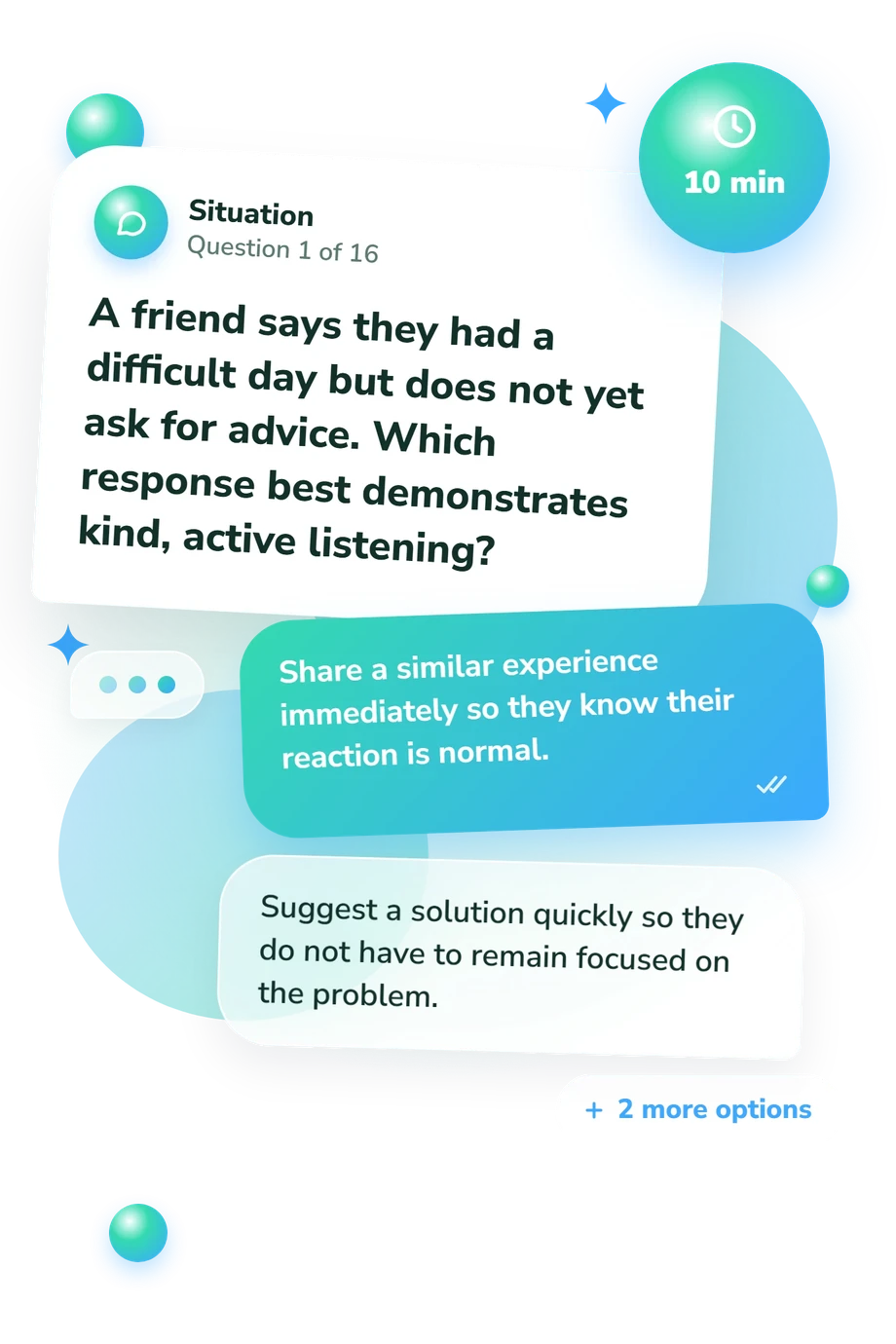
Example Questions From the Test
- Share a similar experience immediately so they know their reaction is normal.
- Suggest a solution quickly so they do not have to remain focused on the problem.
- Reflect what you heard and ask whether they want listening, advice, or practical help.
- Reassure them that the situation will probably feel unimportant after some rest.
- Check on the person and direct a specific bystander to contact emergency services if needed.
- Call out generally that somebody nearby should contact emergency services.
- Wait briefly to see whether someone with more experience takes charge.
- Ask the surrounding group to decide together who is best placed to help.
- Delay replying until you can determine whether every scheduling conflict can be moved.
- Agree first, then try to reduce your other commitments enough to fit it in.
- Decline clearly, acknowledge their need, and offer a realistic alternative only if you can follow through.
- Describe all your current pressures in detail so the neighbor fully understands the refusal.
Kindness Quiz - Description and methodology of the test
People who want a clearer picture of how they recognize kindness in hypothetical situations can use this kindness quiz to examine everyday judgments about care, respect, and responsibility. This assessment uses a how kind are you quiz format with a practical focus on recognizing considerate responses in realistic interpersonal situations, so the result reflects understanding of kindness principles rather than conduct outside the questionnaire.
What This Assessment Measures
The questionnaire assesses understanding of sustainable kindness rather than simple agreeableness. Its scenarios test recognition of actions that balance care and impact while respecting autonomy, accountability, and boundaries, including listening, apologies, feedback, and support. The emphasis is whether each response considers intention and impact.
This assessment uses a how kind am i quiz format to add useful context: its result reflects understanding of principles, not a fixed moral identity. It can highlight whether considerate behavior is recognized when situations involve boundaries, accessibility, cultural difference, accountability, or disagreement.
The sole displayed scale, Kindness Knowledge (0-16), is interpreted through these result bands:
- Emerging Foundations (0-6) indicates that core distinctions may still need attention.
- Developing Understanding (7-12) shows that many principles are recognized, while nuanced situations may remain less clear.
- Strong Understanding (13-16) reflects consistent recognition of care, respect, accountability, and context.
Methodology and Evidence Base
Each item presents a short social situation with four response options. The choices distinguish helpful conduct from rushing to solve, assuming preferences, overextending, minimizing impact, or avoiding accountability. The result is presented as an educational score summarizing recognition of considerate, respectful, and sustainable kindness.
Its structure is conceptually consistent with Youngs et al. (2023), which treats kindness as an interpersonal trait expressed through constructive concern and behavior toward others. Canter et al. (2017) offers a closely related account, while Pommier et al. (2020) and Caprara et al. (2005) support the compassion and prosocial dimensions. These sources clarify related concepts, while the online questionnaire presents its own educational questions rather than reproducing those instruments.
This online educational knowledge questionnaire uses an are you kind quiz format to test recognition of kindness principles rather than personal conduct. Current mood, self-knowledge, social expectations, and desire to impress can shape answers, so the result is most useful alongside reflection on concrete behavior over time. It can identify principles worth practicing, but one score cannot capture every context where kindness appears.
- Youngs, Donna E., Miroslava A. Yaneva, and David V. Canter. “Development of a measure of kindness.” Current Psychology 42, no. 7 (2023): 5428-5440. 10.1007/s12144-021-01882-6
- Canter, David V., Donna E. Youngs, and Miroslava A. Yaneva. “Towards a measure of kindness: An exploration of a neglected interpersonal trait.” Personality and Individual Differences 106 (2017): 15-20. 10.1016/j.paid.2016.10.019
- Pommier, Elizabeth, Kristin D. Neff, and István Tóth-Király. “The Development and Validation of the Compassion Scale.” Assessment 27, no. 1 (2020): 21-39. 10.1177/1073191119874108
- Caprara, Gian Vittorio, Patrizia Steca, Arnaldo Zelli, and Cristina Capanna. “A New Scale for Measuring Adults’ Prosocialness.” European Journal of Psychological Assessment 21, no. 2 (2005): 77-89. 10.1027/1015-5759.21.2.77
Updated: