
Sheet Music Quiz
How the Scales are Structured
Who Usually Takes This Test?
See How You Compare
Below is a preview of how scores are typically distributed across each scale.
Example Questions From the Test
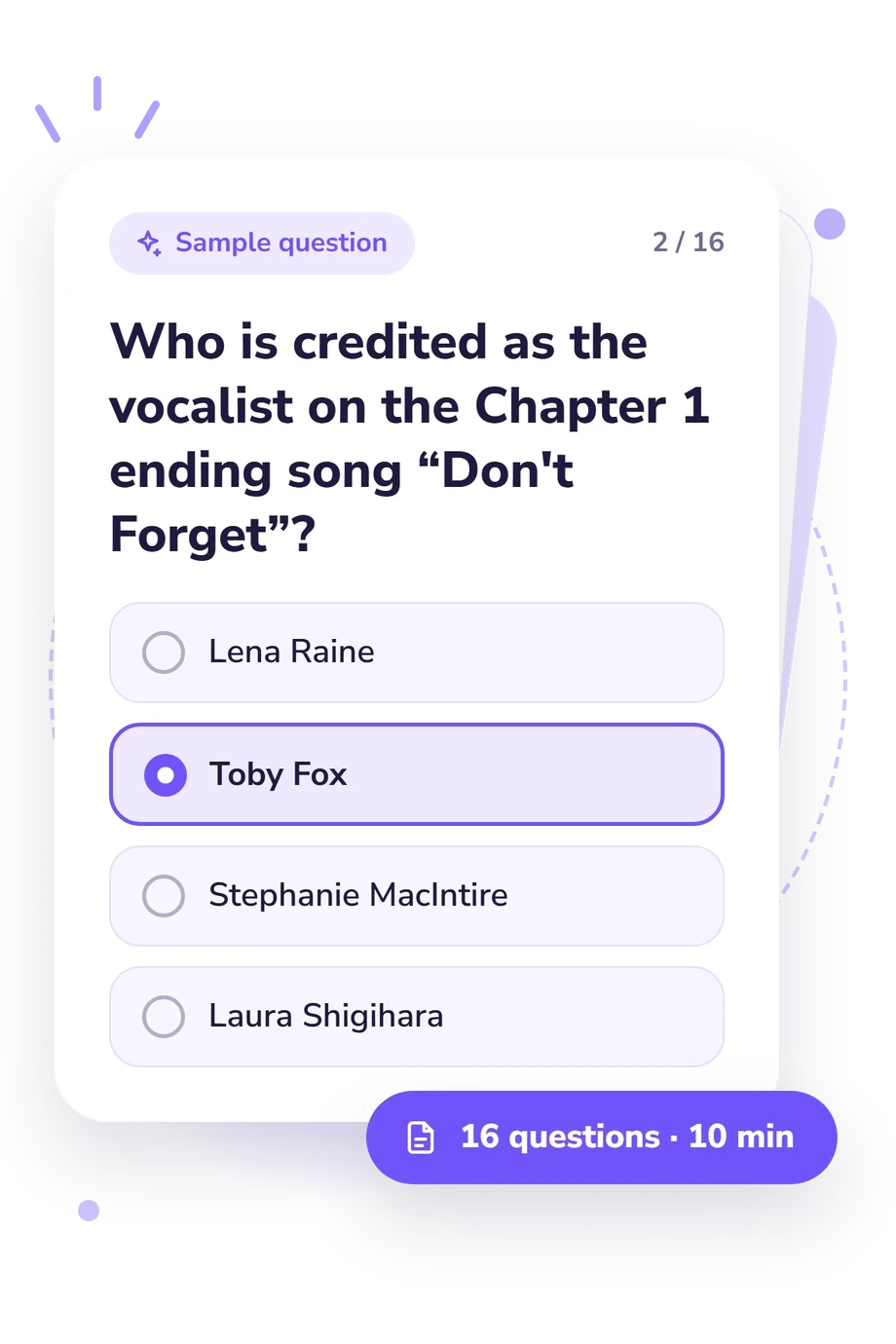
- Lena Raine
- Toby Fox
- Stephanie MacIntire
- Laura Shigihara
- Spamton
- Deal Gone Wrong
- BIG SHOT
- NOW'S YOUR CHANCE TO BE A
- Chaos King
- The Chase
- THE WORLD REVOLVING
- Dialtone
Sheet Music Quiz - Description and methodology of the test
Designed for players, fans, and curious learners, this assessment links elementary notation with recognizable Deltarune musical moments. The sheet music quiz is useful when you want to check whether symbols and soundtrack knowledge work together rather than in isolation. Used as a note reading quiz, this assessment can help identify which parts of your musical understanding feel secure and which deserve another look.
What This Assessment Explores
It brings together score-reading fundamentals and recognition of Deltarune music, asking about repeat signs, clefs, keys, dynamics, rhythms, staff structure, composers, vocal credits, and scene-specific tracks.
As a reading music quiz, it focuses on identification and musical vocabulary rather than performance technique. Results appear as Deltarune Sheet Music Knowledge, 0-16, with Foundations to Build (0-6), Developing Knowledge (7-12), or Strong Knowledge (13-16). The bands indicate how securely notation knowledge connects with soundtrack recognition.
The result covers four areas:
- Notation recognition shows how well you identify symbols that direct a performer.
- Rhythm and meter indicate whether note values fit the beats in a measure.
- Keys and dynamics show how you interpret pitch organization and expressive markings.
- Soundtrack knowledge reflects accurate links between tracks, characters, locations, and scenes.
Methodology and Evidence
Each item uses four answer choices. Questions move between rule-based notation and soundtrack recall, requiring the best answer rather than a rating of personal agreement. The displayed score totals correct responses across both content areas; no separate weighting formula or item-level scoring rule is specified.
Notation topics are conceptually consistent with principles described by Benward and Saker (2009), including staff reading, rhythm, key signatures, dynamics, and repeats. Soundtrack references follow DELTARUNE Chapters 1-2 soundtracks (Fox, 2018, 2021). Irene, Sab, and Diana Dansereau (2025) offer educational context for using game music in learning, but their study does not validate this questionnaire. These sources are reference points, not evidence that the online assessment is a published adaptation.
For anyone approaching it as a quiz on piano sheet music, the notation items may feel familiar, yet the result is not a standardized music aptitude score: no norms or reliability estimates are supplied. Memory and attention can affect performance, so the bands are best read as a snapshot of current knowledge rather than a fixed judgment of musical ability.
- Fox, Toby. DELTARUNE Chapter 1 (Original Game Soundtrack). Materia Collective, 2018.
- Fox, Toby. DELTARUNE Chapter 2 OST. Materia Collective, 2021.
- Benward, Bruce, and Marilyn Nadine Saker. Music in Theory and Practice, Volume 1. 8th ed. McGraw-Hill, 2009.
- Irene, Sab, and Diana Dansereau. “Another Perspective: The Musical Content of Video Game Soundtracks and Implications for Their Use in the Classroom.” Music Educators Journal, 111(3), 16-22, 2025. 10.1177/00274321241311243
Updated: