
Should I Go Blonde or Brunette Quiz
How the Scales are Structured
Who Usually Takes This Test?
See How You Compare
Below is a preview of how scores are typically distributed across each scale.
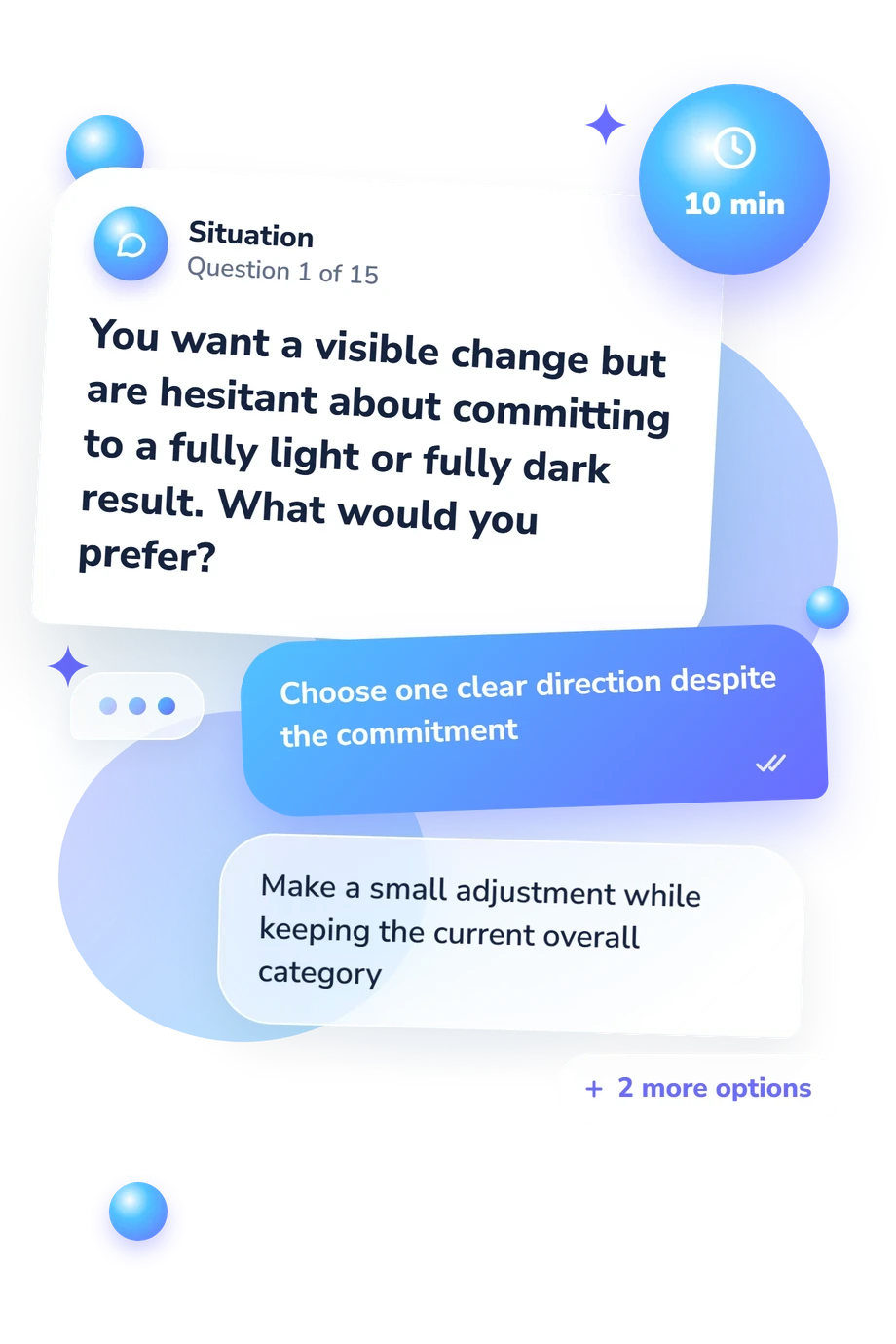
Example Questions From the Test
- Using a solid or nearly solid brunette shade to create definition
- Choosing a dimensional brown that still has substantial depth
- Keeping the hair light with a few darker pieces for contrast
- Relying on an overall blonde effect rather than added depth
- Only enough depth to keep blonde pieces from looking flat
- A balanced medium brown with some lighter movement
- A rich brunette that reads as deep and polished overall
- No brunette goal; I would want the overall result to look light
- A rich brunette with reflective shine
- A mostly deep shade with a few soft highlights
- A dimensional blonde with visible lowlights
- A bright blonde whose overall impression is unmistakably light
Should I Go Blonde or Brunette Quiz - Description and methodology of the test
People weighing a visible color change can use the Should I Go Blonde or Brunette Quiz to clarify whether lightness, depth, or a deliberate blend fits their preferences. This hair color decision quiz is useful for anyone comparing inspiration photos, considering salon options, or thinking through upkeep, reversibility, contrast, and personal style. The result identifies a leading affinity rather than prescribing a shade.
What This Assessment Explores
Hair-color preference falls into three directions: lightness, bronde dimension, or brunette depth. Items also consider contrast, tonal variation, grow-out, upkeep, reversibility, and personal style.
The result dimensions are:
- Blonde Affinity (0-15) measures attraction to lightness: Subtle Pull (0-5), Blonde Curious (6-10), or Strong Blonde Affinity (11-15).
- Bronde Affinity (0-15) measures attraction to a balanced mix of brunette depth and blonde lightness: Clearer Direction Preferred (0-5), Dimension Curious (6-10), or Strong Bronde Affinity (11-15).
- Brunette Affinity (0-15) measures attraction to richer depth: Subtle Pull (0-5), Brunette Curious (6-10), or Strong Brunette Affinity (11-15).
The highest score is the strongest affinity; scores within one point indicate a blended result. This blonde or brunette quiz maps preference, while starting color, hair condition, upkeep capacity, and professional guidance shape feasibility.
Methodology and Evidence Base
Each self-report item offers four choices representing a clear direction, restrained accents, dimensional contrast, or a balanced mix. Choosing the closest response compares preferences across the three directions without requiring salon terminology.
Scoring is comparative rather than norm-referenced. The highest displayed score leads the interpretation, while near-ties indicate a blended preference. Since no point-by-point key is published, the ranges should be read as displayed rather than reverse-engineered.
Its evidence base is conceptual. Saegusa and Watanabe (2014) examined differences between self-evaluation and judgments by others in hair-color suitability and attractiveness. Janif, Brooks, and Dixson (2015) address preferences for women’s hair color, while Fink et al. (2016) link hair-color perception with rendered appearance. These studies support the relevance of visual preference themes, but this questionnaire is not a standardized adaptation or validated diagnostic instrument.
As a can-I-go-blonde quiz, it can organize motivation before a consultation. Mood, self-image, cultural ideals, and response bias may influence answers, so consider the result alongside hair condition and the practical demands of the intended color.
- Saegusa, C., & Watanabe, K. (2014). Hair Color Suitability and Perceived Attractiveness: Self-evaluation versus Evaluation by Others. Transactions of Japan Society of Kansei Engineering, 13(1), 253-258. 10.5057/jjske.13.253
- Janif, Z. J., Brooks, R. C., & Dixson, B. J. (2015). Are Preferences for Women’s Hair Color Frequency-Dependent? Adaptive Human Behavior and Physiology, 1(1), 54-71. 10.1007/s40750-014-0008-y
- Fink, B., Hufschmidt, C., Hirn, T., Will, S., McKelvey, G., & Lankhof, J. (2016). Age, Health and Attractiveness Perception of Virtual (Rendered) Human Hair. Frontiers in Psychology, 7, 1893. 10.3389/fpsyg.2016.01893
Updated: