
Who Loves Me Quiz
How the Scales are Structured
Who Usually Takes This Test?
See How You Compare
Below is a preview of how scores are typically distributed across each scale.
Example Questions From the Test
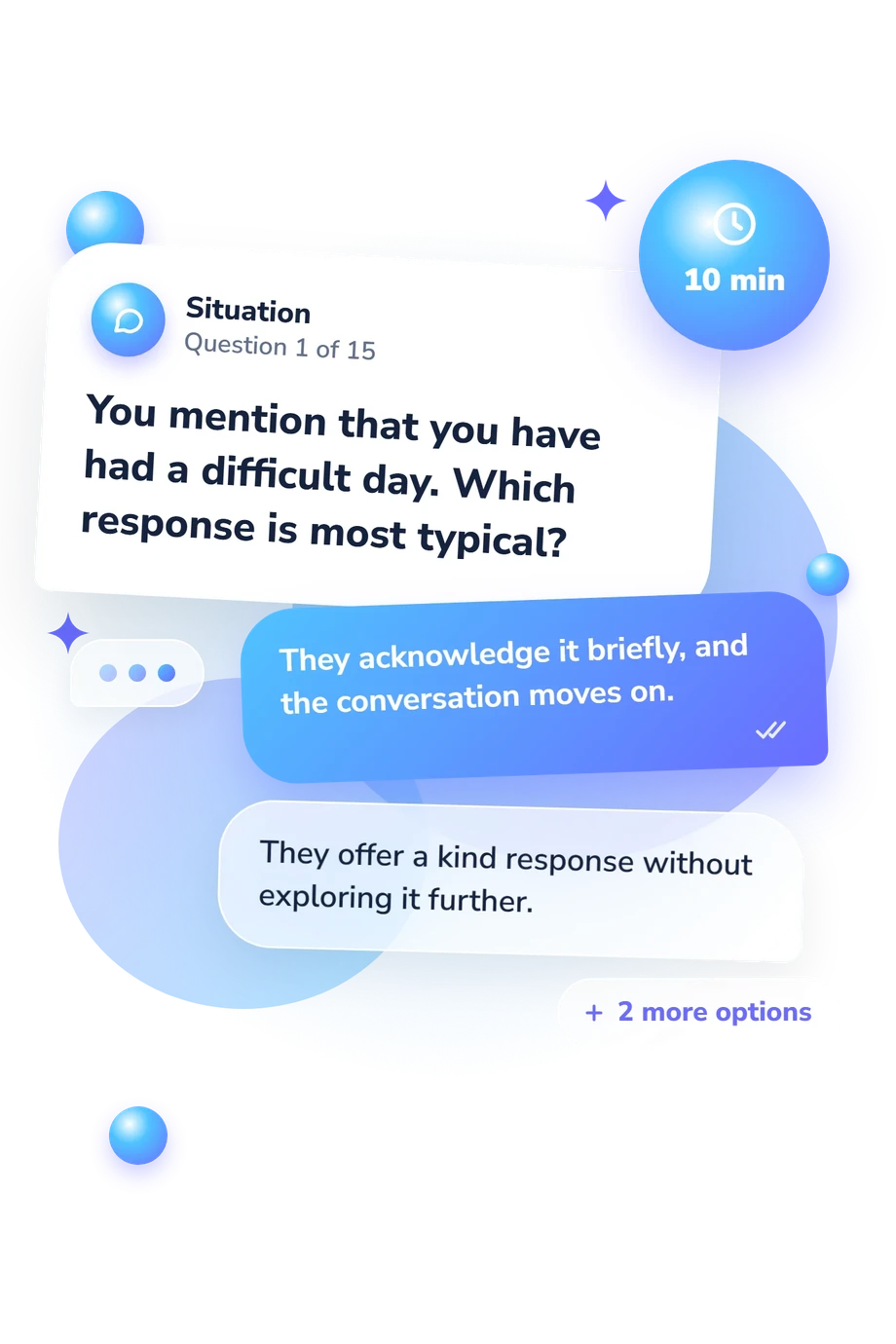
- They acknowledge it briefly, and the conversation moves on.
- They offer a kind response without exploring it further.
- They make time to listen if I want to talk.
- They listen, respond to what I need, and check in again later.
- This has not happened, or they clearly correct the assumption and emphasize friendship.
- They laugh it off and move the conversation along.
- They seem curious or pleased and later revisit the comment with me.
- They use the moment to say that they like the idea or to express attraction.
- They respond neutrally or supportively without showing personal romantic interest.
- They ask about it with the same curiosity they show toward other friends.
- They seem personally invested and ask whether I am emotionally available, without becoming controlling.
- They directly explain that the topic matters because they are romantically interested in me.
Who Loves Me Quiz - Description and methodology of the test
People who want to understand a close connection can use the Who Loves Me Quiz to organize observations about attention, openness, initiative, and possible romantic signaling. It is intended for someone seeking structured reflection rather than a verdict about another person’s feelings. The result from this quiz about who is in love with me organizes ordinary friendship cues that may be difficult to interpret.
What This Assessment Explores
Items cover listening, follow-up, remembered details, contact initiation, future plans, openness, and reactions to dating or attraction. They distinguish ordinary warmth from clearer romantic cues, because close friendship can include substantial care. This assessment’s profile, from a quiz about who is secretly in love with you, shows patterns rather than proof of another person’s feelings.
The three result dimensions are:
- Attention and Initiative (0-15) shows whether the person creates and sustains opportunities to connect: Limited initiative (0-5), Shared or uneven initiative (6-10), or Consistent initiative (11-15).
- Beyond-Friendship Signals (0-15) reflects whether behavior is Friendship-coded or unclear (0-5), Possible romantic undertone (6-10), or Direct romantic signaling (11-15).
- Emotional Investment (0-15) indicates apparent personal involvement: Light involvement (0-5), Growing involvement (6-10), or Strong investment (11-15).
The profile from this quiz about who secretly loves me is most useful for comparing repeated behaviors across situations.
Methodology and Evidence Base
Each item describes a concrete situation and offers four ordered responses, moving from little observed signal toward clearer or more direct behavior. The respondent answers from personal observation, so scores summarize perceived patterns rather than private thoughts.
Scores for the three dimensions summarize responses; repeated patterns matter more than isolated observations. The questionnaire publishes no weighting or population norms, so its bands are descriptive, not universal cutoffs. The assessment’s value lies in comparing repeated interactions, making this quiz about who loves you pattern-based rather than event-based.
Conceptually, this questionnaire aligns with the Perceptions of Attraction scale’s construct (Riggio et al., 2015), but is not its adaptation and does not inherit its validation. Olderbak et al. (2017) and Baxter et al. (2022) show why perceived traits, compatibility, and interaction may relate to romantic interest without making attraction predictable from a checklist.
Current mood, selective attention, wishful thinking, cultural norms, and communication style can shape self-report. Clear words, mutual consent, and respectful conversation are stronger evidence than inferred body language, while patterns across contexts give more context than one score.
- Riggio, Heidi R., P. Priscilla Lui, Amber L. Garcia, Brigitte K. Matthies, Gar Culbert, and Jessica Bailey. Initial validation of a self-report measure of perceptions of interpersonal attraction. Personality and Individual Differences 74 (2015): 292-296. 10.1016/j.paid.2014.10.030
- Olderbak, Sally G., Frederic Malter, Pedro Sofio Abril Wolf, Daniel N. Jones, and Aurelio José Figueredo. Predicting Romantic Interest at Zero Acquaintance: Evidence of Sex Differences in Trait Perception but Not in Predictors of Interest. European Journal of Personality 31, no. 1 (2017): 42-62. 10.1002/per.2087
- Baxter, Alexander, Jessica A. Maxwell, Karen L. Bales, Eli J. Finkel, Emily A. Impett, and Paul W. Eastwick. Initial impressions of compatibility and mate value predict later dating and romantic interest. Proceedings of the National Academy of Sciences 119, no. 45 (2022): e2206925119. 10.1073/pnas.2206925119
Updated: