
AP Gov Quiz
How the Scales are Structured
Who Usually Takes This Test?
See How You Compare
Below is a preview of how scores are typically distributed across each scale.
Example Questions From the Test
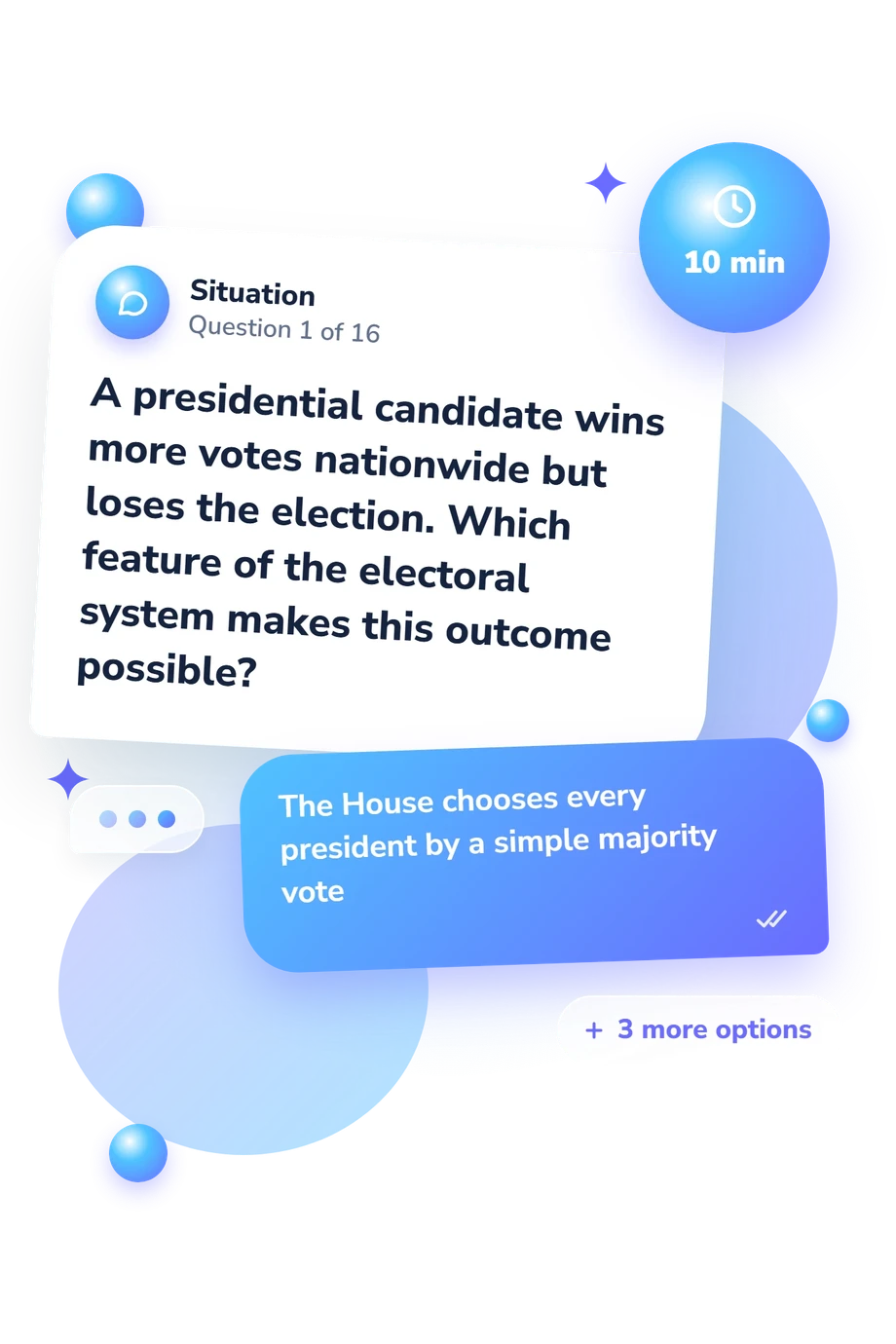
- The House chooses every president by a simple majority vote
- The Senate assigns electoral votes after the popular vote
- Electoral votes are awarded through state-based contests rather than one national popular-vote total
- The Supreme Court normally reallocates votes among close states
- The House of Representatives
- The Senate
- The Department of the Treasury
- A conference committee
- Cloture
- Discharge petition
- Line-item veto
- Unanimous judicial review
AP Gov Quiz - Description and methodology of the test
Taking this test gives you a focused way to check recall and application before further study. The AP Gov Quiz suits learners who want to locate gaps in U.S. government and politics, rather than readers seeking a personality profile. This AP government quiz connects classroom concepts with decisions involving institutions, constitutional rights, elections, policy, and public participation.
What This Assessment Explores
This assessment asks whether a learner can recognize core government concepts and apply them to brief political scenarios. Its content spans constitutional design, civil liberties, federalism, institutions, bureaucracy, public opinion, elections, interest groups, and economic policy. For studying AP government, the result directs targeted review.
The question themes can be grouped into these dimensions:
- Constitutional principles, rights, and institutions show whether the respondent can distinguish protections, clauses, powers, and limits on government.
- Federalism, bureaucracy, and public policy indicate whether the respondent understands how authority is distributed and implemented.
- Elections, polling, interest groups, and participation reveal how well the respondent connects political behavior with collective action.
AP Gov Knowledge runs from 0-16: one point is awarded for each correct answer, with Foundation Building (0-6), Developing Command (7-12), and Strong Command (13-16). These bands summarize sampled knowledge, not an official AP score or prediction.
Methodology and Evidence Base
Each item presents a short scenario followed by four answer choices, requiring the respondent to select the best concept, rule, institution, or procedure. The scoring is direct: a correct response adds one point, while the total reflects performance across the sampled content.
The content is conceptually consistent with the College Board’s AP Government and Politics Framework, which organizes the subject around constitutional foundations, political institutions, civil liberties, participation, and public policy. The textbook by Wilson, DiIulio, Bose, and Levendusky provides context for the institutional and policy concepts appearing in the questions. The questionnaire is not presented as an adaptation of either source.
After seeing the band, review missed concepts, compare performance with classwork, and revisit unfamiliar applications. Champney and Edleman discuss course learning-outcome assessment as relevant context for compact checks of knowledge. For this AP Gov practice quiz, use the result to plan the next study session around uncertain concepts; because it reflects a limited sample, confirm progress through broader classwork and practice.
- College Board. (2026). AP U.S. Government and Politics Course and Exam Description. College Board.
- Wilson, James Q., John J. DiIulio Jr., Meena Bose, and Matthew S. Levendusky. (2022). American Government: Institutions & Policies (17th ed.). Cengage.
- Champney, Leonard, and Paul Edleman. (2010). Assessing Student Learning Outcomes in United States Government Courses. PS: Political Science & Politics, 43(1), 127-131. 10.1017/S1049096510990689
Updated: