
Dr. Axe Leaky Gut Quiz
How the Scales are Structured
Who Usually Takes This Test?
See How You Compare
Below is a preview of how scores are typically distributed across each scale.
Example Questions From the Test
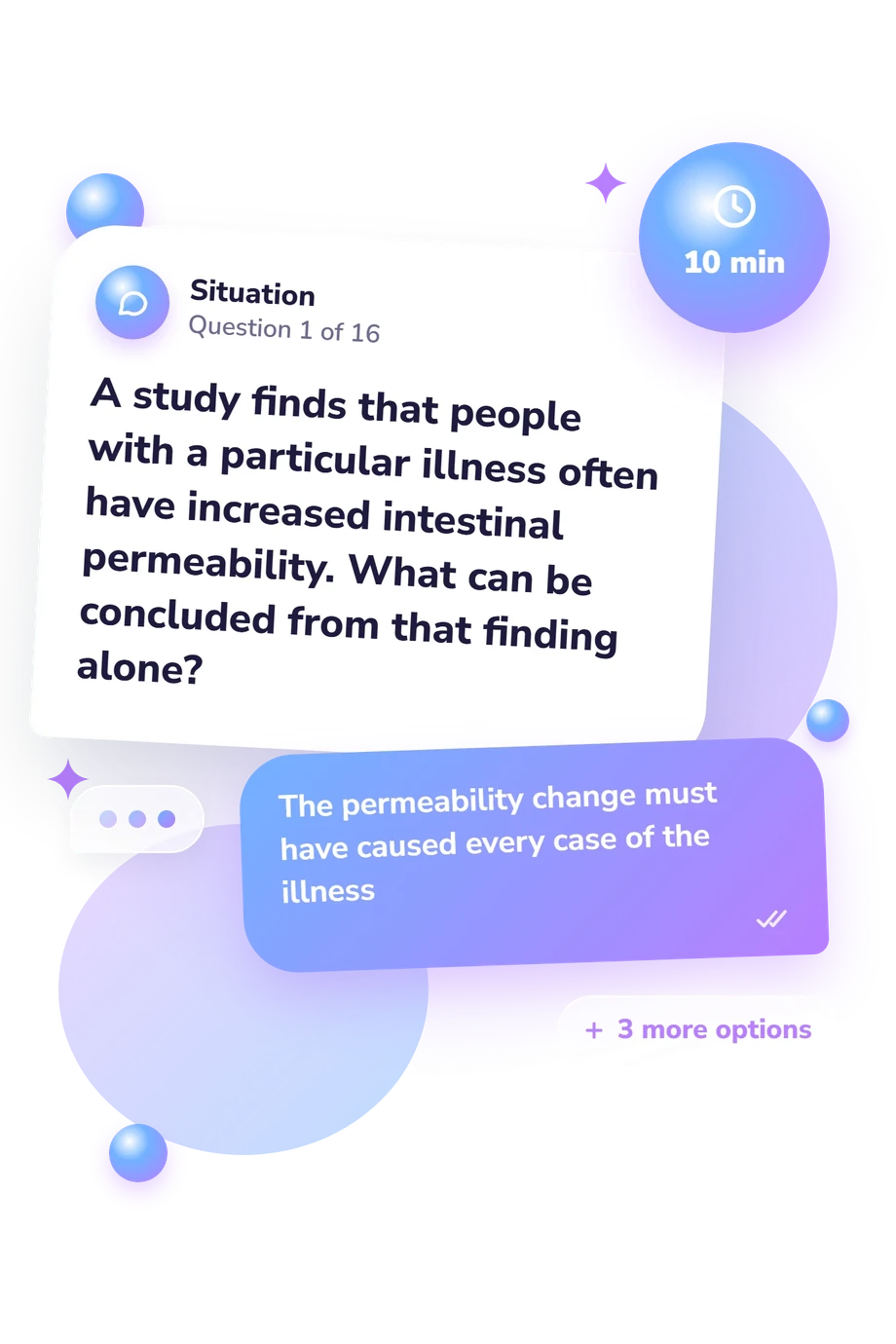
- The permeability change must have caused every case of the illness
- The two are associated, but the study alone may not show which came first or whether one caused the other
- Treating permeability will necessarily cure the illness
- Anyone with similar digestive symptoms has the same illness
- They are interchangeable names for the same biological process
- Food intolerance always results from an immune attack on intestinal cells
- Increased permeability describes difficulty digesting one specific food
- Permeability concerns barrier passage, while food intolerance usually refers to difficulty handling a food or component; one does not automatically prove the other
- Tight junctions
- Stomach sphincters
- Villi alone
- The gallbladder ducts
Dr. Axe Leaky Gut Quiz - Description and methodology of the test
Readers who want to assess their grasp of gut-health claims can use the Dr Axe Leaky Gut Quiz to evaluate claims about symptoms, tests, treatments, supplements, and care choices. It is intended for people thinking about digestive symptoms, supplements, restrictive diets, commercial tests, or care choices. This Dr Axe quiz focuses on informed judgment about evidence and care decisions.
What This Assessment Explores
Questions address intestinal permeability, the barrier’s role in regulating passage between the gut and surrounding tissues, and why symptoms alone cannot prove a mechanism. Scenarios test whether readers separate association from causation and recognize overreach in claims about diets, supplements, commercial panels, or online testing.
Viewed as a leaky gut knowledge quiz, this assessment focuses on evidence-aware judgment: distinguishing food intolerance from permeability, noticing warning signs, and weighing claims about celiac testing, medication effects, probiotics, and restrictive diets. The result reflects conceptual understanding rather than a symptom profile.
The Leaky Gut Knowledge scale runs from 0-16, with these result bands:
- Foundational (0-6) shows basic recognition with room to review permeability, symptoms, and evidence.
- Developing (7-12) shows core understanding with room to sharpen judgment about tests, treatments, and causation.
- Strong (13-16) shows well-grounded understanding of barrier science and care decisions.
Methodology and Scientific Basis
Each item presents a short health scenario or knowledge question with several answer choices. The options ask for evidence-based interpretation, so the format samples conceptual understanding rather than symptom frequency or personal history. Topics include barrier biology, food intolerance, celiac testing, dehydration, NSAID effects, restrictive diets, probiotics, and zonulin.
As an online leaky gut test, this questionnaire uses an educational multiple-choice approach and presents an educational score interpreted through the displayed banding. Because this score is unvalidated and has no clinical cutoff, its bands describe performance on this questionnaire rather than a diagnosis or explanation of persistent symptoms; warning signs such as bleeding, black stools, severe pain, fainting, persistent vomiting, or dehydration require prompt medical attention.
Lacy et al. (2024) provide the closest conceptual match by separating research on intestinal permeability from the less settled label “leaky gut syndrome.” Camilleri (2019) supports distinctions among mechanisms, measurement, and clinical implications, while Ajamian et al. (2019) explains why serum zonulin requires careful interpretation. The questionnaire is conceptually consistent with these works, not an adaptation or validated administration of them.
- Lacy BE, Wise JL, Cangemi DJ. Leaky Gut Syndrome: Myths and Management. Gastroenterology & Hepatology. 2024;20(5):264-272.
- Camilleri M. Leaky gut: mechanisms, measurement and clinical implications in humans. Gut. 2019;68(8):1516-1526. 10.1136/gutjnl-2019-318427
- Ajamian M, Steer D, Rosella G, Gibson PR. Serum zonulin as a marker of intestinal mucosal barrier function: May not be what it seems. PLOS ONE. 2019;14(1):e0210728. 10.1371/journal.pone.0210728
Updated: