
7th Grade Quiz
How the Scales are Structured
Who Usually Takes This Test?
See How You Compare
Below is a preview of how scores are typically distributed across each scale.
Example Questions From the Test
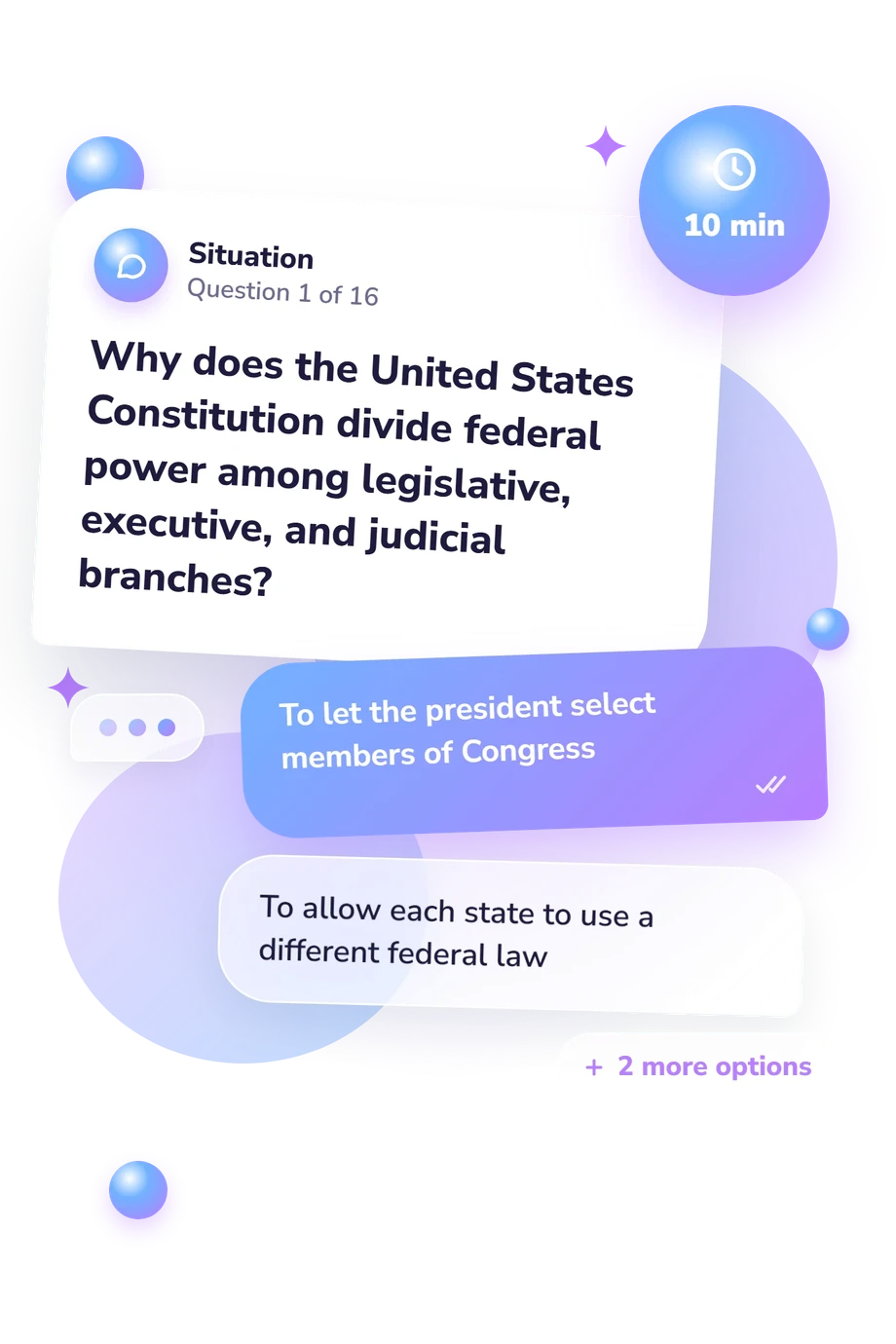
- To let the president select members of Congress
- To allow each state to use a different federal law
- To give courts the power to write all laws
- To prevent one branch from gaining too much power
- 1 3/4 cups
- 1 1/4 cups
- 1 1/2 cups
- 2 1/4 cups
- The leaves danced in the breeze.
- The bell rang loudly at noon.
- The engine roared like a lion.
- Her voice was velvet in the quiet room.
7th Grade Quiz - Description and methodology of the test
For students, parents, and educators, this quiz for 7th graders shows how well a learner performs on sampled seventh-grade concepts across several core school subjects. The 7th grade quiz offers a quick snapshot before revision, class preparation, or targeted practice. It is designed for broad educational feedback, helping the respondent notice strengths and topics that deserve closer attention.
What This Assessment Explores
This assessment examines whether the learner can recall core ideas, interpret information, and apply rules, relationships, definitions, or evidence. Across its subjects, this seventh grade quiz samples breadth rather than one discipline in depth.
One broad scale, 7th Grade Knowledge, runs from 0-16. Foundation Building (0-6) signals ideas needing review; Developing Knowledge (7-12) shows understanding with some concepts to strengthen; Strong Knowledge (13-16) reflects strong command of the sampled concepts.
The question groups represent these areas:
- Mathematics shows performance with operations, equations, probability, measurement, and geometry.
- Science reflects understanding of matter, cells, forces, and living systems.
- History and civics indicate recognition of constitutional structure and branch checks.
- Geography captures use of maps, coordinates, scale, and spatial relationships.
- Language and reading show skill with metaphor, vocabulary, sentence structure, and evidence.
The single score shows broad performance but cannot show mastery of every topic.
Methodology and Evidence Base
Each item offers four answer choices; the learner selects the best response rather than writing an explanation. The grade 7 quiz questions in this assessment combine recall with short applications, including a fraction problem, map reading, sentence structure, and evidence evaluation. This breadth cannot cover every grade-level skill.
The overall score for this quiz for grade 7 is reported through the single broad result above. The bands are interpretive descriptions, not national norms, a classroom grade, or a placement decision.
NAEP sample-question materials in mathematics, reading, and science, along with National Assessment Governing Board frameworks for civics and geography, offer general context for educational assessment and applied reasoning. They do not establish curriculum alignment, validation, or grade-level equivalence for this questionnaire, which is not an adaptation of NAEP or those frameworks. National Research Council guidance likewise supports viewing a result as evidence from selected tasks rather than a complete measure of learning.
Because the score is not standardized, performance may vary with attention, prior instruction, guessing, and wording familiarity. Use it as focused feedback alongside review of represented topics.
- National Center for Education Statistics. (2019). National Assessment of Educational Progress: 2019 Mathematics, Reading, and Science Sample Questions for Grade 8. Washington, DC: U.S. Department of Education.
- National Assessment Governing Board. (2018). Civics Framework for the 2018 National Assessment of Educational Progress. Washington, DC: National Assessment Governing Board.
- National Assessment Governing Board. (2014). Geography Framework for the 2014 National Assessment of Educational Progress. Washington, DC: National Assessment Governing Board.
- National Research Council. (2001). Knowing What Students Know: The Science and Design of Educational Assessment. James W. Pellegrino, Naomi Chudowsky, and Robert Glaser, Editors. Washington, DC: The National Academies Press. DOI 10.17226/10019.
Updated: