
70s Music Quiz
How the Scales are Structured
Who Usually Takes This Test?
See How You Compare
Below is a preview of how scores are typically distributed across each scale.
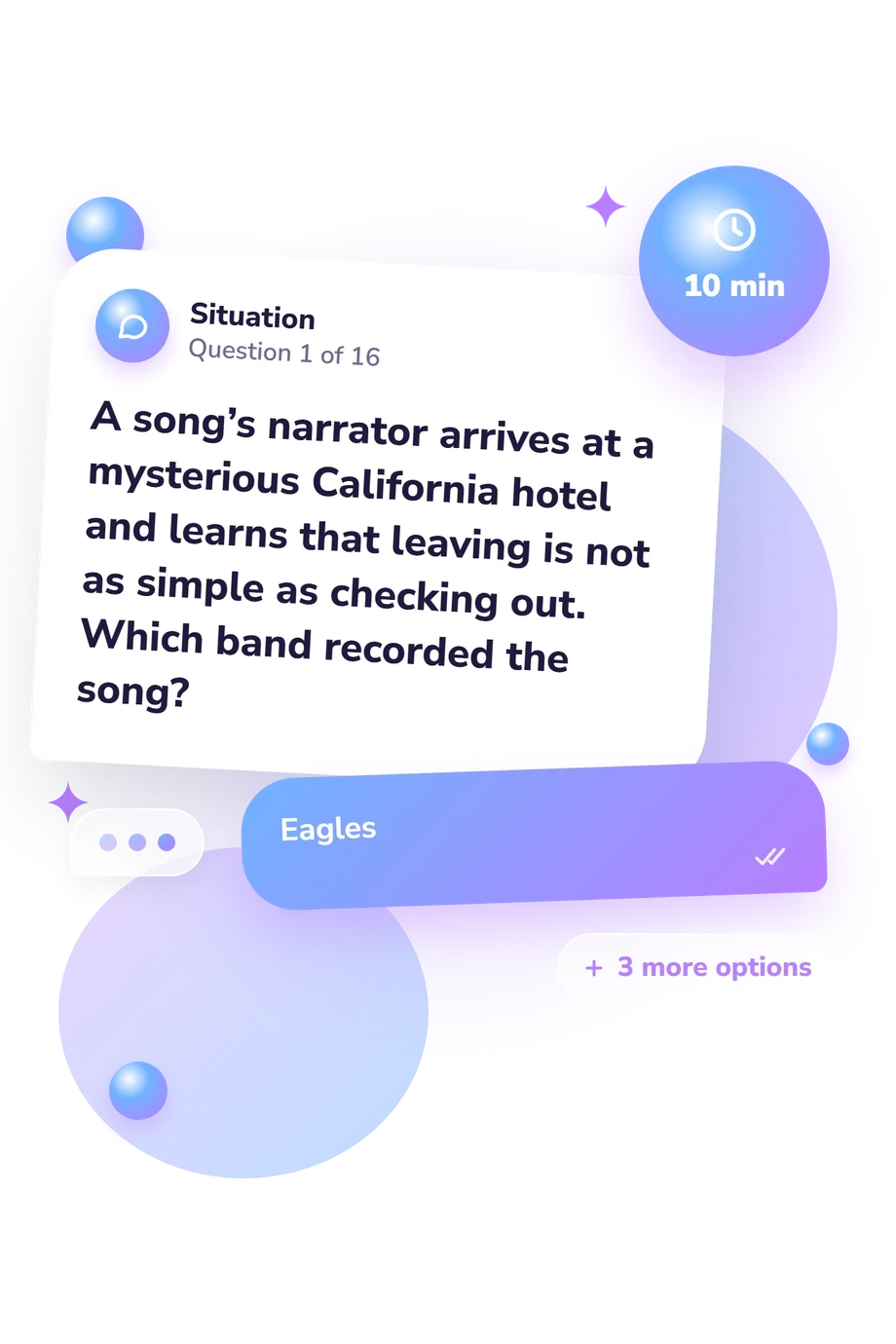
Example Questions From the Test
- Bruce Springsteen
- Bob Seger
- Jackson Browne
- Tom Petty
- Billy Joel
- Elton John
- James Taylor
- Cat Stevens
- Chic
- Sister Sledge
- Donna Summer
- Heatwave
70s Music Quiz - Description and methodology of the test
Listeners who want to check how widely their knowledge travels across classic popular music can use this assessment as a focused self-test. The 70s music quiz suits curious fans who recognize familiar recordings but want to map their recall across artists, albums, genres, and cultural moments. It is designed for general listeners rather than performers or specialists. A quiz about 1970s music can show whether knowledge is concentrated in one style or extends across the decade.
What This Assessment Explores
The test measures recognition of 1970s popular-music connections, not singing, instrumental skill, or preference. Prompts link performers with recordings, albums with artists, and songs with cultural settings or genres. The result reflects music knowledge and retrieval of associations.
These themes show the knowledge represented:
- Rock and singer-songwriters measure recall of major performers, albums, and recordings.
- Disco and soul measure recognition of dance, soundtrack, and socially engaged releases.
- Reggae and country measure familiarity beyond a rock canon.
- Punk, electronic music, and heavy metal measure awareness of contrasting movements and albums.
A 70s song quiz with this range suits listeners seeking a cross-style profile. The 70s Music Knowledge scale runs from 0-16: Foundation (0-6) indicates some recognition with connections to explore; Developing (7-12) shows broad familiarity with room to deepen it; Standout (13-16) reflects strong, wide-ranging knowledge.
Methodology and Scientific Basis
Each item gives a clue about a recording, performer, album, soundtrack, persona, or movement, followed by four choices. The format tests recognition; alternatives require attention to year, genre, or setting. It is a multiple-choice quiz about music from the 70s, so a missed answer may reflect an unfamiliar corner of the decade rather than weak knowledge overall.
The result reports performance on the displayed scale and band. These labels describe this question set, not population norms, intelligence, musicianship, or listening quality. One overall result replaces separate genre scores.
Omar et al. (2010) provide the closest conceptual support, describing music knowledge through linked representations of people, songs, and meanings. This questionnaire is conceptually consistent with that account, not an adaptation of the clinical instrument. Spivack et al. (2019) offers a comparison because shared memory can make prominent recordings easier to recognize.
Results can vary with cultural background, listening history, exposure, attention, and familiarity with the repertoire. Treat the outcome as a snapshot of recall, not a standardized population estimate or measure of musical ability.
- Omar, Rohani; Hailstone, Julia C.; Warren, Jane E.; Crutch, Sebastian J.; Warren, Jason D. (2010). The cognitive organization of music knowledge: a clinical analysis. Brain, 133(4), 1200-1213. 10.1093/brain/awp345
- Spivack, Stephen; Philibotte, Sara Jordan; Spilka, Nathaniel Hugo; Passman, Ian Joseph; Wallisch, Pascal. (2019). Who remembers the Beatles? The collective memory for popular music. PLoS ONE, 14(2), e0210066. 10.1371/journal.pone.0210066
Updated: