
Schema Quiz
How the Scales are Structured
Who Usually Takes This Test?
See How You Compare
Below is a preview of how scores are typically distributed across each scale.
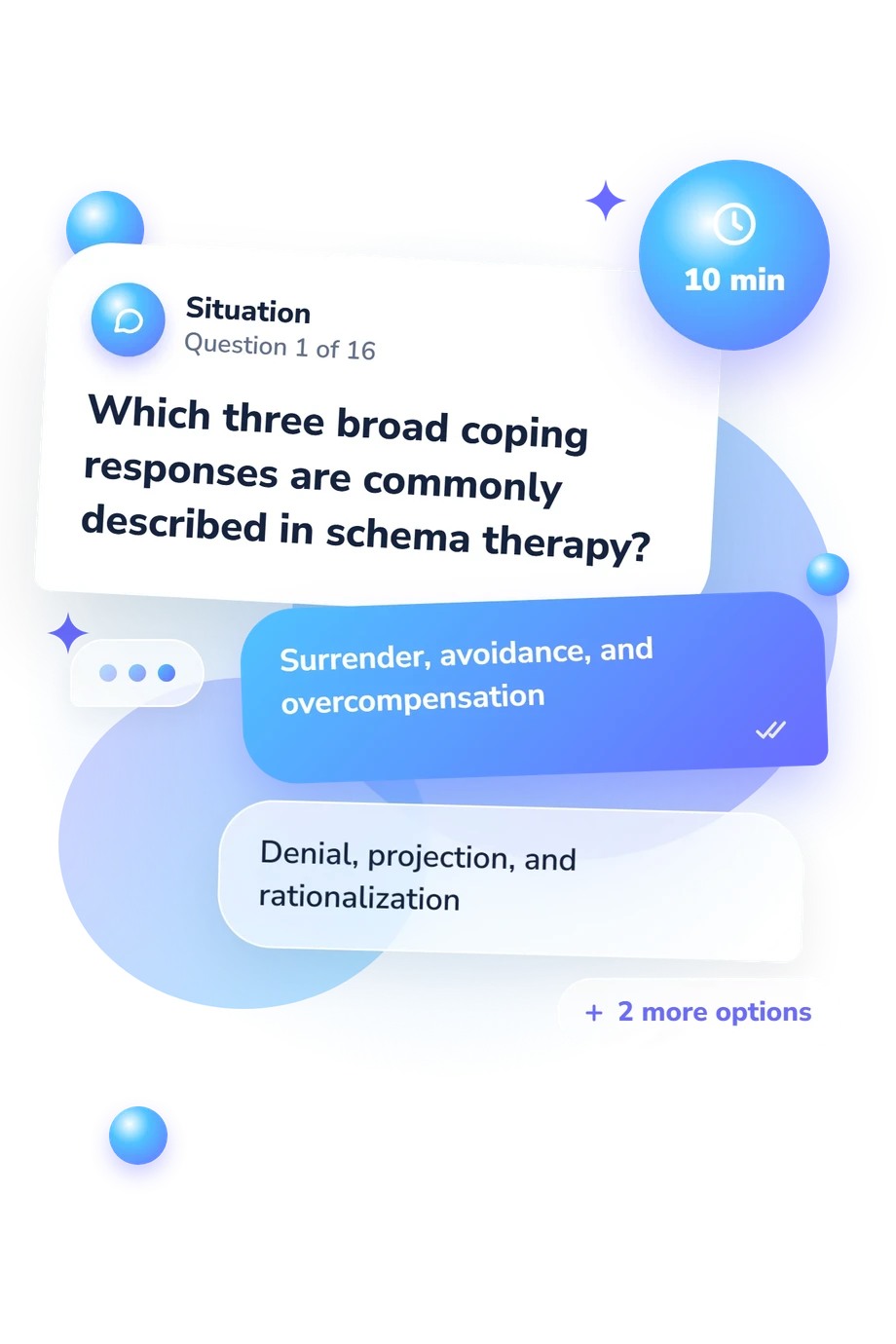
Example Questions From the Test
- Free association
- Behavioural activation
- Imagery rescripting
- Exposure without modification
- Surrender, avoidance, and overcompensation
- Denial, projection, and rationalization
- Reflection, reassurance, and redirection
- Observation, interpretation, and acceptance
- Contented Child mode
- Detached Protector mode
- Vulnerable Child mode
- Demanding Parent mode
Schema Quiz - Description and methodology of the test
People learning the model can use this schema therapy quiz to check conceptual understanding and organize further study. Its questions focus on how schemas, modes, coping responses, emotional needs, and treatment techniques fit together. The schema quiz is intended for students, therapy clients, and curious readers who want a clear starting point. Results highlight areas for review rather than describing the respondent’s personal patterns.
What This Assessment Explores
The questions test whether respondents can recognize core concepts and apply them to therapy situations. They distinguish early maladaptive schemas from diagnoses, connect coping responses with feared patterns, and identify modes, emotional needs, and interventions. As a schema knowledge test, the questionnaire measures conceptual understanding rather than personal symptoms.
The main areas examined are:
- Schemas describe patterns involving memories, emotions, beliefs, and bodily sensations about self or relationships.
- Coping responses show whether someone surrenders to, avoids, or overcompensates for a painful pattern.
- Schema modes represent emotional and coping states, including vulnerable, punitive, demanding, detached, and Healthy Adult responses.
- Therapeutic techniques illustrate ways to address unmet needs, memories, and inner states.
The result shows the respondent's overall grasp of the concepts and suggests whether broader review may help learners and therapy clients seeking structured study.
Methodology and Evidence Base
Each item presents a short prompt with four answer choices. The respondent selects the option that best matches the model, so the score counts correct answers rather than agreement or symptom frequency. The Schema Therapy model described by Jeffrey Young, Janet Klosko, and Marjorie Weishaar provides the framework for these concepts.
The questionnaire is not the SMI, an inventory examined by Lobbestael et al. (2010). Its treatment of modes is conceptually consistent with that work, but this question set is not an adaptation of it. As an educational schema-therapy questionnaire, it offers an educational snapshot rather than a standardized measure with established norms.
Schema Knowledge: 0-16. The displayed bands are Foundation 0-6, Developing 7-12, and Strong 13-16. Foundation indicates that reviewing distinctions may help; Developing indicates a useful grasp with room to strengthen application; Strong indicates well-developed understanding. These labels describe performance on this questionnaire, not validated clinical cutoffs.
Prior study, attention, current context, and interpretation of short scenarios can affect performance. The score does not reveal personal schemas or provide a diagnosis.
- Young, Jeffrey E., Janet S. Klosko, and Marjorie E. Weishaar. Schema Therapy: A Practitioner's Guide. New York: Guilford Press, 2003.
- Lobbestael, Jill, Michiel van Vreeswijk, Philip Spinhoven, Erik Schouten, and Arnoud Arntz. "Reliability and Validity of the Short Schema Mode Inventory (SMI)." Behavioural and Cognitive Psychotherapy 38, no. 4 (2010): 437-458. 10.1017/S1352465810000226
Updated: