
Twin Flame or Karmic Relationship Quiz
How the Scales are Structured
Who Usually Takes This Test?
See How You Compare
Below is a preview of how scores are typically distributed across each scale.
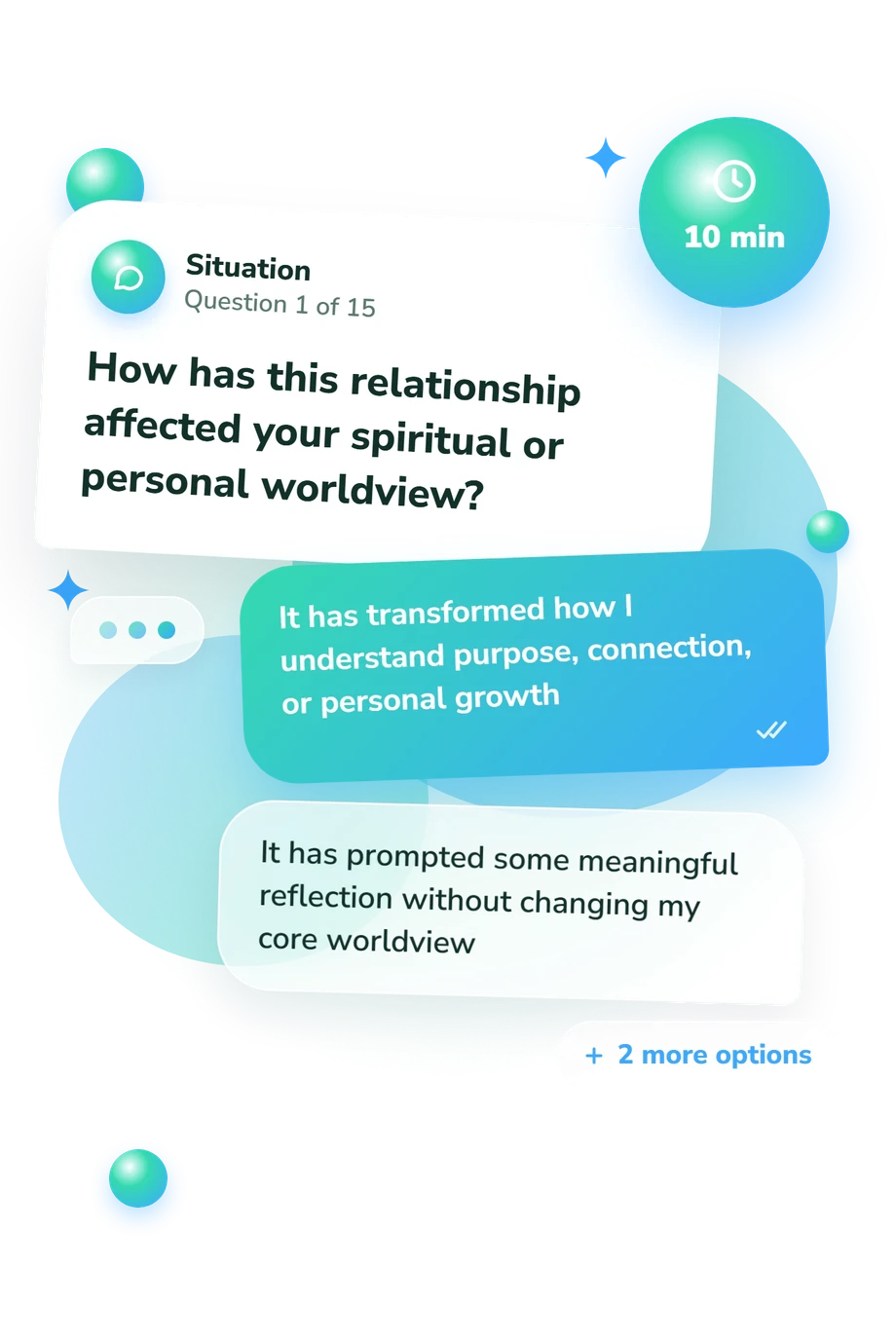
Example Questions From the Test
- To confront a recurring pattern that I had not resolved elsewhere
- To share experiences that helped me learn about relationships
- To challenge me through a mixture of growth and repetition
- I do not usually frame relationships as predetermined lessons
- We have made specific changes that address what went wrong
- I miss the familiar connection, even if little has changed
- A powerful pull returns despite expecting the same problems
- Hope that time apart may have shifted our perspective
- Observable compatibility and the choices we each make
- A combination of practical evidence and personal symbolism
- Mostly the emotional significance of particular moments
- A persistent inner sense that the bond has a larger purpose
Twin Flame or Karmic Relationship Quiz - Description and methodology of the test
People weighing an intense bond against everyday compatibility can use this karmic relationship quiz to organize a spiritually charged, practically uncertain relationship around recurring patterns and compatibility. This assessment suits anyone reflecting on attraction, rupture, separation, and shared choices. The Twin Flame or Karmic Relationship Quiz organizes those reflections into three affinity profiles. Its result compares their relative strength, with close scores indicating a blended result.
What This Assessment Explores
The questionnaire compares practical partnership, recurring patterns, and twin-flame meaning. It suits readers assessing attraction, conflict, repair, separation, commitment, and independence.
A karmic and twin-flame relationship comparison helps respondents examine spiritual meaning alongside observable compatibility and recurring patterns.
The result contains these affinity scales:
- Grounded Partnership Affinity (0-15) measures mutual choice, consistency, compatibility, repair, and separate identities: Limited grounding (0-5), Emerging grounding (6-10), Strong grounding (11-15).
- Karmic Pattern Affinity (0-15) measures intense attraction with recurring lessons, triggers, or cycles: Limited pattern (0-5), Mixed pattern (6-10), Strong pattern (11-15).
- Twin Flame Affinity (0-15) measures recognition, mirroring, spiritual meaning, and connection across separation: Limited resonance (0-5), Partial resonance (6-10), Strong resonance (11-15).
The highest score is strongest; scores within one point form a blended result. The grounded profile reflects practical relationship grounding, while the other two express narrative affinity.
Methodology and Scientific Basis
Each item presents a relationship situation with four response options covering practical evidence, recurring patterns, spiritual interpretation, and conflict or separation. Respondents select the description closest to their experience.
The scoring model cannot establish karma, predict the future, or prove a destined bond; instead, this relationship compatibility assessment expresses affinity with the displayed profiles rather than certainty about the relationship. The per-answer scoring rule is undocumented, so interpretation follows the displayed comparison: the highest score is strongest, while scores within one point form a blended result.
Stokke's (2021) observational study of soulmate experiences provides a conceptual parallel for spiritual-meaning and separation themes, but it did not create or validate this questionnaire. Franiuk, Cohen, and Pomerantz (2002), with Knee, Patrick, and Lonsbary (2003), provide related relationship-belief models for destiny-oriented and growth-oriented interpretations.
These papers provide theoretical context; they do not validate this questionnaire or establish norms for its displayed profiles. Self-reported scores may shift with current circumstances and self-awareness. Repeated distress, control, fear, threats, or harm deserve direct attention and safety planning rather than spiritual labeling.
- Christian Stokke (2021). Exploring the transpersonal phenomena of spiritual love relations: A naturalistic observation study of soulmate experiences shared in a New Age Facebook group. Journal for the Study of Spirituality, 11(2), 130-144. 10.1080/20440243.2021.1955454
- Renae Franiuk, Dov Cohen, and Eva M. Pomerantz (2002). Implicit theories of relationships: Implications for relationship satisfaction and longevity. Personal Relationships, 9(4), 345-367. 10.1111/1475-6811.09401
- C. Raymond Knee, Heather Patrick, and Cynthia Lonsbary (2003). Implicit theories of relationships: Orientations toward evaluation and cultivation. Personality and Social Psychology Review, 7(1), 41-55. 10.1207/S15327957PSPR0701_3
Updated: