
Where Should I Vacation in the US Quiz
How the Scales are Structured
Who Usually Takes This Test?
See How You Compare
Below is a preview of how scores are typically distributed across each scale.
Example Questions From the Test
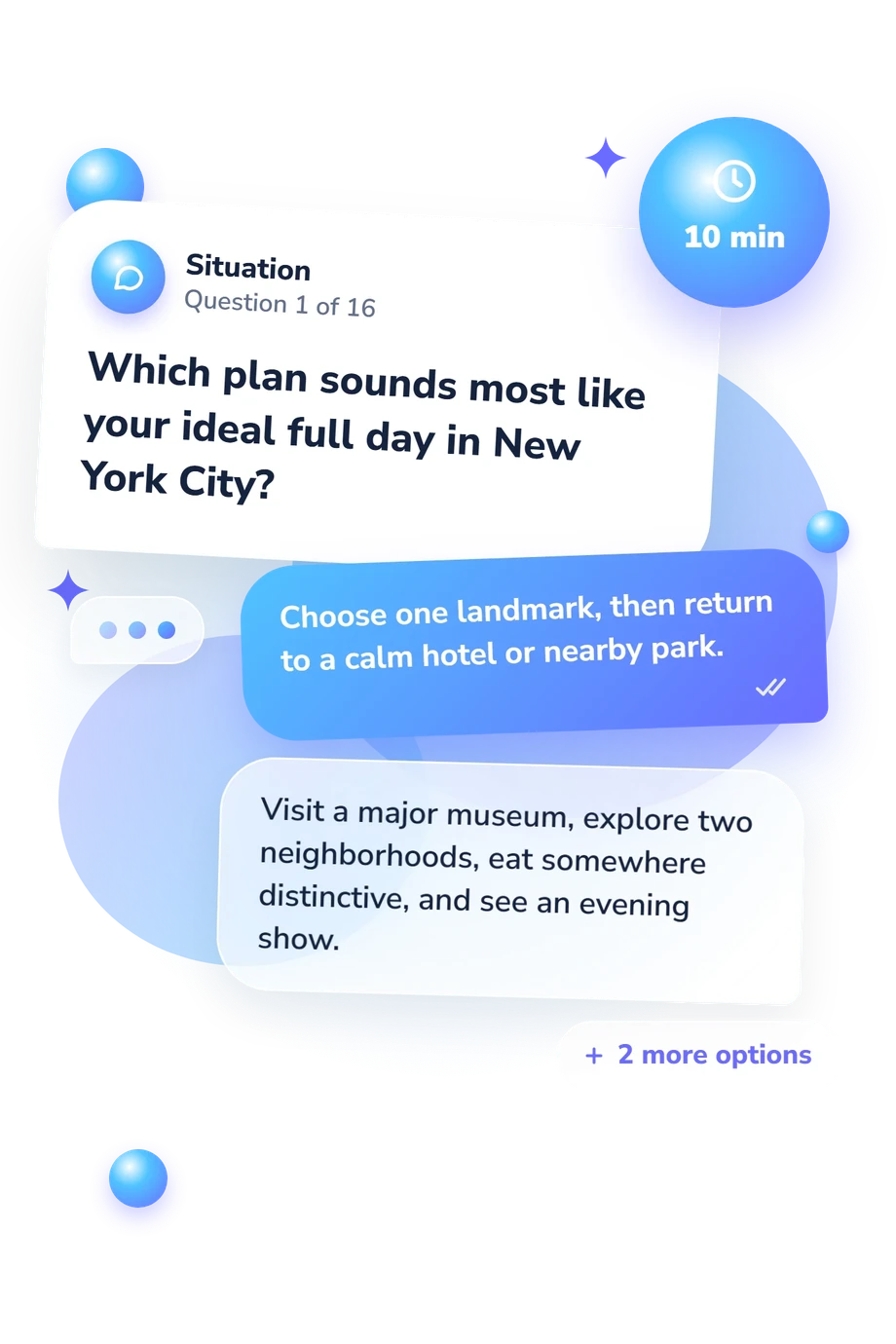
- Choose one landmark, then return to a calm hotel or nearby park.
- Visit a major museum, explore two neighborhoods, eat somewhere distinctive, and see an evening show.
- Spend most of the day outside the city on a nature excursion.
- Pick a neighborhood and explore it slowly, leaving the evening open.
- A mountain day trip followed by a casual meal or brewery visit in the city.
- Two days in the city and one easy scenic excursion.
- Mostly museums and restaurants, with the mountains viewed from a distance.
- A vacation centered on beaches, warm water, and sea-level relaxation.
- Take a coastal walk, spend time on the beach, and decide on lunch afterward.
- Visit a major indoor attraction before the crowds arrive.
- Start a tightly scheduled day covering several urban landmarks.
- Enjoy breakfast outside, then choose between the coast and a neighborhood visit.
Where Should I Vacation in the US Quiz - Description and methodology of the test
Travelers comparing city energy, mountain access, coastal ease, and local culture can use this assessment to identify a vacation style that fits their preferences. The Where Should I Vacation in the U.S. Quiz serves people choosing among appealing U.S. trips when pace, climate, scenery, mobility, and activities matter more than one must-see attraction. Its results compare four cities, not states, addressing the what state should i visit quiz question.
What This Assessment Explores
Questions examine urban density, outdoor exertion, ocean access, cultural immersion, climate, mobility, flexible time, and spontaneity. They suit travelers comparing vacation styles rather than testing geographic knowledge or ranking cities. Asked where should I go on vacation in the US, travelers can use the quiz to identify the strongest destination match. Profiles:
- Denver (0-12) reflects mountain access and casual city time: Different terrain (0-4), City-and-mountains sampler (5-8), or Mountain gateway match (9-12).
- New Orleans (0-12) reflects music, food, history, and an unhurried atmosphere: Different atmosphere (0-4), Curious visitor (5-8), or Cultural immersion match (9-12).
- New York City (0-12) reflects dense energy, walkability, variety, and culture: Different rhythm (0-4), Selective city explorer (5-8), or Big-city match (9-12).
- San Diego (0-12) reflects ocean access, outdoor living, mild weather, and flexible pacing: Different setting (0-4), Coastal sampler (5-8), or Coastal match (9-12).
Methodology and Evidence Base
Each item presents a travel situation with four response options. The comparison weighs travel preferences and trade-offs, helping travelers choose a U.S. destination, not test factual knowledge.
Each destination receives a score. The highest marks strongest affinity; scores within one point form a blended result. Bands describe fit, not a universal ranking.
Conceptually, the questionnaire aligns with Moscardo et al. (1996), which links destination choice with travel motivations and activities. Yiannakis and Gibson (1992) and Gibson and Yiannakis (2002) offer a tourist-role perspective on preferred travel experiences; their studies provide context, not validation of this scoring. These themes-climate, mobility, culture, outdoor activity, and unplanned time-come from its travel situations, not those studies.
This online self-reflection questionnaire provides destination bands rather than population norms, so results work best as a structured comparison. Self-reported results may shift with mood, budget, companions, season, or the imagined trip. After asking where should I travel in the US, quiz results can guide checks of weather, access, costs, and itinerary needs.
- Gianna Moscardo, Alastair M. Morrison, Philip L. Pearce, Cheng-Te Lang, and Joseph T. O'Leary. "Understanding vacation destination choice through travel motivation and activities." Journal of Vacation Marketing, 2(2), 109-122, 1996. 10.1177/135676679600200202
- Andrew Yiannakis and Heather Gibson. "Roles tourists play." Annals of Tourism Research, 19(2), 287-303, 1992. 10.1016/0160-7383(92)90082-Z
- Heather J. Gibson and Andrew Yiannakis. "Tourist roles: Needs and the lifecourse." Annals of Tourism Research, 29(2), 358-383, 2002. 10.1016/S0160-7383(01)00037-8
Updated: