
VSEPR Quiz
How the Scales are Structured
Who Usually Takes This Test?
See How You Compare
Below is a preview of how scores are typically distributed across each scale.
Example Questions From the Test
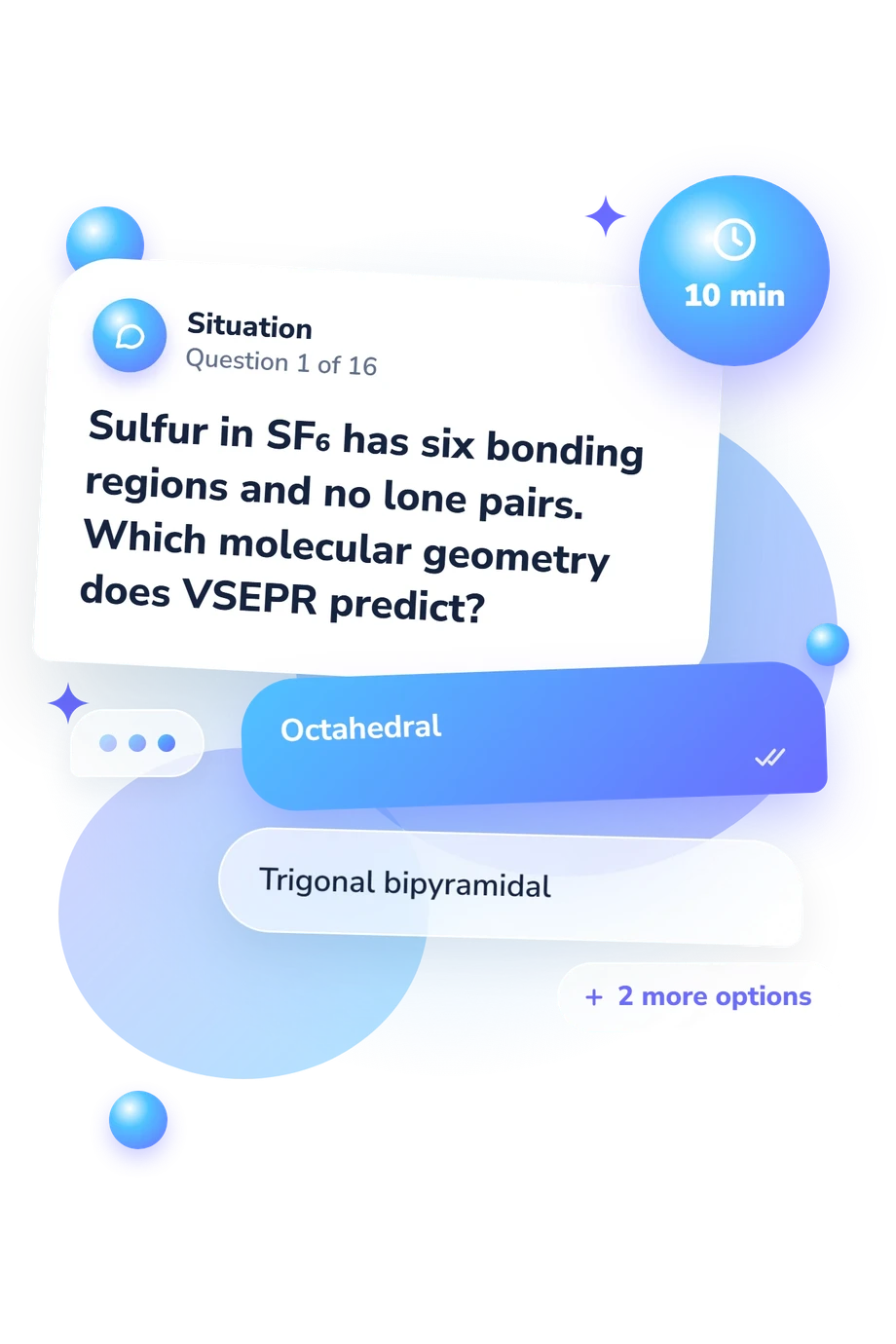
- Octahedral
- Trigonal bipyramidal
- Square pyramidal
- Hexagonal planar
- Trigonal planar
- Tetrahedral
- Trigonal pyramidal
- Bent
- Square pyramidal
- Trigonal bipyramidal
- Seesaw
- Octahedral
VSEPR Quiz - Description and methodology of the test
Students who want to check whether they can move from Lewis structures to three-dimensional molecular reasoning can use the VSEPR Quiz as a focused knowledge check. It suits learners reviewing general chemistry or preparing for coursework. As a VSEPR theory quiz, it emphasizes applying rules to structures rather than recalling labels. The result reflects the respondent's VSEPR knowledge and how consistently they apply electron-region, lone-pair, bond-angle, and molecular-shape principles.
What This Assessment Explores
The assessment examines whether a respondent can use electron-domain repulsion to predict structures rather than memorize isolated shapes. It connects steric number with electron-domain geometry, molecular geometry, lone-pair effects, and bond-angle changes. In this VSEPR practice quiz, learners can see how these ideas work together.
The thematic groups below describe the reasoning represented in the questions:
- Electron-domain counting shows how bonding regions and lone pairs determine the number of regions around a central atom.
- Geometry and shape distinguish the arrangement of all electron domains from the positions occupied by atoms.
- Lone-pair effects explain compressed bond angles and altered shapes in cases such as water and ammonia.
The result helps learners identify strengths and review gaps, especially when electron-domain geometry differs from molecular shape. It is intended for students and independent learners using general-chemistry concepts.
Methodology and Scientific Basis
The questions use multiple-choice responses with one best answer, asking learners to apply VSEPR to Lewis structures, AXE notation, steric number, resonance, and familiar molecular examples. The format tests competing geometries and explanations, not only terminology.
The method follows the VSEPR model developed by Gillespie and Nyholm, which treats electron regions around a central atom as arranging to reduce repulsions. The questionnaire is conceptually consistent with that model and later explanatory treatments by Gillespie and Flowers and colleagues; it is not an adaptation of any published instrument. This VSEPR theory practice quiz can therefore reinforce the model’s reasoning while keeping the result specific to this online question set.
Results are reported as VSEPR Knowledge: 0-16. The displayed bands are Foundations to review (0-6), Developing knowledge (7-12), and Strong knowledge (13-16). These ranges reflect performance in electron-domain counting, lone-pair effects, shape identification, and applying common and expanded-valence arrangements. Since the format relies on selected answers, current preparation, attention, or misunderstanding can affect performance. Use the profile to target review of electron counting, lone-pair placement, and shape-versus-geometry distinctions.
- Gillespie, R. J., and Nyholm, R. S. (1957). Inorganic stereochemistry. Quarterly Reviews, Chemical Society, 11, 339-380. 10.1039/QR9571100339
- Gillespie, R. J. (2008). Fifty years of the VSEPR model. Coordination Chemistry Reviews, 252(12-14), 1315-1327. 10.1016/j.ccr.2007.07.007
- Flowers, Paul, Klaus Theopold, Richard Langley, and William R. Robinson. (2019). Chemistry 2e. OpenStax, Houston, Texas, Section 7.6, Molecular Structure and Polarity.
Updated: