
What Musical Am I Quiz
How the Scales are Structured
Who Usually Takes This Test?
See How You Compare
Below is a preview of how scores are typically distributed across each scale.
Example Questions From the Test
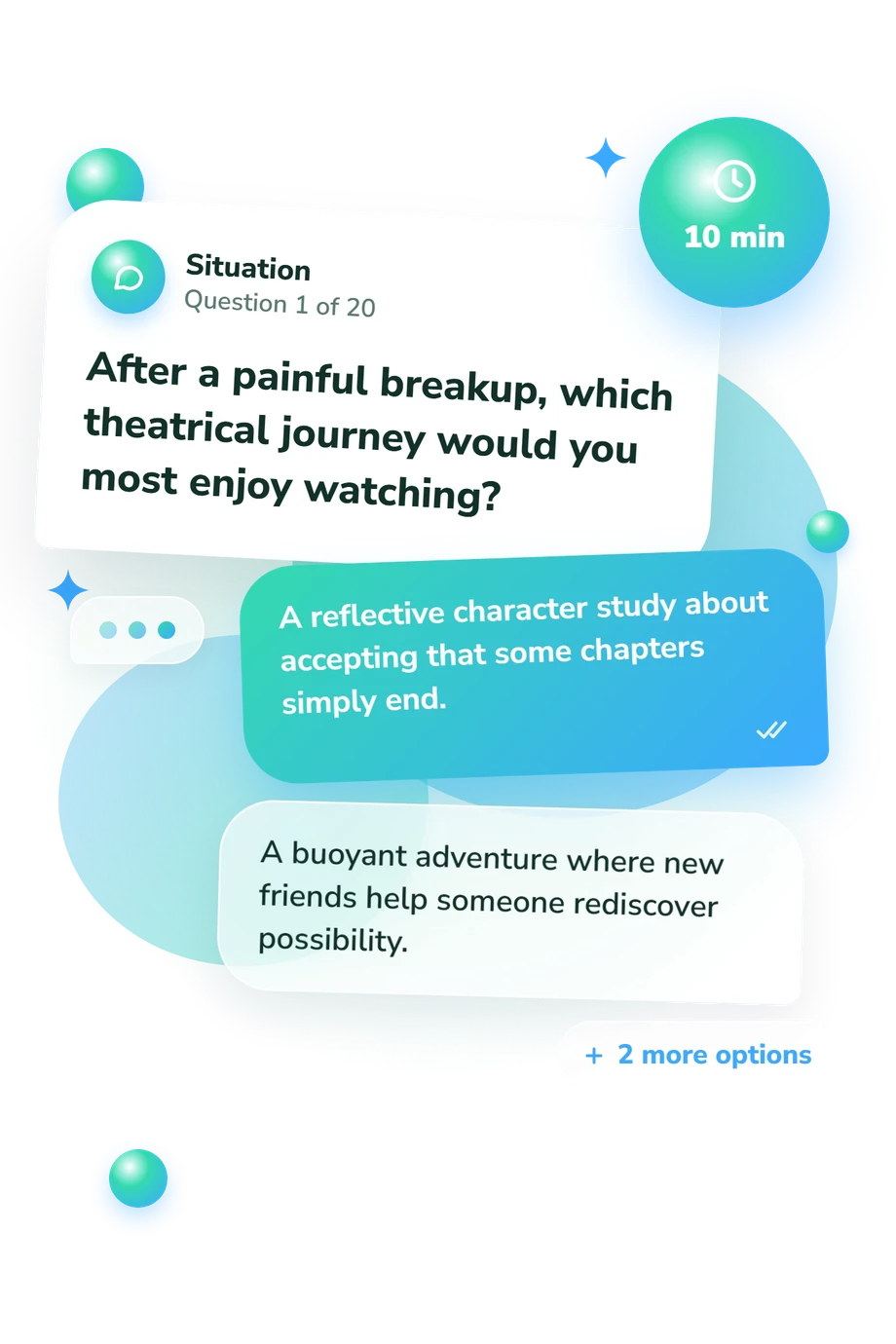
- A reflective character study about accepting that some chapters simply end.
- A buoyant adventure where new friends help someone rediscover possibility.
- A romance focused mainly on winning the former partner back.
- A balanced story that leaves reconciliation and a fresh start equally possible.
- Warm, chaotic, and ultimately generous toward everyone’s imperfect past.
- Mostly heartfelt, with humor softening the more complicated revelations.
- A serious reckoning that keeps celebration in the background.
- A tense mystery centered on proving exactly who was at fault.
- A carefully researched period drama with restrained characterization.
- Mostly historical staging, with occasional modern jokes or music.
- A modern reinterpretation that preserves a strong conventional plot.
- A fearless pop remix that lets each woman reclaim and perform her own story.
What Musical Am I Quiz - Description and methodology of the test
Anyone comparing pop-concert spectacle, romantic escapism, courtroom determination, or pointed social comedy may find this questionnaire useful when deciding which theatrical styles to explore. It is a musical theatre preference questionnaire for readers comparing five distinct stage worlds. The what musical am i quiz organizes those choices around story tone, character arcs, staging, and sound.
What This Assessment Explores
It compares each production as an affinity. Items cover reinvention, ambition, family, school dynamics, rivalry, staging, songs, and emotion. This musical preference quiz compares shows’ themes, tone, character arcs, songs, and staging. The scales and bands are:
- & Juliet (0-12): Another Ending (0-4), Open to a Rewrite (5-8), or Rewrite the Script (9-12) reflect comfort with pop reinvention and self-authored futures.
- Legally Blonde (0-12): Alternate Ambition (0-4), Case Building (5-8), or Positively Determined (9-12) reflect bright style, disciplined growth, and authenticity.
- Mamma Mia! (0-12): Different Destination (0-4), Island Guest (5-8), or Dancing-Queen Spirit (9-12) reflect nostalgia, family discovery, romance, and celebration.
- Mean Girls (0-12): Softer Focus (0-4), Cafeteria Observer (5-8), or Social-Satire Match (9-12) reflect interest in status, humor, and accountability.
- SIX (0-12): Different Spotlight (0-4), Remix Ready (5-8), or Royal Concert Energy (9-12) reflect concert framing, reclamation, and solidarity.
Methodology and Scientific Basis
Each item presents a short scenario with four response options about tone, character development, setting, or staging. Choices move among restrained, conventional, pop-driven, emotionally expansive, and sharply comic possibilities. No answer is correct; meaning comes from the response pattern.
Scoring is comparative, not diagnostic. Responses produce a questionnaire-defined affinity profile: the highest score is the strongest match, while scores within one point form a blended result. Together, the five profiles show how different theatrical combinations appeal to you.
Methodologically, the self-report format is conceptually consistent with the Entertainment-Preference Measure and with Rentfrow, Goldberg, and Levitin’s five-factor model of musical preferences. These sources offer conceptual comparison points for organized entertainment tastes; this show-specific questionnaire is not a direct adaptation or psychometric reproduction of either instrument, and those studies do not validate it.
As a musical affinity test, it presents questionnaire-defined bands for comparing the five results. Mood, familiarity with the shows, current interests, and self-awareness can shape responses, so close scores may be most useful as a blended preference profile.
- Rentfrow, Peter J., Lewis R. Goldberg, and Ran Zilca. 2011. "Listening, Watching, and Reading: The Structure and Correlates of Entertainment Preferences." Journal of Personality 79 (2): 223-258. DOI 10.1111/j.1467-6494.2010.00662.x
- Rentfrow, Peter J., Lewis R. Goldberg, and Daniel J. Levitin. 2011. "The Structure of Musical Preferences: A Five-Factor Model." Journal of Personality and Social Psychology 100 (6): 1139-1157. DOI 10.1037/a0022406
Updated: