
Skeletal Muscle Quiz
How the Scales are Structured
Who Usually Takes This Test?
See How You Compare
Below is a preview of how scores are typically distributed across each scale.
Example Questions From the Test
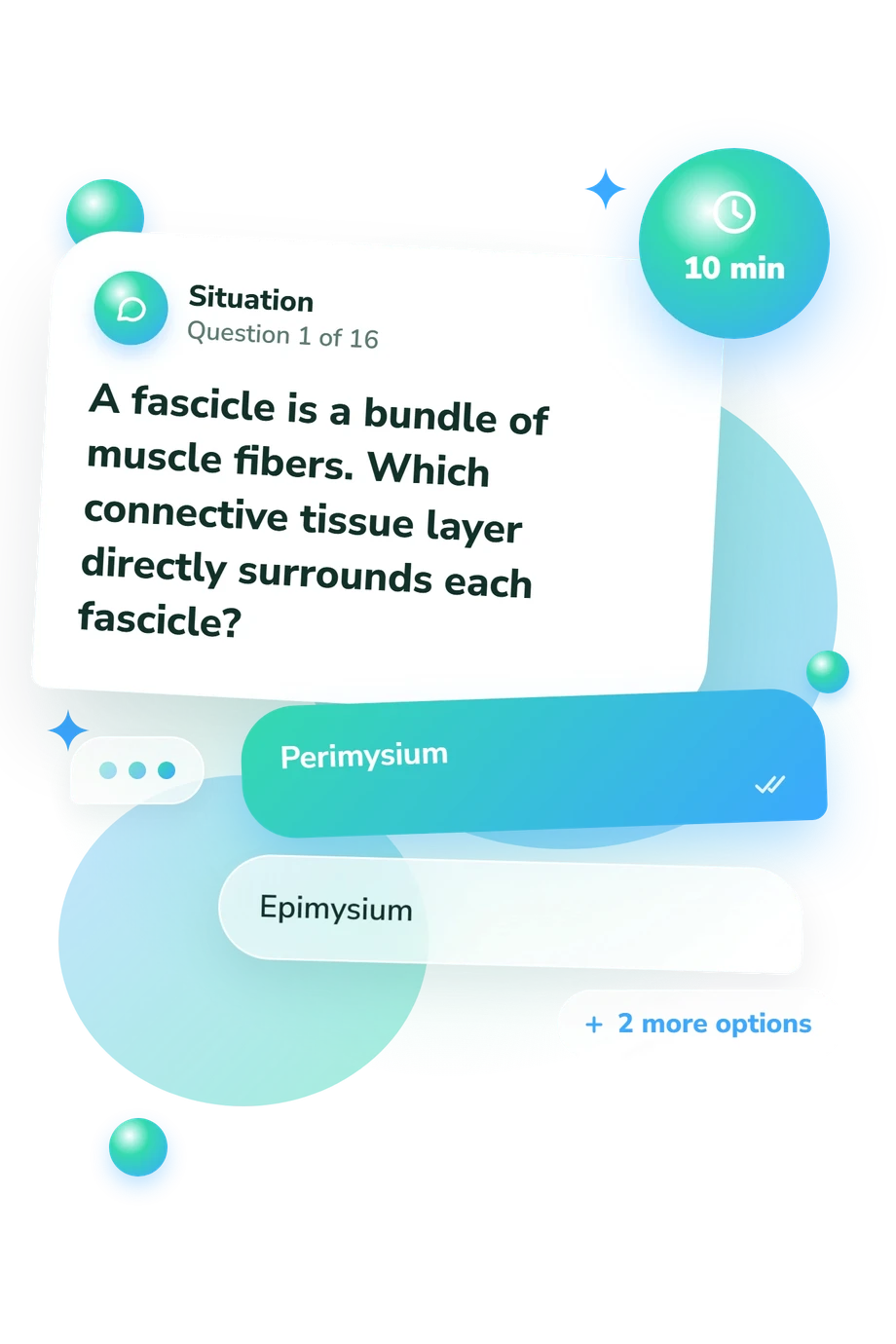
- Perimysium
- Epimysium
- Endomysium
- Deep fascia
- Tibialis anterior
- Fibularis longus
- Soleus
- Biceps femoris
- Tibialis anterior
- Gluteus medius
- Rectus femoris
- Gastrocnemius
Skeletal Muscle Quiz - Description and methodology of the test
Designed for students, trainees, and curious readers, this skeletal muscle quiz checks whether core anatomy can be recognized and applied in familiar movement and structure problems. As a skeletal muscle anatomy quiz, it helps readers decide which topics deserve another pass before coursework, practical study, or revision. The result gives a focused picture of current understanding for study planning.
What This Assessment Explores
Knowledge of organization, movement, and contraction is the focus. Its scenarios connect terms with actions such as lifting the foot, rising from a chair, standing on tiptoe, and raising the arm. It functions as a skeletal muscle test of applied anatomy: results show how well a person can identify structures and apply basic physiology.
The items cover these areas:
- Connective-tissue organization explains how three layers relate to fibers, fascicles, and whole muscles.
- Regional movement identifies muscles responsible for ankle, knee, and shoulder actions.
- Contractile structure links sarcomeres, filaments, calcium, and regulatory proteins with contraction.
- Functional organization shows how fiber types and motor units support endurance and control.
Skeletal Muscle Knowledge (0-16) is reported as Foundation to Build (0-6), Developing Knowledge (7-12), or Strong Knowledge (13-16). These bands range from reviewing core terms to showing strong command of anatomy and applications.
Methodology and Scientific Basis
Each item in this skeletal muscle assessment presents a prompt in a four-option multiple-choice format. The questions use recognition and application: some ask for a definition or structure, while others match a muscle, tissue layer, fiber type, or protein with its role. Together they sample microscopic organization, regional actions, contraction, and neuromuscular control.
The displayed result is a bounded knowledge result reported in descriptive bands. The questionnaire's weighting, total-score calculation, and norming are not specified, so the result is most useful for locating topics to review. The prompts also require distinctions between nearby structures and links between anatomical terms and movement, contraction, or control.
Content is conceptually consistent with Gray's Anatomy for Students and Anatomy and Physiology. These textbooks provide subject-matter references, but they do not establish this questionnaire's validation, norming, or provenance.
Attention, guessing, prior study, and wording familiarity can affect performance, so the result is best checked against instruction or formal assessment.
- Drake, Richard L., A. Wayne Vogl, and Adam W. M. Mitchell. Gray's Anatomy for Students. 5th ed. Elsevier, 2023.
- Betts, J. Gordon, Kelly A. Young, James A. Wise, Eddie Johnson, Brandon Poe, Dean H. Kruse, Oksana Korol, Jody E. Johnson, Mark Womble, and Peter DeSaix. Anatomy and Physiology 2e. OpenStax, 2022.
- Severo, Milton, and Maria A. Ferreira Tavares. "Meta-evaluation in clinical anatomy: a practical application of item response theory in multiple choice examinations." Anatomical Sciences Education, vol. 3, no. 1, 2010, pp. 17-24. 10.1002/ase.118.
Updated: