
Stroller Quiz
How the Scales are Structured
Who Usually Takes This Test?
See How You Compare
Below is a preview of how scores are typically distributed across each scale.
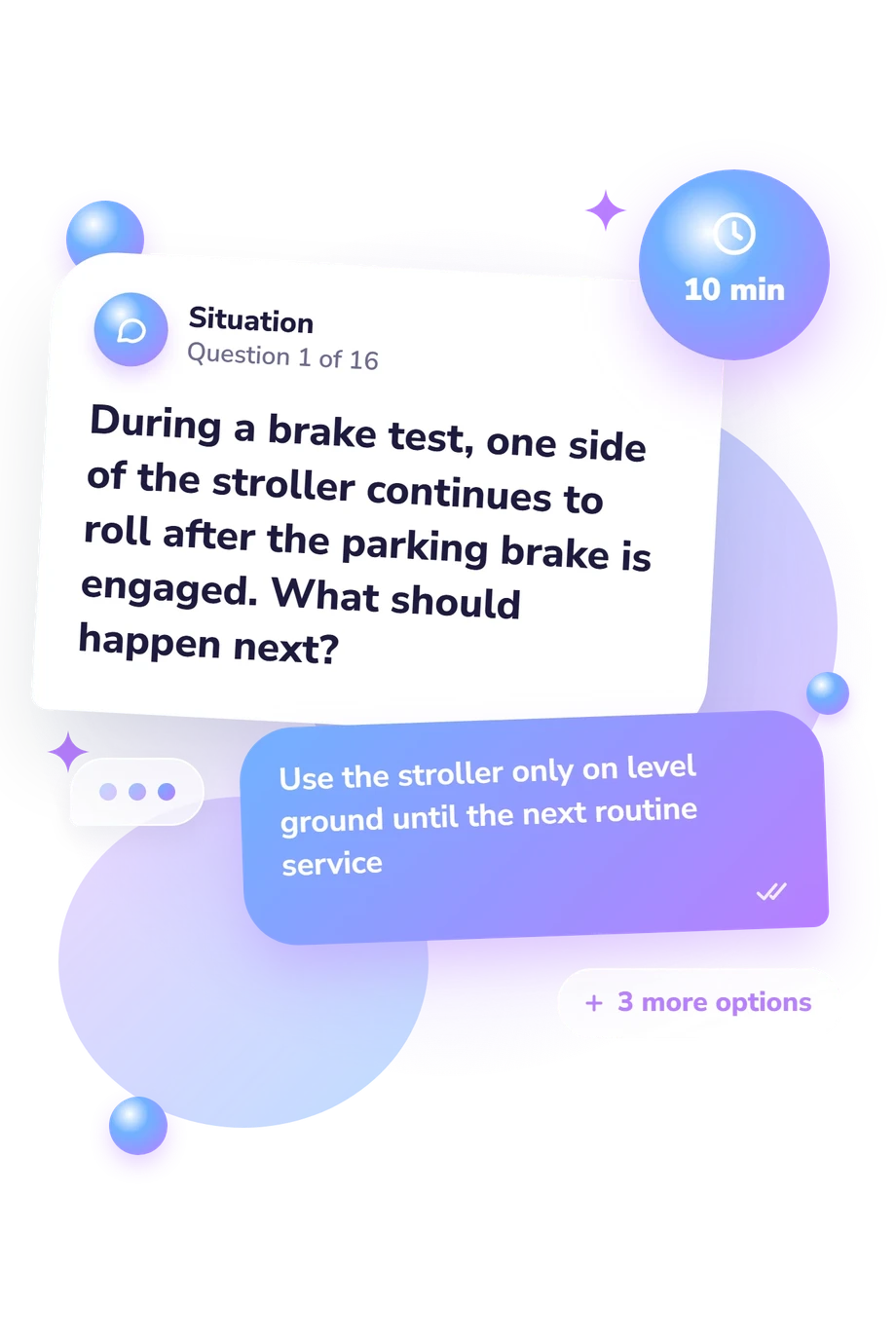
Example Questions From the Test
- Lock the front wheels in the forward position, following the manual
- Increase the handle height to put more weight over the front wheels
- Unlock the rear wheels so they can rotate independently
- Move all basket contents to the back of the stroller
- On top of the canopy to keep the seat area clear
- Evenly divided between both sides of the handlebar
- In the lower basket without exceeding its stated weight limit
- Behind the child's back if the seat remains upright
- To control how far the seat can recline
- To keep the parking brake engaged while the stroller is stored
- To help prevent the frame from folding unintentionally during use
- To align the swivel wheels before each turn
Stroller Quiz - Description and methodology of the test
Caregivers who want to make more informed everyday decisions can use this assessment to examine practical stroller-use principles. The Stroller Quiz is useful when selecting equipment, reviewing a setup, or refreshing knowledge after a change in routine. Questions about fit, approved configurations, and handling make the what stroller should i get quiz practical rather than brand-specific, while the result remains a general knowledge profile rather than a brand recommendation.
What This Assessment Explores
This questionnaire examines whether a respondent can recognize appropriate actions in common stroller situations. It suits caregivers and family members who choose, operate, or maintain equipment, and it works as a stroller safety quiz because it emphasizes practical decisions rather than brand preference.
The main result areas are:
- Brake and frame checks show whether the respondent recognizes rolling, bent, damaged, or unsecured equipment that needs attention.
- Fit and restraint items indicate understanding of harness use, newborn configurations, and required support.
- Loading and stability questions examine basket limits, hanging bags, wheel design, and balance.
- Compatibility and conditions cover adapters, accessories, terrain, weather covers, and jogging restrictions.
Stroller Knowledge runs from 0-16: Foundations to build (0-6), Developing knowledge (7-12), and Strong knowledge (13-16). These are unvalidated educational summaries of practical knowledge, not safety, legal, or clinical cutoffs.
Methodology and Scientific Basis
Each item presents a brief safety scenario with four answer choices. The options distinguish a response consistent with safe practice from plausible but inadequate shortcuts. The displayed total summarizes recognition across the situations.
As an online stroller knowledge test, the questionnaire is conceptually consistent with Couper et al. (1994), whose work addresses stroller-related injury risks. Its practical content also aligns with ASTM F833-21 and CPSC's 2010 stroller-safety guidance. These sources support the subject matter, but the questionnaire is not presented as an adaptation or validation of them.
The displayed bands are educational summaries rather than validated safety thresholds, and the total cannot confirm that a particular stroller or setup is suitable. Results are most useful for identifying topics to review, while responses may vary with self-awareness, memory, attention, and current context. Follow the manufacturer's instructions and act on damage, recalls, failed brakes, or compatibility concerns regardless of the total.
- Couper, Richard T. L., William Monkhouse, Maureen Busutil, and Peter Thompson. "Stroller safety." Medical Journal of Australia 160, no. 6 (1994): 335-338. 10.5694/j.1326-5377.1994.tb138233.x
- ASTM International. Standard Consumer Safety Performance Specification for Carriages and Strollers, ASTM F833-21. West Conshohocken, PA: ASTM International, 2021. 10.1520/F0833-21
- U.S. Consumer Product Safety Commission. Infants in Strollers Must Be Properly Secured at All Times. Publication 5096, October 2010.
Updated: