
South Asia Capitals Quiz
How the Scales are Structured
Who Usually Takes This Test?
See How You Compare
Below is a preview of how scores are typically distributed across each scale.
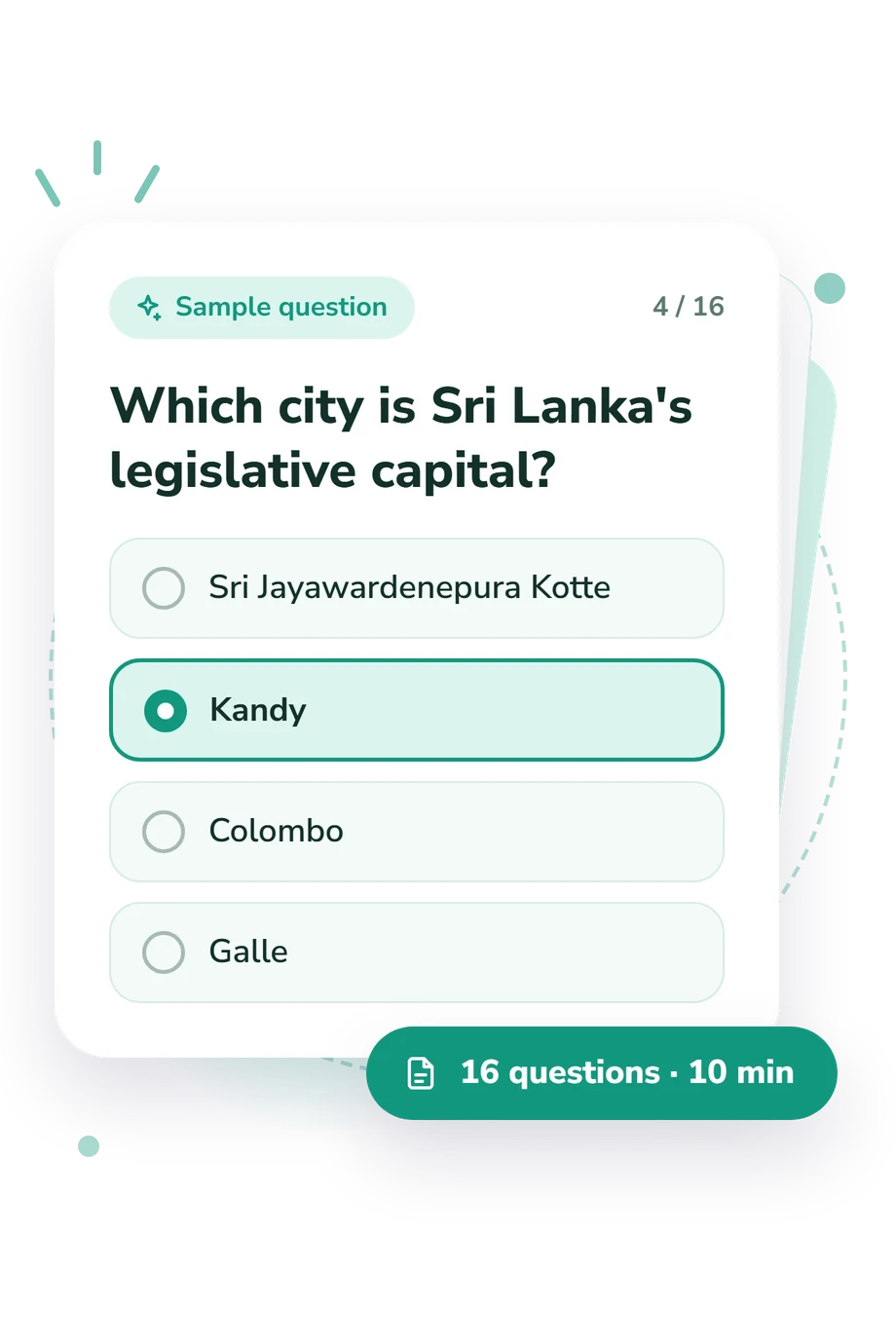
Example Questions From the Test
- Pakistan, then Bhutan
- India, then Nepal
- Bangladesh, then Bhutan
- India, then Bangladesh
- Kabul, then Sri Jayawardenepura Kotte
- Kabul, then Colombo
- Islamabad, then Sri Jayawardenepura Kotte
- Islamabad, then Colombo
- Herat
- Kandahar
- Kabul
- Mazar-i-Sharif
South Asia Capitals Quiz - Description and methodology of the test
For learners, travelers, and students who want to check regional geography, the South Asia Capitals Quiz offers a focused way to test readiness for travel, study, or classroom review. Its result gives an overall indication of performance on the tested capital-country material. As a South Asia map quiz with capitals, this assessment connects individual facts with the region’s wider geographic pattern.
What This Assessment Explores
This questionnaire connects South Asian countries with national capitals, including Sri Lanka’s legislative capital, Sri Jayawardenepura Kotte. It suits learners, travelers, educators, and anyone using this South Asia capitals test for regional review.
Questions combine direct prompts, comparisons, and short route, itinerary, departure-board, and conference-travel situations. The result reflects recall and applying capital-country relationships in context.
The thematic groups are:
- Direct recall shows how readily you identify a city when a country is named.
- Pairing checks whether each capital is linked to the country.
- Scenarios show how accurately you use the facts in sequences and comparisons.
The South Asia Capitals Knowledge scale runs from 0-16. Foundations (0-6) indicates recognition of some capitals, Developing (7-12) reflects knowledge of many capitals with occasional regional mix-ups, and Strong Command (13-16) indicates accurate performance across recall, comparison, and short scenarios.
Methodology and Evidence Base
Each item presents a geographic prompt with four answer choices and asks for one selection. This keeps the South Asian capitals knowledge test focused on observable answers rather than self-described traits. Direct recall, correct-pair recognition, and route or itinerary scenarios create a structured multiple-choice assessment.
The content uses established country-capital facts, including Sri Lanka’s national and legislative capitals. The CIA World Factbook and Sri Lankan government information provide factual context, but this questionnaire is a purpose-built online knowledge check, not an adaptation of either source. No standardized psychological instrument or theoretical model is claimed.
The questionnaire displays the stated knowledge scale and its three result bands; it does not document a rule for converting answers into points. The result is best read as performance on these geography items and a guide to facts worth reviewing, not as a measure of every aspect of geographic knowledge.
Performance may vary with schooling, travel experience, language familiarity, concentration, and guessing; a higher band indicates stronger command of the tested capital-country content, not complete geographic knowledge.
- Kathuria, Sanjay, Ravindra A. Yatawara, and Xiao'ou Zhu. 2021. Regional Investment Pioneers in South Asia: The Payoff of Knowing Your Neighbors. South Asia Development Forum. Washington, DC: World Bank. 10.1596/978-1-4648-1534-8.
- Government of Sri Lanka. n.d. Sri Lanka: Country Overview. Official Government Information Portal.
Updated: