
What Would You Do Quiz
How the Scales are Structured
Who Usually Takes This Test?
See How You Compare
Below is a preview of how scores are typically distributed across each scale.
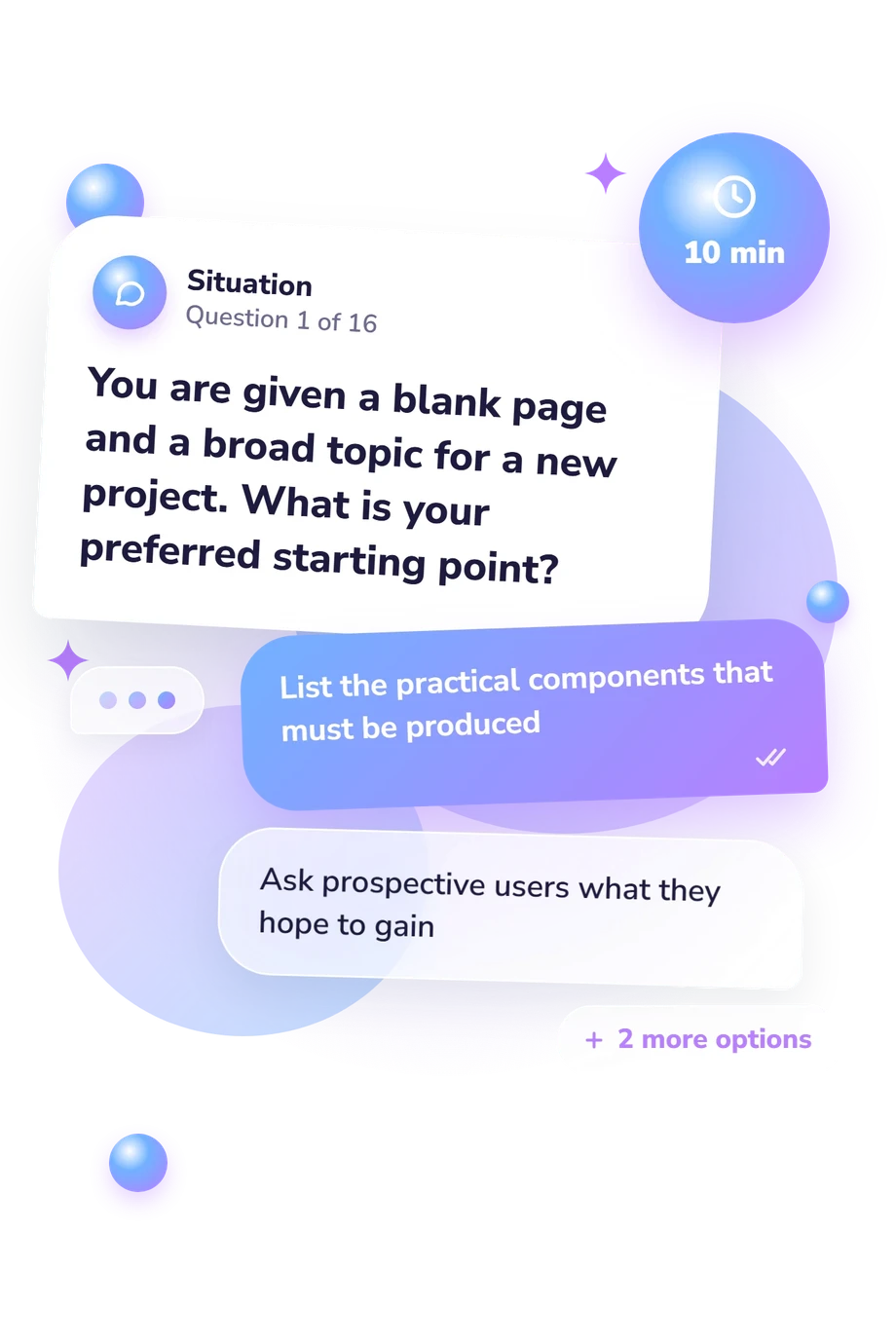
Example Questions From the Test
- Develop a visual concept for an upcoming campaign
- Help colleagues learn a process they find difficult
- Compare workflow data to identify a recurring delay
- Assemble and test a more efficient workstation layout
- Give them time to explore it independently before stepping in
- Send a concise resource they can use at their own pace
- Ask what part is unclear and demonstrate that section
- Improve the process notes so the steps are easier to follow
- Finding an original way to make a familiar subject engaging
- Understanding why a complicated result occurred
- Helping a group become comfortable working together
- Turning a detailed plan into a reliable physical setup
What Would You Do Quiz - Description and methodology of the test
People deciding which kinds of work, study, or projects may suit their interests can use the What Would You Do Quiz as a structured point of reflection. It turns responses to everyday dilemmas into a profile of preferred contribution, helping readers notice whether they are drawn more to evidence, ideas, practical action, or supporting other people. It is also a what would you do personality quiz for comparing these tendencies.
What This Assessment Explores
The scenarios measure preferences, not competence. They place readers in situations involving research, invention, practical construction, communication, or support, then identify which contribution feels engaging. The result suggests kinds of problems and projects that may suit the respondent; it does not assign an occupation.
The four dimensions are:
- Analytical Investigator (0-12) measures evidence-seeking: Intuitive Explorer (0-4), Practical Analyst (5-8), or Deep Investigator (9-12).
- Creative Communicator (0-12) measures original expression: Structure-Seeking (0-4), Purposeful Creator (5-8), or Expressive Originator (9-12).
- Hands-On Builder (0-12) measures tangible problem-solving: Concept-Oriented (0-4), Practical Contributor (5-8), or Active Builder (9-12).
- People-Centered Guide (0-12) measures helping and development: Independent Focus (0-4), Selective Supporter (5-8), or Engaged Guide (9-12).
The highest score marks the strongest affinity; scores within one point create a blended result. It works as a what would you do if quiz, comparing these four directions.
Methodology and Scientific Basis
Each item presents a work or project situation with four response options. The alternatives show different approaches to a challenge: investigating causes, shaping communication, building a solution, or helping people progress. Choosing the response that feels most natural makes the result a preference profile, not a measure of demonstrated skill.
Responses are grouped into four scores and compared. The displayed ranges identify result bands, but the questionnaire does not state how many points each answer contributes, so weighting cannot be inferred from an option’s wording. Scores within one point are read as a blended result.
The framework is conceptually consistent with RIASEC marker scales (Armstrong et al., 2008) and Holland’s vocational-choice model (1959, 1997), which connect interests with recurring person-environment patterns. The Freudly questionnaire is not presented as an adaptation of those instruments. It is an online profile tool with no established norms or standardization.
A what would you do career quiz can suggest activities or environments worth examining. Scores may vary with recent experiences, confidence, and context, so compare the profile with tasks, values, opportunities, and feedback.
- Armstrong, Patrick Ian, Wyndolyn Allison, and James Rounds. (2008). Development and initial validation of brief public domain RIASEC marker scales. Journal of Vocational Behavior, 73(2), 287-299. 10.1016/j.jvb.2008.06.003
- Holland, John L. (1959). A theory of vocational choice. Journal of Counseling Psychology, 6(1), 35-45. 10.1037/h0040767
- Holland, John L. (1997). Making vocational choices: A theory of vocational personalities and work environments (3rd ed.). Odessa, FL: Psychological Assessment Resources.
Updated: