
Freudly+971 508685814hello@freudly.ai
Freudly
psychopathology

Tic Test for Adults: Do I Have Tics?
Tic Test for Adults: Motor and Vocal Tics - FreudlyDo you blink, sniff or clear your throat without meaning to? Take this tic test for adults: 25 questions, 5 minutes, your tic level from 0 to 100.en
Do you blink, sniff or clear your throat without meaning to? This tic test turns 25 quick questions into one tic level from 0 to 100 and shows the four parts behind it: movements, sounds, the urge before a tic and how much tics shape your day. It takes about 5 minutes.
Questions: 255 minutes
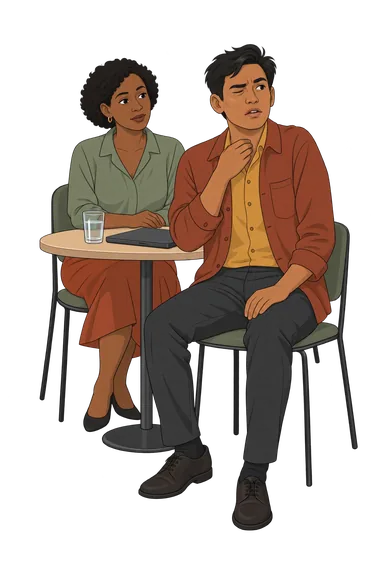
Tic Test for Adults: blinking in a meeting
October 28, 2026October 28, 2026Material has been updatedOctober 28, 2026Material has been published
8,524 views
807 completions
702 likes
Daniel HallPsychologist · Test reviewer
702 likes
Scale Explorer

How the Scales are Structured

Tic levelTl
How often and how strongly tics show up for you, from 0 to 100.
example score56/100
56/100Noticeable ticsexample score
0 – 35Few tics
36 – 65Noticeable tics
66 – 100Frequent tics
Your tic level is 56 out of 100: Noticeable tics.
Motor ticsMt
Blinks, grimaces, jerks and movement sequences.
example score20/32
20/32Moderateexample score
0 – 11Low
12 – 21Moderate
22 – 32High
You scored 20 out of 32: Moderate.
Vocal ticsVt
Throat clearing, sniffing, sounds and repeated words.
example score18/28
18/28Moderateexample score
0 – 9Low
10 – 18Moderate
19 – 28High
You scored 18 out of 28: Moderate.
Urge before a ticUbat
The itch or pressure before a tic and the relief after.
example score13/20
13/20Moderateexample score
0 – 7Low
8 – 13Moderate
14 – 20High
You scored 13 out of 20: Moderate.
Impact on daily lifeIodl
Holding tics back, stress, tiredness and other people noticing.
example score13/20
13/20Moderateexample score
0 – 7Low
8 – 13Moderate
14 – 20High
You scored 13 out of 20: Moderate.
just completed the test
DATA-BASED USER COHORTS

Who Usually Takes This Test?

Something new appeared
36%OF USERS
A blink, sniff or jerk started recently and you want to know what it is.
Living with it for years
34%OF USERS
You have had tics since childhood and want to see where they stand now.
Someone pointed it out
30%OF USERS
A partner, friend or colleague noticed a movement or sound you make.
BASED ON AGGREGATED, ANONYMIZED DATA FROM TENS OF THOUSANDS OF FREUDLY USERS.
Benchmarking

See How You Compare

Once you complete the test, your results are compared with real-world data from people in your country.
Below is a preview of how scores are typically distributed across each scale.
Shaded area — where most people score
Dot — the average
You — your score lands on each curve after the test— your score, after the test
Tic levelTl
You?
Average35
Typical rangeTypical24.2 – 45.8
Possible0 – 100
Motor ticsMt
You?
Average11
Typical rangeTypical7.3 – 14.7
Possible0 – 32
Vocal ticsVt
You?
Average10
Typical rangeTypical6.6 – 13.4
Possible0 – 28
Urge before a ticUbat
You?
Average7
Typical rangeTypical4.6 – 9.4
Possible0 – 20
Impact on daily lifeIodl
You?
Average7
Typical rangeTypical4.6 – 9.4
Possible0 – 20
Featured On
SAMPLE QUESTIONS

Example Questions From the Test

Each statement describes a movement, a sound or a feeling. Think about the last month and choose how often it happened to you, from Never to Very often. Count only what happens without your choosing, not movements you make on purpose. One statement describes a calm moment, so read each line before you answer. Go with your first honest reaction: it is usually the most accurate.
    • Never
    • Rarely
    • Sometimes
    • Often
    • Very often
    • Never
    • Rarely
    • Sometimes
    • Often
    • Very often
    • Never
    • Rarely
    • Sometimes
    • Often
    • Very often
WHAT THE TEST MEASURES

Tic Test for Adults: Do I Have Tics? - Description and methodology of the test

psychopathology

A blink that will not settle, a throat that keeps clearing, a shoulder that jerks in the middle of a call: tics in adulthood are far more common than most people expect. Many people start by searching for a Tourette test for adults, when what they really want is a clear picture of their own movements and sounds. This tic test gives you that picture in a few minutes.

What the test measures

Your headline result is a tic level from 0 to 100, built from four parts. The first covers motor tics: hard blinking, grimaces, jerks of the head, neck or shoulders and longer sequences such as tapping in a set order. The second looks at sounds, from throat clearing and sniffing to grunts, hums and words that slip out. These are vocal tics, and many adults have them for years without naming them. The third part measures what comes before a tic: an itch, pressure or not-quite-right feeling that eases once the movement is done. The fourth shows the impact: the effort of holding tics back, how stress and tiredness turn them up and whether others notice. Researchers such as James Leckman describe tics in the same terms: number, frequency, strength and interference.

How it works and how to read your result

There are 25 short statements about the last month, and most people finish in about five minutes. For each one you choose how often it happened, from Never to Very often. One statement describes a calm moment, so read each line before you answer. The questions about the inner signal reflect the work of Douglas Woods and colleagues, who described how a premonitory urge builds before a tic and how relief follows it. Your result includes:

  • your tic level from 0 to 100, labelled few, noticeable or frequent;
  • the four parts ranked, from the strongest to the quietest;
  • how strong your urge is and what it says about your tics;
  • a comparison with other people who took the test.

Many adults are surprised by which part leads. Some score highest on sounds they had stopped hearing themselves. Others find that the effort of holding tics back costs more than the tics do, and that is often the best place to start.

Literature:
  • Leckman, J. F., Riddle, M. A., Hardin, M. T., Ort, S. I., Swartz, K. L., Stevenson, J., & Cohen, D. J. (1989). The Yale Global Tic Severity Scale: Initial testing of a clinician-rated scale of tic severity. Journal of the American Academy of Child and Adolescent Psychiatry, 28(4), 566-573.
  • Leckman, J. F., Walker, D. E., & Cohen, D. J. (1993). Premonitory urges in Tourette's syndrome. American Journal of Psychiatry, 150(1), 98-102.
  • Woods, D. W., Piacentini, J., Himle, M. B., & Chang, S. (2005). Premonitory Urge for Tics Scale (PUTS): Initial psychometric results and examination of the premonitory urge phenomenon in youths with tic disorders. Journal of Developmental and Behavioral Pediatrics, 26(6), 397-403.

Updated:

Popular tests
Comments
Leave a Comment