
Winter Blues Test: How Much Do the Dark Months Affect You?
How the Scales are Structured
Who Usually Takes This Test?
See How You Compare
Below is a preview of how scores are typically distributed across each scale.
Example Questions From the Test
- Strongly disagree
- Disagree
- Not sure
- Agree
- Strongly agree
- Strongly disagree
- Disagree
- Not sure
- Agree
- Strongly agree
- Strongly disagree
- Disagree
- Not sure
- Agree
- Strongly agree
Winter Blues Test: How Much Do the Dark Months Affect You? - Description and methodology of the test
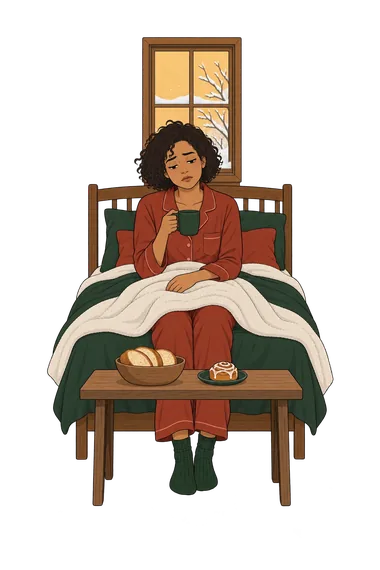
Every autumn some people notice the same slide: heavier mornings, a stronger pull towards bread and the sofa, and less patience for plans. This winter blues test measures how much the dark months change you. For most people the dip stays mild, while for some it deepens into seasonal depression that colours the whole winter. Your answers show where you sit on that range and what the season touches first.
What the test measures
Looking at seasonal change across several areas of life at once goes back to Norman Rosenthal and his colleagues, who first described the winter pattern in 1984. They noticed that the shift rarely stays in mood alone. Your headline result is a seasonality score from 0 to 100, built from four areas. Mood covers the sinking feeling when the days get shorter and the lift when spring arrives. Energy and sleep covers longer nights, harder mornings and the urge to nap. Appetite and weight covers cravings for carbs and sweets, evening snacking and the weight that arrives with the cold. Social life and drive covers staying home, slower replies and plans put on hold. When all four rise together, the picture comes close to what researchers call winter depression rather than a passing low.
How it works and how to read the result
There are 25 short statements, and most people finish in about five minutes. Each one compares the darker months with the brighter ones, and you choose how much you agree, from Strongly disagree to Strongly agree. A few statements describe staying the same all year, which keeps the score honest when you answer quickly. Unlike a quick SAD test that only asks about mood, this one shows how the season spreads into your body, your appetite and your social life. Your result includes:
- your overall score from 0 to 100, labelled steady all year, noticeable winter dip or strong winter dip;
- the area that reacts to the dark months most and the one that holds up best;
- the patterns behind your answers, such as hibernation mode or life on pause;
- a comparison with other people who took the test.
Many people are surprised by where their winter shows up. One person mostly loses energy, another loses control over cravings, a third drops out of their social life. Knowing your mix tells you where to start before the next dark season.
- Rosenthal, N. E., Sack, D. A., Gillin, J. C., Lewy, A. J., Goodwin, F. K., Davenport, Y., Mueller, P. S., Newsome, D. A., & Wehr, T. A. (1984). Seasonal affective disorder: A description of the syndrome and preliminary findings with light therapy. Archives of General Psychiatry, 41(1), 72-80.
- Kasper, S., Wehr, T. A., Bartko, J. J., Gaist, P. A., & Rosenthal, N. E. (1989). Epidemiological findings of seasonal changes in mood and behavior: A telephone survey of Montgomery County, Maryland. Archives of General Psychiatry, 46(9), 823-833.
- Magnusson, A. (2000). An overview of epidemiological studies on seasonal affective disorder. Acta Psychiatrica Scandinavica, 101(3), 176-184.
- Lam, R. W., & Levitan, R. D. (2000). Pathophysiology of seasonal affective disorder: A review. Journal of Psychiatry & Neuroscience, 25(5), 469-480.
Updated: