
Skin Picking Test: Picking, Pulling and Biting Habits
How the Scales are Structured
Who Usually Takes This Test?
See How You Compare
Below is a preview of how scores are typically distributed across each scale.
Example Questions From the Test
- Never
- Rarely
- Sometimes
- Often
- Very often
- Never
- Rarely
- Sometimes
- Often
- Very often
- Never
- Rarely
- Sometimes
- Often
- Very often
Skin Picking Test: Picking, Pulling and Biting Habits - Description and methodology of the test
A spot you cannot leave alone, a hair that has to come out, nails that never grow past the fingertip. This skin picking test looks at all three, because these habits usually travel together. Nail biting is the most common of them, yet most people never count it alongside picking or pulling, and that is exactly where the full picture starts.
What the questionnaire measures
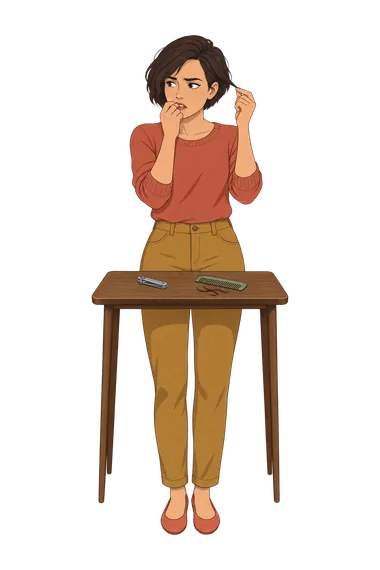
Psychologists group these habits as body-focused repetitive behaviours: repeated actions aimed at your own skin, hair or nails that are hard to stop even when you want to. The 25 questions are split across four parts. Picking covers spots, scabs, cuticles and dry lips. Hair pulling covers the scalp, eyebrows and eyelashes, so the questionnaire also works as a short hair pulling test. Biting covers nails, the inside of the cheeks, lips and fingertips. The fourth part looks at what drives everything: tension that builds before, relief after, boredom and stress as triggers, and episodes that run on autopilot. If you came here looking for a trichotillomania test, pay special attention to the pulling score and to the urge part, since together they show how the habit works for you.
How the test works and how to read the result
For each statement you choose how often it happened in the last month, from Never to Very often. Three statements describe calm hands and are scored in reverse, so rushing through on autopilot does not inflate the result. Every answer adds to one part and to the overall level, which runs from 0 to 100. The result shows:
- your body-focused habits level with a plain label: low, moderate or high.
- the habit that leads for you and the one that stays quietest.
- whether your habits run on focused urges, on autopilot or on both, the split Christopher Flessner and colleagues described for hair pulling.
- how your four parts compare with other people in your country.
Anyone who has looked for a BFRB test knows that most quizzes check one habit at a time. Here you see them side by side, and that often explains why giving up one habit makes another one louder. Retake it after a few weeks to see whether the changes you try actually move the number.
- Flessner, C. A., Woods, D. W., Franklin, M. E., Cashin, S. E., Keuthen, N. J., & Trichotillomania Learning Center-Scientific Advisory Board (2008). The Milwaukee Inventory for Subtypes of Trichotillomania-Adult Version (MIST-A): Development of an instrument for the assessment of "focused" and "automatic" hair pulling. Journal of Psychopathology and Behavioral Assessment, 30(1), 20-30.
- Keuthen, N. J., Wilhelm, S., Deckersbach, T., Engelhard, I. M., Forker, A. E., Baer, L., & Jenike, M. A. (2001). The Skin Picking Scale: Scale construction and psychometric analyses. Journal of Psychosomatic Research, 50(6), 337-341.
- Woods, D. W., & Twohig, M. P. (2008). Trichotillomania: An ACT-enhanced behavior therapy approach. New York: Oxford University Press.
Updated: