
What Irons Should I Buy Quiz
How the Scales are Structured
Who Usually Takes This Test?
See How You Compare
Below is a preview of how scores are typically distributed across each scale.
Example Questions From the Test
- Provide maximum assistance while I build repeatable contact from the ground up.
- Remain forgiving enough for ordinary misses while still feeling suitable as my consistency improves.
- Reward advanced strike control and shot shaping with minimal built-in correction.
- Offer a more compact presentation while helping me generate modern distance.
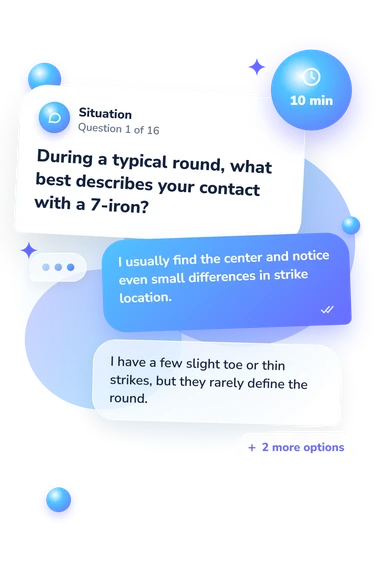
- I usually find the center and notice even small differences in strike location.
- I have a few slight toe or thin strikes, but they rarely define the round.
- My contact moves around the face, and several shots lose noticeable height or distance.
- Center contact is still developing, so I want the clubhead to preserve as much launch and distance as possible.
- A large head with a wide sole and noticeable offset.
- A medium-size head with visible forgiveness and a reassuring topline.
- A compact cavity-back with limited offset and some perimeter support.
- A very compact shape with a thin topline, narrow sole, and minimal visual correction.
What Irons Should I Buy Quiz - Description and methodology of the test
Choosing between forgiving, compact, and speed-oriented irons is easier when your priorities are explicit. For golfers weighing those trade-offs, the What Irons Should I Buy Quiz organizes preferences around contact, launch, appearance, distance, and feedback. For golfers preparing for a fitting or demo, this iron selector quiz turns subjective preferences into a practical starting profile.
What This Assessment Explores
Instead of judging swing quality, the questionnaire maps priorities for mishit protection, launch, speed, feedback, shaping, and control. As a golf club quiz, it helps golfers compare equipment before a fitting or demo.
The four profiles are:
- Game-Improvement Irons - 0-12: this scale measures balanced forgiveness, launch help, moderate size, and playability.
- Players-Distance Irons - 0-12: this scale measures compact looks, ball-speed support, carry, and moderate forgiveness.
- Players Irons - 0-12: this scale measures compact shaping, feedback, distance control, and trajectory control.
- Super Game-Improvement Irons - 0-12: this scale measures a larger head, wide sole, visible offset, and maximum mishit support.
Each profile is shown as Limited affinity (0-4), Mixed affinity (5-8), or Strong affinity (9-12). The highest score is the strongest affinity; scores within one point indicate a blended result.
Methodology and Scientific Basis
Each item presents a situation or design preference with four choices. The options contrast assistance, forgiveness, compact speed, feedback, and workability, so this golf iron quiz captures equipment priorities, not swing mechanics. Responses produce four profile totals: the highest indicates strongest affinity, while totals within one point indicate a blend. This online self-report preference questionnaire uses comparative affinity bands with no stated standardization or norm-based interpretation; ranges are not universal buying cutoffs.
Wallace and colleagues’ studies connect 5-iron mass distribution with launch and clubhead presentation. Nesbit and colleagues address iron-head inertia, while Yang and colleagues examine shaft weight and swing performance. These studies provide equipment context for the questions and are conceptually consistent with this questionnaire, but they do not establish its four scales or scoring; it is neither adapted from nor validated by those studies.
Use the result to choose clubs for side-by-side testing of launch, carry, landing, dispersion, feedback, and turf interaction. Swing delivery, lie, length, shaft weight, comfort, current form, and self-report can shift the match, so fitting evidence and ordinary-miss performance should guide the final decision.
- Wallace, E. S., Corke, T. W., Jones, K. M., Betzler, N. F., and Otto, S. R. (2021). The influence of 5-iron clubhead mass distribution on clubhead presentation and initial ball launch conditions: Part I: Golf robot tests. Proceedings of the Institution of Mechanical Engineers, Part P: Journal of Sports Engineering and Technology, 235(1), 36-45. 10.1177/1754337120969357
- Wallace, E. S., Corke, T. W., Jones, K. M., Betzler, N. F., and Otto, S. R. (2021). The influence of 5-iron clubhead mass distribution on clubhead presentation and initial ball launch conditions - Part II: Player tests. Proceedings of the Institution of Mechanical Engineers, Part P: Journal of Sports Engineering and Technology, 235(1), 46-52. 10.1177/1754337120953309
- Nesbit, S. M., Hartzell, T. A., Nalevanko, J. C., Starr, R. M., White, M. G., Anderson, J. R., and Gerlacki, J. N. (1996). A Discussion of Iron Golf Club Head Inertia Tensors and Their Effects on the Golfer. Journal of Applied Biomechanics, 12(4), 449-469. 10.1123/jab.12.4.449
- Yang, C.-C., Chang, C.-C., Chao, T., Tai, H.-L., and Tsai, Y.-S. (2024). The effects of different iron shaft weights on golf swing performance. Frontiers in Bioengineering and Biotechnology, 12, 1343530. 10.3389/fbioe.2024.1343530