
What Does My Name Mean Quiz
How the Scales are Structured
Who Usually Takes This Test?
See How You Compare
Below is a preview of how scores are typically distributed across each scale.
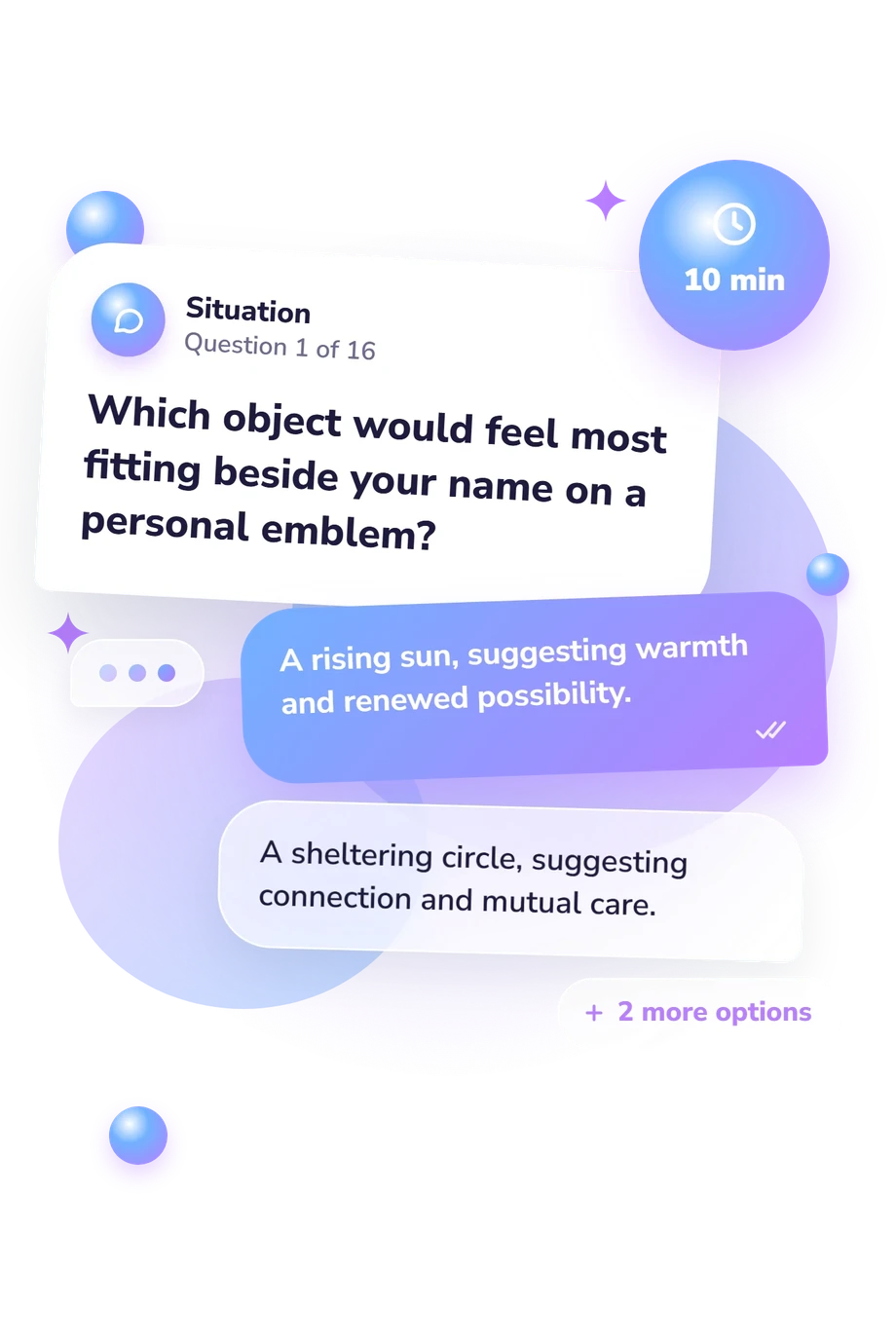
Example Questions From the Test
- A rising sun, suggesting warmth and renewed possibility.
- A sheltering circle, suggesting connection and mutual care.
- An open book with a small lantern, suggesting discovery and perspective.
- A mountain path, suggesting resolve through difficulty.
- They made difficult moments feel brighter.
- They helped people see situations more clearly.
- They stood firm when something truly mattered.
- They helped different people feel understood and included.
- A bold rhythm that keeps moving through tension.
- A bright melody that makes the world feel more open.
- Layered notes that reveal more meaning with attention.
- Blended harmonies that make every part feel welcome.
What Does My Name Mean Quiz - Description and methodology of the test
Readers who want to connect a given name with personal values or an ideal it represents can use the What Does My Name Mean Quiz as a reflective starting point. This name meaning quiz treats symbolism as personal association, not a dictionary exercise. Its result shows how strongly you associate your name with each symbolic theme and which qualities feel most central.
What This Assessment Explores
Questions connect names with resilience, belonging, hope, curiosity, reflection, and care. Scenarios about setbacks, conflict, advice, newcomers, and legacy reveal the symbolic qualities you associate with a name and the ideal it represents. Taking a what is the meaning of my name quiz shows which qualities feel most connected to your name.
The dimensions are:
- Courage & Strength (0-12) shows endurance and conviction: Gentler emphasis (0-4), Steady resolve (5-8), or Courageous presence (9-12).
- Harmony & Care (0-12) shows empathy, cooperation, and belonging: Independent emphasis (0-4), Connecting presence (5-8), or Harmonizing heart (9-12).
- Joy & Light (0-12) shows hope, playfulness, and renewal: Quieter brightness (0-4), Warm spark (5-8), or Radiant spirit (9-12).
- Wisdom & Insight (0-12) shows curiosity, reflection, and judgment: Other themes lead (0-4), Thoughtful undertone (5-8), or Guiding insight (9-12).
The highest score marks the strongest affinity; scores within one point blend the result.
Methodology and Scientific Basis
Each item presents a situation with four choices. Each option represents a symbolic quality, and the selected response reflects the identity you want your name to express. As a quiz about what your name means, it presents choices involving decisions, relationships, disappointment, learning, encouragement, and belonging.
Responses are grouped into the four displayed dimensions and compared. The highest score indicates the strongest affinity, while scores within one point form a blended profile. This comparative symbolic model avoids assigning one fixed meaning to every name.
The closest conceptual source is Mehrabian’s Name Connotation Profile work, which connects first-name impressions with attributed characteristics. Mehrabian’s 2001 study extends that research; this questionnaire is conceptually consistent with both works, not a documented adaptation. Dion adds an identity perspective, while Peterson and Seligman provide a character-strength vocabulary relevant to courage, care, hope, and wisdom.
Because this is an online self-report questionnaire, results can shift with mood, culture, family history, and self-image, which can shape how you interpret the symbolic situations and choose among their responses. Read them as reflective associations and consider the reasons behind your choices.
- Mehrabian, Albert. "Impressions Created by Given Names." Names 45, no. 1 (1997): 19-33. DOI 10.1179/nam.1997.45.1.19
- Mehrabian, Albert. "Characteristics Attributed to Individuals on the Basis of Their First Names." Genetic, Social, and General Psychology Monographs 127, no. 1 (2001): 59-88.
- Dion, Kenneth L. "Names, Identity, and Self." Names 31, no. 4 (1983): 245-257. DOI 10.1179/nam.1983.31.4.245
- Peterson, Christopher, and Martin E. P. Seligman. Character Strengths and Virtues: A Handbook and Classification. New York: Oxford University Press, 2004.
Updated: