
What Career Does God Want for Me Quiz
How the Scales are Structured
Who Usually Takes This Test?
See How You Compare
Below is a preview of how scores are typically distributed across each scale.
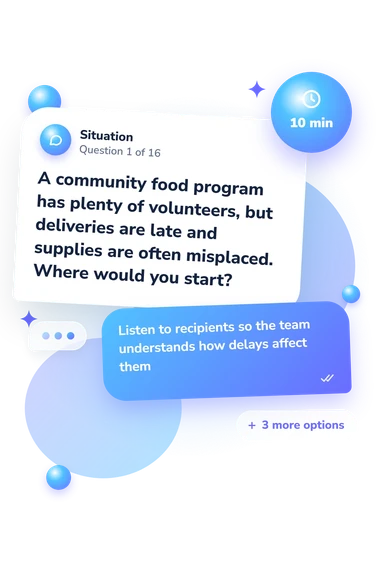
Example Questions From the Test
- Listen to recipients so the team understands how delays affect them
- Map the workflow, identify bottlenecks, and redesign responsibilities
- Create a clearer volunteer guide and teach the new process
- Develop a campaign that attracts attention to the program
- Planning the logistics and budget for a community program
- Mentoring two newcomers as they build knowledge and confidence
- Creating occasional learning materials for someone else to present
- Leading a monthly workshop on a subject that matters to you
- Help the team communicate the vision to its audience
- Track a defined set of tasks assigned by the project lead
- Balance cost, time, people, and quality to create a workable plan
- Coordinate one major workstream and adapt when constraints change
What Career Does God Want for Me Quiz - Description and methodology of the test
For people weighing a change of direction, study choice, ministry role, or service-oriented work, the What Career Does God Want for Me Quiz offers a structured way to reflect on vocational preferences. The profile is intended for readers who want faith and practical strengths considered together. This Christian career quiz turns broad questions about calling into themes for prayer, discussion, and practical exploration.
What This Assessment Explores
The questionnaire compares four contribution styles and shows which activities feel energizing. A lower score appears as Supporting fit, meaning the area may complement another primary direction.
The results are grouped into four dimensions:
- Building & Stewardship (0-12) measures affinity for systems and durable results; Supporting fit 0-4, Possible fit 5-8, Strong affinity 9-12.
- Care & Service (0-12) measures affinity for meeting human needs; Supporting Fit 0-4, Possible Fit 5-8, Strong Affinity 9-12.
- Creative Expression (0-12) measures affinity for imaginative communication; Supporting fit 0-4, Possible fit 5-8, Strong affinity 9-12.
- Teaching & Guidance (0-12) measures affinity for explaining and mentoring; Supporting fit 0-4, Possible fit 5-8, Strong affinity 9-12.
Results from this Christian vocation test can accompany prayer and practical experiments. The result is not divine confirmation; explore it through training and informed counsel. Compare the profile with activities and constraints.
Methodology and Scientific Basis
Each prompt presents a situation involving work, service, learning, creativity, or guidance. Four options represent different contributions; each person chooses the option that best matches their likely response, preference, or inclination. This career discernment quiz uses self-report rather than testing knowledge or competence.
Responses are grouped into four scales within displayed ranges. Higher values indicate stronger alignment with a scale’s activities; the displayed ranges organize the profile. The profile helps compare preferences with concrete roles and workplace demands.
Holland's RIASEC model (Campbell & Holland, 1972) and vocational framework (1997) are related published comparison points, not established foundations for this questionnaire. It is not documented as an adaptation or validated application of either instrument. The calling construct studied by Dik, Eldridge, Steger, and Duffy (2012), including the CVQ and BCS, is another related comparison point, not a documented source of this questionnaire's scoring.
No norms, reliability estimates, or clinical cutoffs are stated. Mood, experience, social expectations, and self-knowledge may influence answers, so compare the profile with activities, training, feedback, and informed counsel. Concrete projects can test whether a theme fits your pace, responsibilities, and boundaries.
- Campbell, David P., and John L. Holland. “A merger in vocational interest research: Applying Holland’s theory to Strong’s data.” Journal of Vocational Behavior, 2(4), 353-376 (1972). 10.1016/0001-8791(72)90012-7
- Holland, John L. Making Vocational Choices: A Theory of Vocational Personalities and Work Environments. 3rd ed. Odessa, FL: Psychological Assessment Resources, 1997.
- Dik, Bryan J., Brandy M. Eldridge, Michael F. Steger, and Ryan D. Duffy. “Development and Validation of the Calling and Vocation Questionnaire (CVQ) and Brief Calling Scale (BCS).” Journal of Career Assessment, 20(3), 242-263 (2012). 10.1177/1069072711434410