
US History Quiz
How the Scales are Structured
Who Usually Takes This Test?
See How You Compare
Below is a preview of how scores are typically distributed across each scale.
Example Questions From the Test
- It shifted most overseas commerce from Atlantic ports to Gulf ports
- It reduced cross-country travel time and helped move settlers and goods westward
- It ended conflicts over Native lands in the West
- It replaced waterways as the only practical routes for transporting bulk goods
- The Open Door Policy
- The Roosevelt Corollary
- The Monroe Doctrine
- The policy of popular sovereignty
- The United States entered World War II
- Germany immediately surrendered to the Allied powers
- The United States joined the League of Nations
- Congress ended the military draft
US History Quiz - Description and methodology of the test
Designed for learners who want a structured check of historical knowledge, this assessment connects individual facts with the wider development of the United States. The US History Quiz shows how confidently you recognize institutions, conflicts, social change, and links between events. For independent study, this American history quiz can point toward topics that deserve closer review without reducing history to a single fact.
What This Assessment Explores
The questionnaire covers colonial and national periods through items on chronology, constitutional principles, federalism, territorial expansion, slavery and emancipation, civil rights, economic policy, war, and influential figures. Several prompts ask respondents to connect a policy with its purpose or identify a consequence rather than recall a name.
By linking events, institutions, and cause-and-effect relationships, this basic U.S. history quiz offers a checkpoint for classroom preparation or independent review. Its result reflects recognition of tested material, not every form of historical interpretation.
The result is organized around one measured dimension:
- US History Knowledge runs from 0 to 16 correct answers. Building Foundations (0-6) indicates that some key material may need review; Developing Knowledge (7-12) reflects a useful grasp with chronology and cause-and-effect links to strengthen; Strong Knowledge (13-16) indicates broad command of the major events, figures, policies, and historical relationships covered.
Methodology and Evidence Base
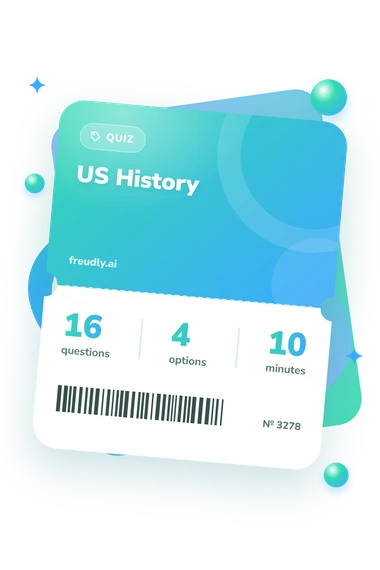
Each item presents a historical question or scenario with four answer choices. The U.S. history quiz questions move from direct recall to contextual judgment about documents, amendments, programs, people, consequences, and constitutional principles. The displayed total is the number of correct answers; no separate norm or weighting is stated.
The answer choices test recognition among plausible alternatives. This US history trivia quiz asks readers to distinguish nearby periods, policies, and interpretations rather than rely only on familiar names.
In content and emphasis, the questionnaire is conceptually consistent with the Test of Understanding of United States History, a framework organized around major periods and civic developments. It is not presented as an adaptation of that work. Smith, Breakstone, and Wineburg (2019) distinguish historical content knowledge from broader historical thinking, while Reich (2013) shows that multiple-choice performance can provide evidence without capturing every form of reasoning.
No population norms or diagnostic cutoffs are attached. Prior study, current recall, test-taking strategy, and plausible distractors can affect performance, so the result is a focused study signal rather than a complete measure of historical understanding.
- Committee on American History in Schools and Colleges. American History in Schools and Colleges: The Report of the Committee on American History in Schools and Colleges of the American Historical Association, the Mississippi Valley Historical Association, and the National Council for the Social Studies. New York: Macmillan, 1944.
- Mark Smith, Joel Breakstone, and Sam Wineburg. History Assessments of Thinking: A Validity Study. Cognition and Instruction, 37(1), 118-144, 2019. 10.1080/07370008.2018.1499646
- Gabriel A. Reich. Imperfect Models, Imperfect Conclusions: An Exploratory Study of Multiple-Choice Tests and Historical Knowledge. Journal of Social Studies Research, 37(1), 3-16, 2013. 10.1016/j.jssr.2012.12.004
Updated: