
Try Penny's Botanical Quiz
How the Scales are Structured
Who Usually Takes This Test?
See How You Compare
Below is a preview of how scores are typically distributed across each scale.
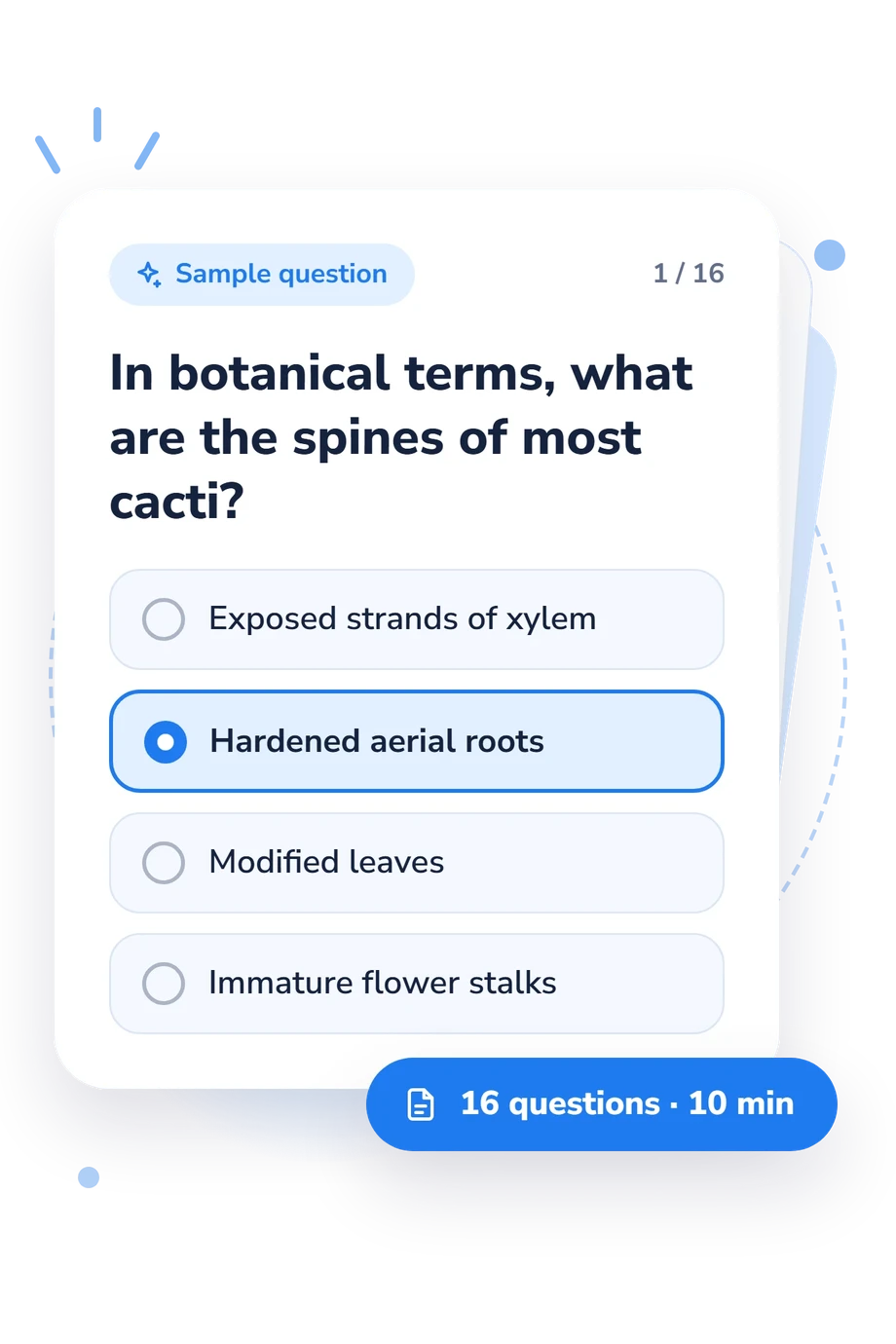
Example Questions From the Test
- Exposed strands of xylem
- Hardened aerial roots
- Modified leaves
- Immature flower stalks
- More pollen can enter the leaf
- Mineral absorption by the roots stops completely
- Water loss through transpiration is reduced
- The leaves absorb more water vapor for photosynthesis
- Cambium
- Phloem
- Xylem
- Epidermis
Try Penny's Botanical Quiz - Description and methodology of the test
For curious learners, gardeners, and students, Try Penny's Botanical Quiz offers a focused way to check how well plant science ideas are understood and applied. It suits anyone who wants to connect terminology with biological processes instead of relying on memorized labels. This plant knowledge quiz can highlight secure foundations, reveal topics that need review, and suggest practical study priorities.
What This Assessment Explores
The questions examine plant anatomy, physiology, reproduction, classification, and practical growing decisions. Scenarios connect roots, leaves, xylem, chloroplasts, water transport, photosynthesis, pollination, germination, light-directed growth, and seasonal development.
Taken together, Penny's botanical quiz works as a learning check, not a personality profile. It shows whether core concepts are secure enough to explain mechanisms and choose sensible responses to common plant-care situations.
The result covers:
- Plant structures and processes show how anatomy, transport, photosynthesis, and growth fit together.
- Reproduction and classification indicate your understanding of pollination, fertilization, plant groups, and life cycles.
- Growing applications show how botanical principles explain drought, transplant stress, drainage, and light problems.
Performance is summarized on Botanical Knowledge: 0-16. Emerging (0-6) reflects recognition of some ideas with core review needs; Developing (7-12) reflects a useful foundation with gaps; Flourishing (13-16) reflects strong, well-rounded application across varied situations.
Methodology and Evidence Base
The items present several answer choices covering structures, mechanisms, reproductive sequences, plant classification, and growing problems. The pennys botanical quiz format tests recognition and application rather than recall alone.
The total score counts correct answers across the set, giving a broad snapshot rather than separate subscores.
A relevant study by Buck et al. (2019) examined botanical knowledge and plant-identification education, including the relationship between identifying plants and understanding taxonomic ideas. This text-based questionnaire is conceptually consistent with that work, but it was not adapted from the study and uses its own questions and scoring bands.
Uno's framework for botanical literacy supports learning that connects plant structures, processes, and applications instead of isolated labels. As a botanical quiz, it works best for identifying topics to revisit and making study progress easier to discuss.
Results can vary with prior coursework, reading familiarity, guessing, and attention to the options, all of which can influence performance on this set. The bands describe performance on this item set rather than general expertise, and reviewing missed concepts makes the result more useful for planning further study.
- Buck T, Bruchmann I, Zumstein P, Drees C. Just a small bunch of flowers: the botanical knowledge of students and the positive effects of courses in plant identification at German universities. PeerJ. 2019;7:e6581. 10.7717/peerj.6581
- Uno GE. Botanical literacy: What and how should students learn about plants? American Journal of Botany. 2009;96(10):1753-1759. 10.3732/ajb.0900025
Updated: