
Spiritual Awakening Quiz
How the Scales are Structured
Who Usually Takes This Test?
See How You Compare
Below is a preview of how scores are typically distributed across each scale.
Example Questions From the Test
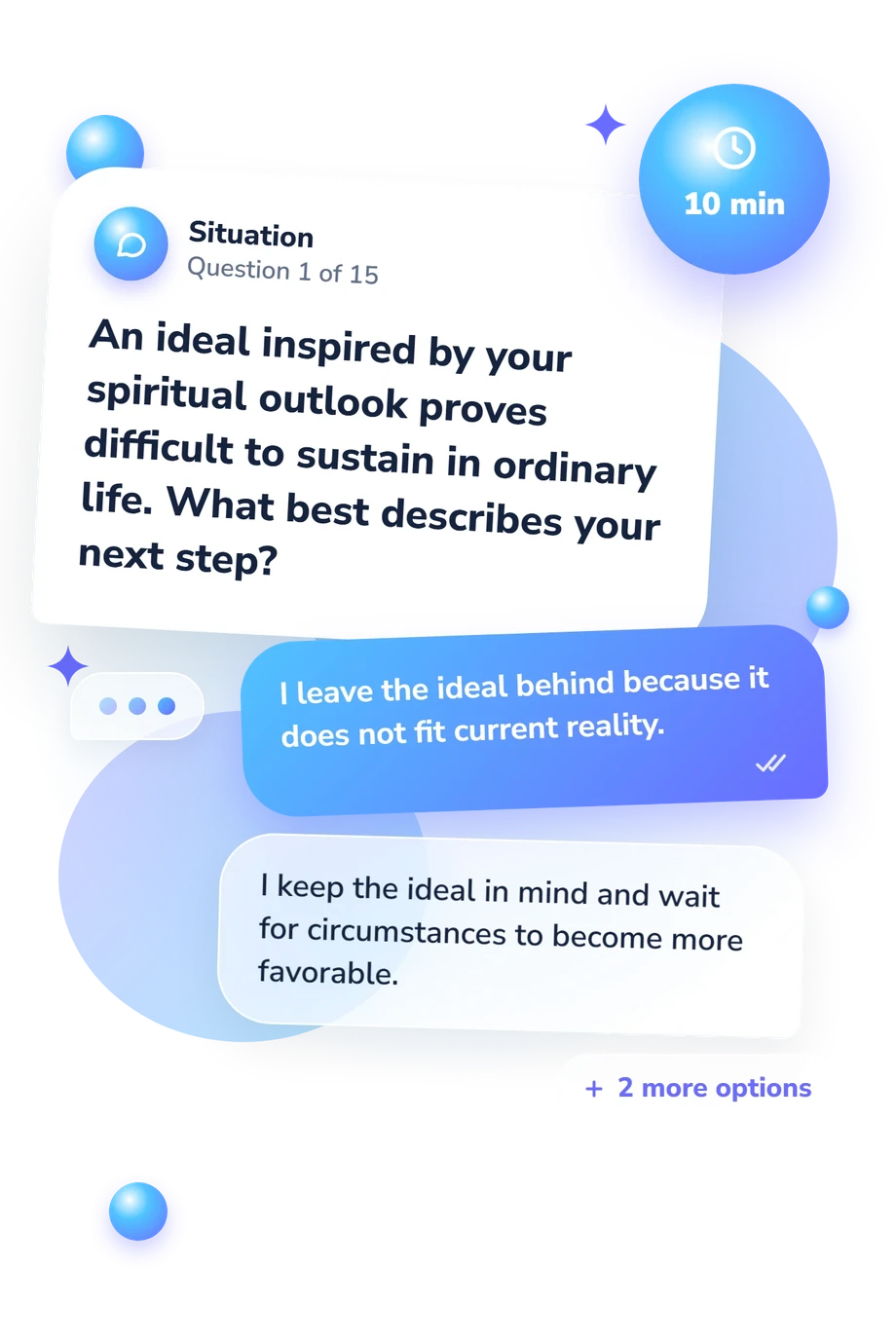
- I leave the ideal behind because it does not fit current reality.
- I keep the ideal in mind and wait for circumstances to become more favorable.
- I reduce the ideal to a more achievable version for now.
- I revise the practice while preserving the underlying value and learning from the mismatch.
- I focus on immediate responsibilities and let purpose questions wait.
- I look for a clear role, goal, or belief that could provide direction.
- I reflect on the activities and relationships that feel most worthwhile.
- I treat uncertainty itself as an invitation to examine and reshape how I want to live.
- The practical benefits, because opportunities may not come again.
- Whether the conflict could be managed without giving up the opportunity.
- A careful comparison of the benefits with the value I might compromise.
- Whether accepting would let me remain aligned with the person I want to be.
Spiritual Awakening Quiz - Description and methodology of the test
People exploring personal change, reflective practice, or a new sense of meaning may use this spiritual awakening quiz to examine how inner experiences influence ordinary choices. It suits readers who want a structured pause around awareness, daily integration, and values rather than a verdict about belief. As a spiritual awakening assessment, it turns broad questions about transformation into a profile that can guide further reflection.
What This Assessment Explores
Questions explore awareness of inner experience, responses to challenged beliefs, and the movement from insight to everyday conduct. They also consider purpose, connection, and examined values. The profile suits readers exploring personal change or spiritual experience without assuming a religion.
The three dimensions show parts of reflective change. A spiritual awakening stages quiz maps how experiences are noticed, integrated, and connected with choices; it does not determine whether a belief or experience is spiritually true.
The displayed dimensions are:
- Inner Awareness (0-15) measures noticing thoughts, feelings, sensations, and recurring patterns: Emerging Noticing (0-5), Growing Awareness (6-10), Sustained Awareness (11-15).
- Integration and Grounding (0-15) measures carrying insight into balanced daily action: Early Integration (0-5), Developing Grounding (6-10), Embodied Integration (11-15).
- Values and Meaning (0-15) measures how purpose and examined values guide choices: Open Exploration (0-5), Active Clarification (6-10), Values-Led Orientation (11-15).
Methodology and Scientific Basis
Each item presents a situation with four response choices. The scenarios ask about purpose, values, relationships, emotional patterns, intuition, evidence, and translating insight into routines. The respondent selects the option that best matches current experience, so the format captures reflective tendencies rather than factual knowledge.
The result groups responses into the three displayed dimensions and assigns each a catalogue-defined band. No universal point contribution for each option is specified, so interpretation should focus on the tendency named by the band, not on a supposed ranking of spiritual attainment.
Conceptually, the content is consistent with the work of Kilrea et al. (2026), which examines ongoing wakefulness through attention, insight, and lived change, but this questionnaire is not an adaptation of that instrument. It also sits alongside Kontrimienė’s Humanistic Spirituality Inventory and Corneille and Luke’s 2021 review of varied awakening experiences.
As a spiritual awakening test, this online profile is unstandardized, and scores may shift with mood, context, expectations, and candor; use them to examine concrete examples and practical consequences rather than treating them as a fixed identity or proof about spiritual beliefs.
- Kilrea, Kelly A., Steve Taylor, Cynthia Bilodeau, Marc Wittmann, Damisela Linares Gutiérrez, and Sebastian L. Kübel. (2026). Measuring an Ongoing State of Wakefulness: The Development and Validation of the Inventory of Secular/Spiritual Wakefulness (WAKE). Journal of Humanistic Psychology, 66(5), 1250-1281. 10.1177/00221678231185891
- Kontrimienė, Simona. (2024). Assessing Spirituality as the Ultimate End: Development and Validation of the Humanistic Spirituality Inventory. Journal of Humanistic Psychology, 64(5), 916-939. 10.1177/0022167819850678
- Corneille, Jessica Sophie, and David Luke. (2021). Spontaneous Spiritual Awakenings: Phenomenology, Altered States, Individual Differences, and Well-Being. Frontiers in Psychology, 12, Article 720579. 10.3389/fpsyg.2021.720579
Updated: