
Spanish Numbers Quiz
How the Scales are Structured
Who Usually Takes This Test?
See How You Compare
Below is a preview of how scores are typically distributed across each scale.
Example Questions From the Test
- cien uno
- ciento uno
- ciento y uno
- cien y uno
- dieciocho
- catorce
- dieciséis
- veinte
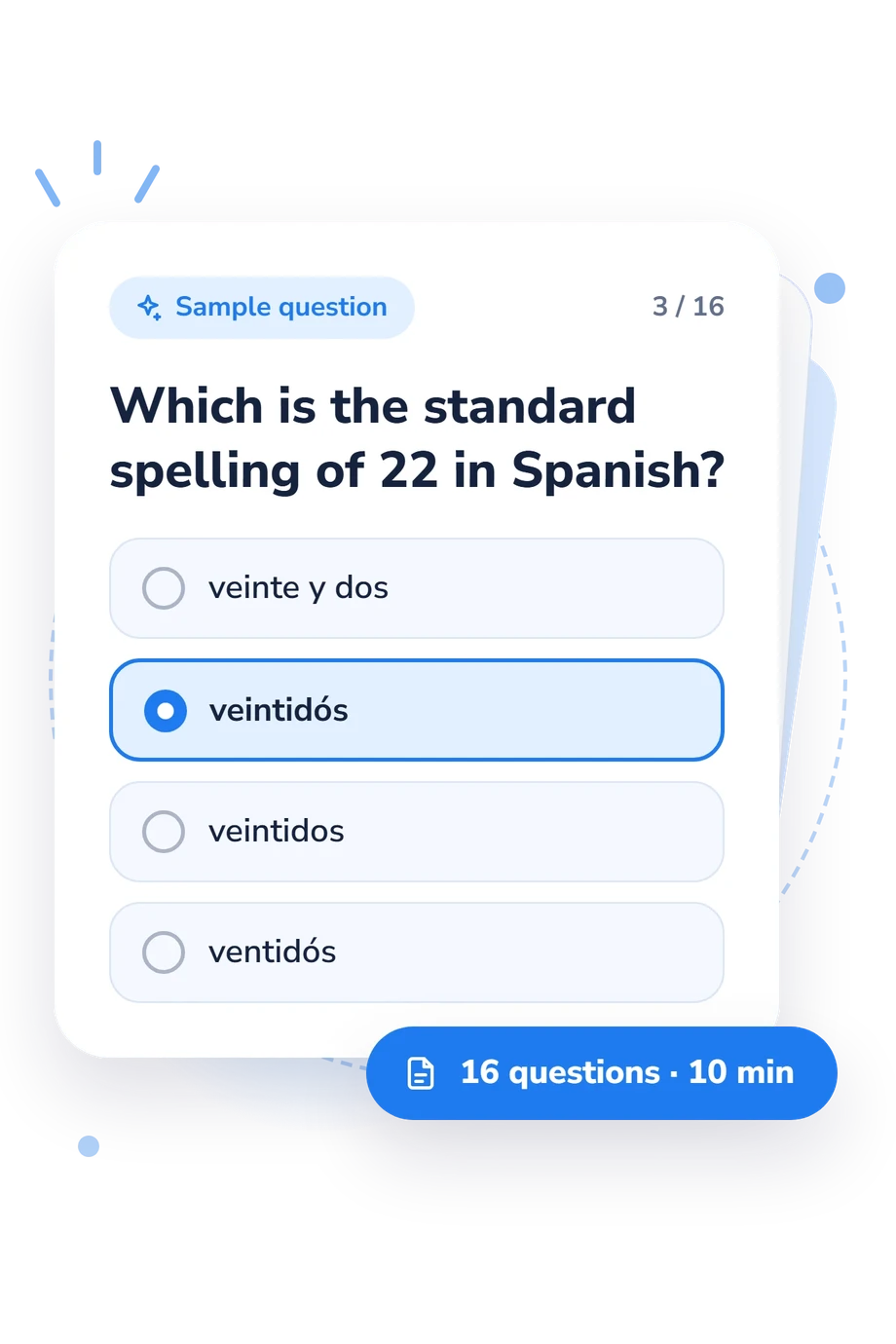
- veinte y dos
- veintidós
- veintidos
- ventidós
Spanish Numbers Quiz - Description and methodology of the test
People who want a practical check of how confidently they read and form Spanish numerals can use the Spanish Numbers Quiz as a focused learning checkpoint. This quiz on numbers in Spanish checks how learners recognize and use written forms, while the result shows which patterns are secure. It suits independent learners, classroom students, and travellers seeking a clear snapshot of their current command.
What This Assessment Explores
Items cover quantities, prices, rooms, digit sequences, and values from units to millions. Spelling and noun agreement make the result about contextual recognition rather than translation.
Question themes include:
- Basic quantities show whether common amounts match the correct Spanish word.
- Spelling and irregular forms show whether forms such as veintidós and quinientos are recognized.
- Sequences and larger values show whether codes, hundreds, thousands, and millions are read accurately.
- Agreement shows whether number phrases fit nouns, including veintiuna casas and treinta y un libros.
These are not separate scores; together, they show where recognition is secure. The quiz supports practice with Spanish numbers and helps learners turn the result into review priorities. The displayed scale, Spanish Numbers Knowledge (0-16), summarizes recognition and use of Spanish numbers in practical situations: Building the basics (0-6), Developing knowledge (7-12), and Strong knowledge (13-16).
Methodology and Evidence Base
Each item presents a short prompt or practical situation followed by four answer choices. The respondent selects the form that best fits a quantity, spelling rule, digit sequence, or noun context, so the format checks recognition and application through multiple choice rather than extended production.
The scoring display summarizes performance descriptively, and the questionnaire does not state a weighting formula or point-allocation rule.
Butt, Benjamin, and Moreira Rodríguez (2019) provide linguistic reference material on cardinal forms, compounds, larger numbers, spelling, and agreement. Bradley and Mackenzie (2004) provide complementary guidance on standard usage. These works support terminology and forms, not the validation or standardization of this questionnaire, which is conceptually consistent with them rather than an adaptation of either book.
This Spanish numerals test examines recognition and offers a compact snapshot for planning revision. Scores can still be affected by guessing, previous exposure, attention, and the difference between recognizing an option and producing a number independently. Broader language performance should be considered when a fuller proficiency picture is needed.
- Butt, John, Carmen Benjamin, and Antonia Moreira Rodríguez. “Numerals.” In A New Reference Grammar of Modern Spanish, 6th ed., Routledge, 2019. 10.4324/9781315648446-11
- Bradley, Peter T., and Ian Mackenzie. Spanish: An Essential Grammar, 1st ed., Routledge, 2004. 10.4324/9780203497296
Updated: