
Series 7 Practice Quiz
How the Scales are Structured
Who Usually Takes This Test?
See How You Compare
Below is a preview of how scores are typically distributed across each scale.
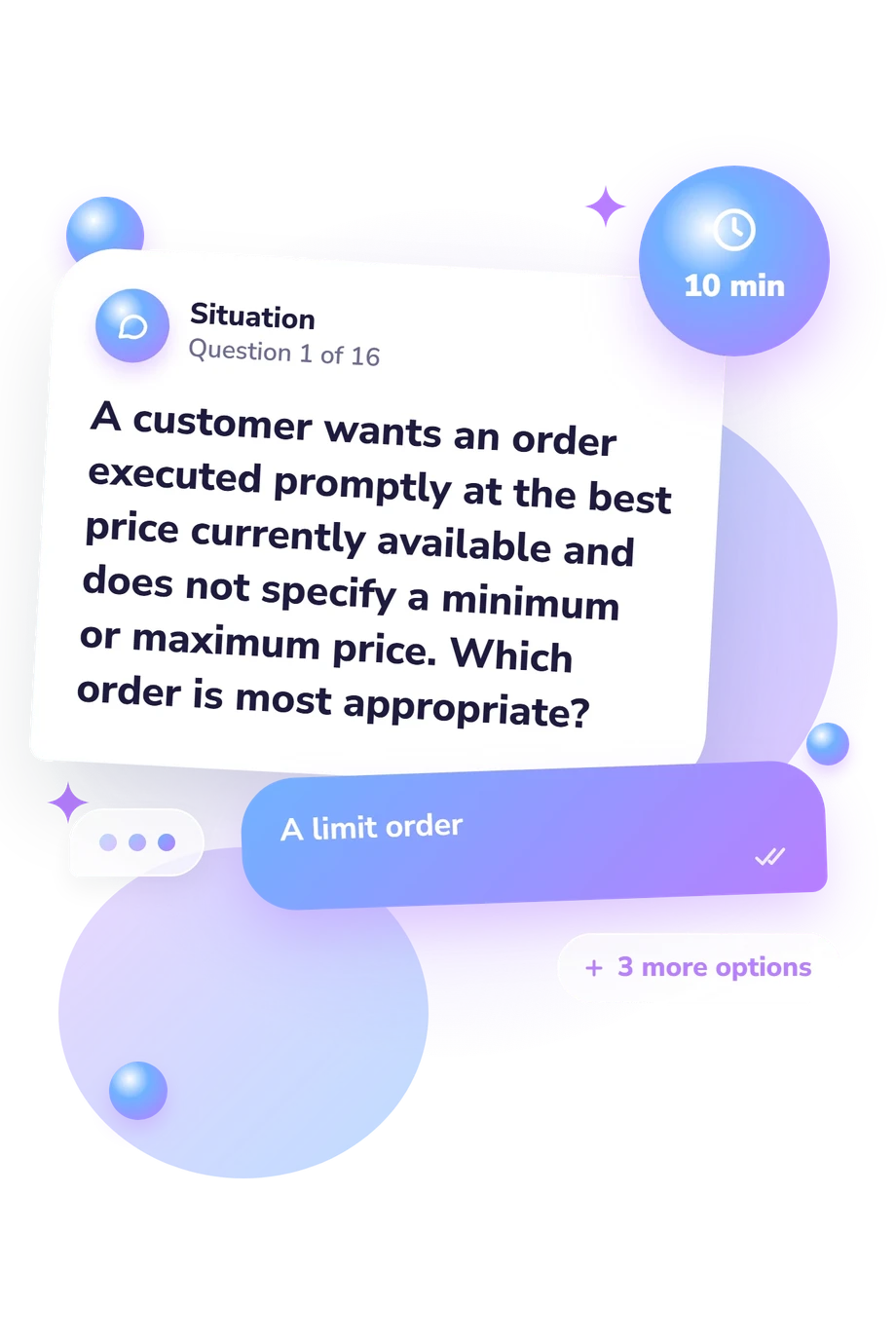
Example Questions From the Test
- The primary market
- The secondary market
- The over-the-counter secondary market
- The exchange auction market
- Assets minus liabilities, divided by shares outstanding
- Offering price minus the fund's operating expenses
- Total portfolio purchases divided by shares redeemed
- Annual distributions divided by the number of shareholders
- Market price divided by annual interest
- Annual interest divided by par value
- Annual interest divided by current market price
- Capital gain divided by years to maturity
Series 7 Practice Quiz - Description and methodology of the test
For learners preparing for general securities representative responsibilities, this series 7 practice quiz checks both knowledge and application of sampled Series 7 concepts through questions resembling common licensing tasks. The series 7 quiz presents applied items that ask candidates to select the best response in realistic representative situations. Its compact format connects core information with the decisions and calculations used in licensing study.
What This Assessment Explores
Questions sample knowledge and application across orders, funds, bonds, options, annuities, risk, and conduct. Formula and scenario items ask learners to recognize rules and choose responses. This suits learners seeking Series 7 practice questions for representative tasks.
The main thematic groups are:
- Order handling and products link instructions with valuation and ownership.
- Options and market risk show how strategies address exposure.
- Conduct scenarios test responses to customer interests and misleading communications.
Results use Series 7 Knowledge (0-16): Foundation to build (0-6) calls for review of terminology, product features, order mechanics, and risk concepts; Developing knowledge (7-12) indicates many principles are understood while some need targeted review; Strong practice performance (13-16) shows consistent application of sampled concepts and supports broader preparation. The score is educational, not an official FINRA result or a guarantee of exam readiness.
Methodology and Evidence Base
Each item presents a securities scenario with four answer choices and asks for the single best response, making these Series 7 exam practice questions a check of recognition and application. Prompts may require a definition, formula, or match between a customer objective and an appropriate action. The total is reported on the questionnaire’s stated scale.
Its coverage is conceptually consistent with the FINRA Series 7 Content Outline, which includes products, accounts, trading, recommendations, risks, and conduct. It is not an adaptation of the official exam. A Securities and Exchange Commission rule-change notice and a study-oriented treatment by Knopman Marks and colleagues provide related regulatory and domain context, not validation of this questionnaire.
The questionnaire reports the displayed total and specifies no additional weighting or conversion. Because 16 items sample selected blueprint areas, performance should not be generalized to untested content and may reflect guessing or current study context. Use the result to set review priorities across the broader blueprint.
- Financial Industry Regulatory Authority (FINRA). General Securities Representative Qualification Examination (Series 7): Content Outline. 2025.
- U.S. Securities and Exchange Commission. Notice of Filing and Immediate Effectiveness of a Proposed Rule Change to Revise the General Securities Representative (Series 7) Examination. Release No. 34-82747, February 21, 2018; 83 FR 8524.
- Knopman Marks Financial Training, Howard Kaplan, Marcia Larson, Brian Marks, David Meshkov, and Ian Franklin. Series 7 General Securities Representative Top-Off Exam. 1st ed., Kaplan Financial Education, 2019. ISBN 978-1-4754-9312-2.
- Egan, Mark, Gregor Matvos, and Amit Seru. The Market for Financial Adviser Misconduct. Journal of Political Economy 127, no. 1 (2019): 233-295. 10.1086/700735
Updated: