
Respiratory System Quiz
How the Scales are Structured
Who Usually Takes This Test?
See How You Compare
Below is a preview of how scores are typically distributed across each scale.
Example Questions From the Test
- Thin layers surrounding the lungs and lining the chest cavity
- Muscles between the ribs that change chest volume
- Mucus-lined folds that produce sound in the larynx
- Cartilage rings that hold the trachea open
- Bronchi
- Alveoli
- Pleurae
- Sinuses
- Medulla oblongata
- Thalamus
- Cerebellum
- Corpus callosum
Respiratory System Quiz - Description and methodology of the test
Designed for students, educators, and curious learners, this assessment connects respiratory structures with the processes that keep ventilation and gas exchange working. Taking the respiratory system quiz can show which concepts you demonstrate and which deserve review. This assessment functions as a respiratory anatomy quiz when you apply core knowledge to familiar physiological situations rather than recall isolated labels.
What This Assessment Explores
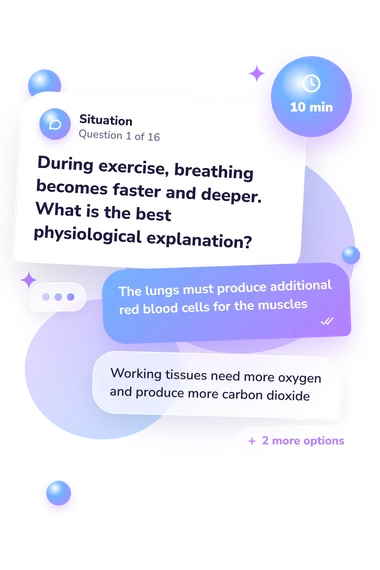
Questions connect anatomy with function through airflow, filtering, pressure, and gas diffusion. Exercise, asthma, cilia damage, and alveolar injury test application.
The result reflects four themes:
- Airway organization shows whether you can trace air to alveoli.
- Protective clearance shows how mucus and cilia remove particles; the epiglottis protects airways, while cartilage and pleurae support structure.
- Breathing mechanics reveals how diaphragm movement and resistance affect ventilation.
- Gas exchange and regulation show how diffusion, capillaries, brainstem control, and lung structure interact.
The respiratory quiz indicates whether knowledge is structural, functional, or integrated. Respiratory System Knowledge (0-16) has three bands: Building Foundations (0-6) calls for review of structures, airflow, mechanics, and gas exchange; Developing Knowledge (7-12) reflects core understanding with gaps in how structures work together; Strong Knowledge (13-16) reflects well-developed knowledge applied to common scenarios.
Methodology and Evidence Base
Each item offers four choices and asks for identification, sequencing, or the best explanation of a physiological situation. Visual reading is included through a respiratory system diagram quiz item that asks the reader to identify or interpret a structure, so the assessment also tests visual anatomical reading. The format favors reasoning over isolated vocabulary.
The result supports review of respiratory knowledge by highlighting the concepts represented by the questions.
The questionnaire is conceptually consistent with the anatomy and physiology framework in Betts and colleagues' OpenStax textbook, including its treatment of airways, pleurae, ventilation, diffusion, and breathing regulation; it is not an adaptation of that textbook. Its content-focused format is comparable to the HAPS Testing Task Force's multiple-choice assessment framework, but neither source validates this questionnaire.
Score interpretation follows the measurement principle described by the AERA, APA, and NCME Standards: meaning depends on intended use and supporting evidence. Stanger-Hall's work on multiple-choice testing also notes that this format may underrepresent higher-level thinking. Prior study, attention, wording, and test-taking strategy can affect performance, while the displayed educational score has no stated standardization or clinical cutoff.
- Betts, J. Gordon, Kelly A. Young, James A. Wise, Eddie Johnson, Brandon Poe, Dean H. Kruse, Oksana Korol, Jody E. Johnson, Mark Womble, and Peter DeSaix. Anatomy and Physiology 2e. Houston, Texas: OpenStax, 2022.
- Witt, Elizabeth, and HAPS Testing Task Force. Psychometric Evaluation of the HAPS Anatomy & Physiology Comprehensive Exam. White paper, Human Anatomy & Physiology Society, January 2017.
- American Educational Research Association, American Psychological Association, and National Council on Measurement in Education. Standards for Educational and Psychological Testing. Washington, DC: American Educational Research Association, 2014.
- Stanger-Hall, Katharine F. "Multiple-Choice Exams: An Obstacle for Higher-Level Thinking in Introductory Science Classes." CBE-Life Sciences Education, 11(3), 294-306, 2012. 10.1187/cbe.11-11-0100