
Quiz Facts Answers
How the Scales are Structured
Who Usually Takes This Test?
See How You Compare
Below is a preview of how scores are typically distributed across each scale.
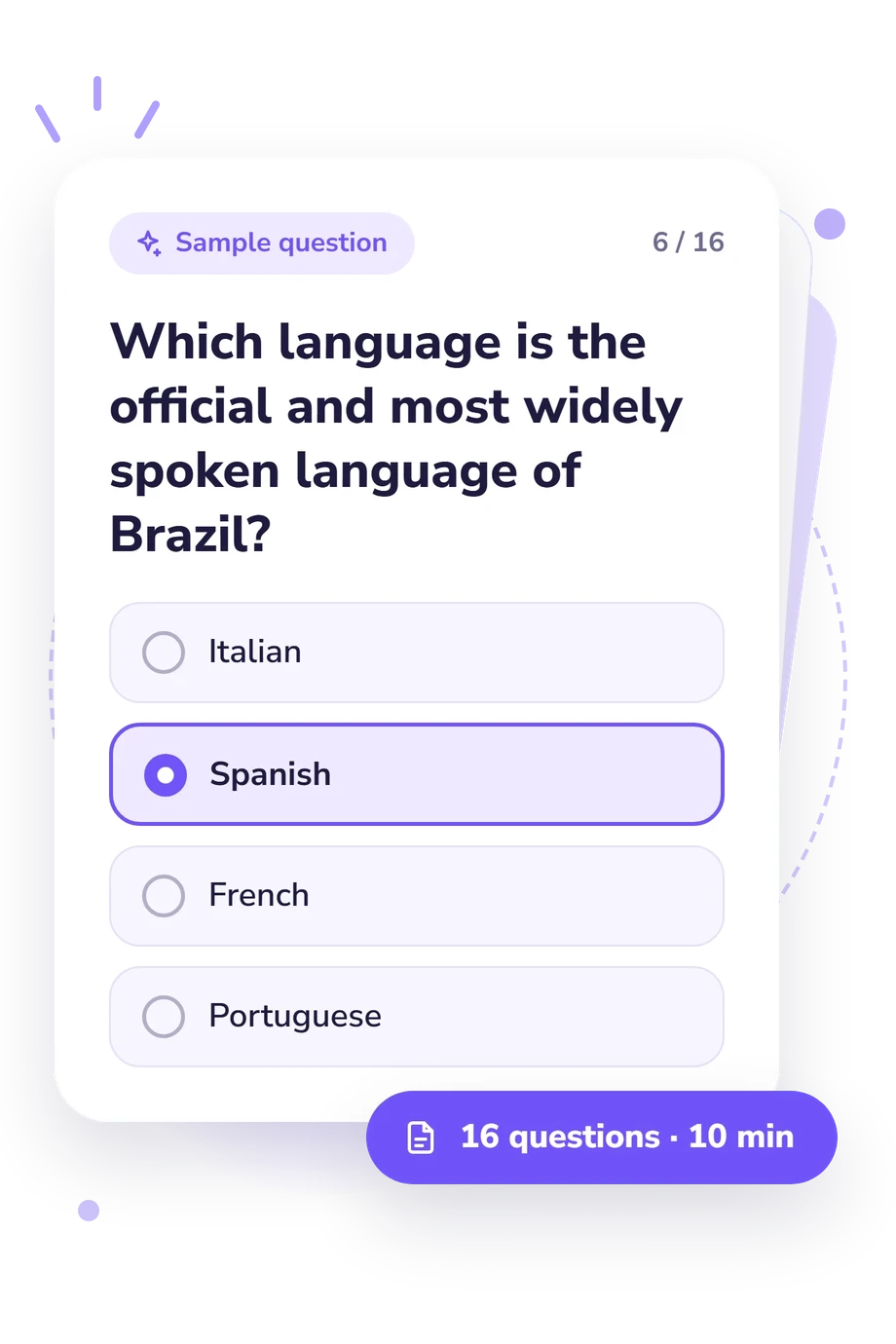
Example Questions From the Test
- The dog wagged it’s tail.
- Its going to rain this afternoon.
- It’s clear that the machine has lost its power.
- The team celebrated it’s victory.
- Precipitation
- Evaporation
- Infiltration
- Condensation
- Italian
- Spanish
- French
- Portuguese
Quiz Facts Answers - Description and methodology of the test
Students, lifelong learners, and curious adults can use Quiz Facts Answers to check how readily they retrieve familiar information across school and everyday domains. As a general knowledge quiz, it offers a broad snapshot rather than a narrow subject score. Its total summarizes performance across the sampled topics rather than identifying subject-specific strengths or gaps. If individual questions are available, reviewing them may guide topic revision.
What This Assessment Explores
Questions sample recognition and application across science, geography, language, mathematics, literature, and everyday facts. Some require recall; others ask for a brief inference, such as predicting a food-web change, applying geometry, or identifying a process from a description. The result reflects usable breadth rather than specialist mastery.
Because it reports one total, the result summarizes performance across sampled topics rather than separate subject scores. If individual questions are available, reviewing them may guide topic revision.
The displayed scale groups that overall performance into three bands:
- Foundation Builder (0-6) indicates that some useful facts are recognized, while core areas remain open for review.
- Developing Generalist (7-12) indicates a solid base across subjects, with room to broaden consistency.
- Strong Facts Range (13-16) indicates accurate, wide-ranging knowledge applied across topics.
As a facts quiz, its labels describe performance on these items, not fixed intellectual potential.
Methodology and Scientific Basis
Each item uses four-option multiple choice. The set combines direct recognition with brief application of a rule or concept, so a response may require recall or contextual use. The questionnaire displays a total on this scale and assigns it to the displayed result bands; these categories describe performance on this question set rather than universal cutoffs.
BEFKI GC-K provides a relevant conceptual comparison: it measures crystallized intelligence, meaning knowledge acquired through education and experience. This questionnaire is conceptually consistent with that construct, but should not be treated as the published instrument. Cattell’s distinction between fluid and crystallized intelligence explains the emphasis on learned information, while Steger, Schroeders, and Wilhelm support viewing crystallized knowledge as multidimensional.
The multiple-choice format can support factual review and retrieval practice: answering varied questions encourages active recall across several domains. Interpretation is limited to the displayed descriptive bands and performance on this question set. Education, language, cultural familiarity, attention, and guessing can affect outcomes, while reviewing missed items when identifiable can add learning value.
- Schipolowski, S., Wilhelm, O., Schroeders, U., Kovaleva, A., Kemper, C. J., & Rammstedt, B. (2013). BEFKI GC-K: A Short Scale for the Measurement of Crystallized Intelligence. Methods, Data, Analyses, 7(2), 153-181. 10.12758/mda.2013.010
- Steger, D., Schroeders, U., & Wilhelm, O. (2019). On the dimensionality of crystallized intelligence: A smartphone-based assessment. Intelligence, 72, 76-85. 10.1016/j.intell.2018.12.002
- Cattell, R. B. (1963). Theory of fluid and crystallized intelligence: A critical experiment. Journal of Educational Psychology, 54(1), 1-22. 10.1037/h0046743
Updated: