
Men Quiz
How the Scales are Structured
Who Usually Takes This Test?
See How You Compare
Below is a preview of how scores are typically distributed across each scale.
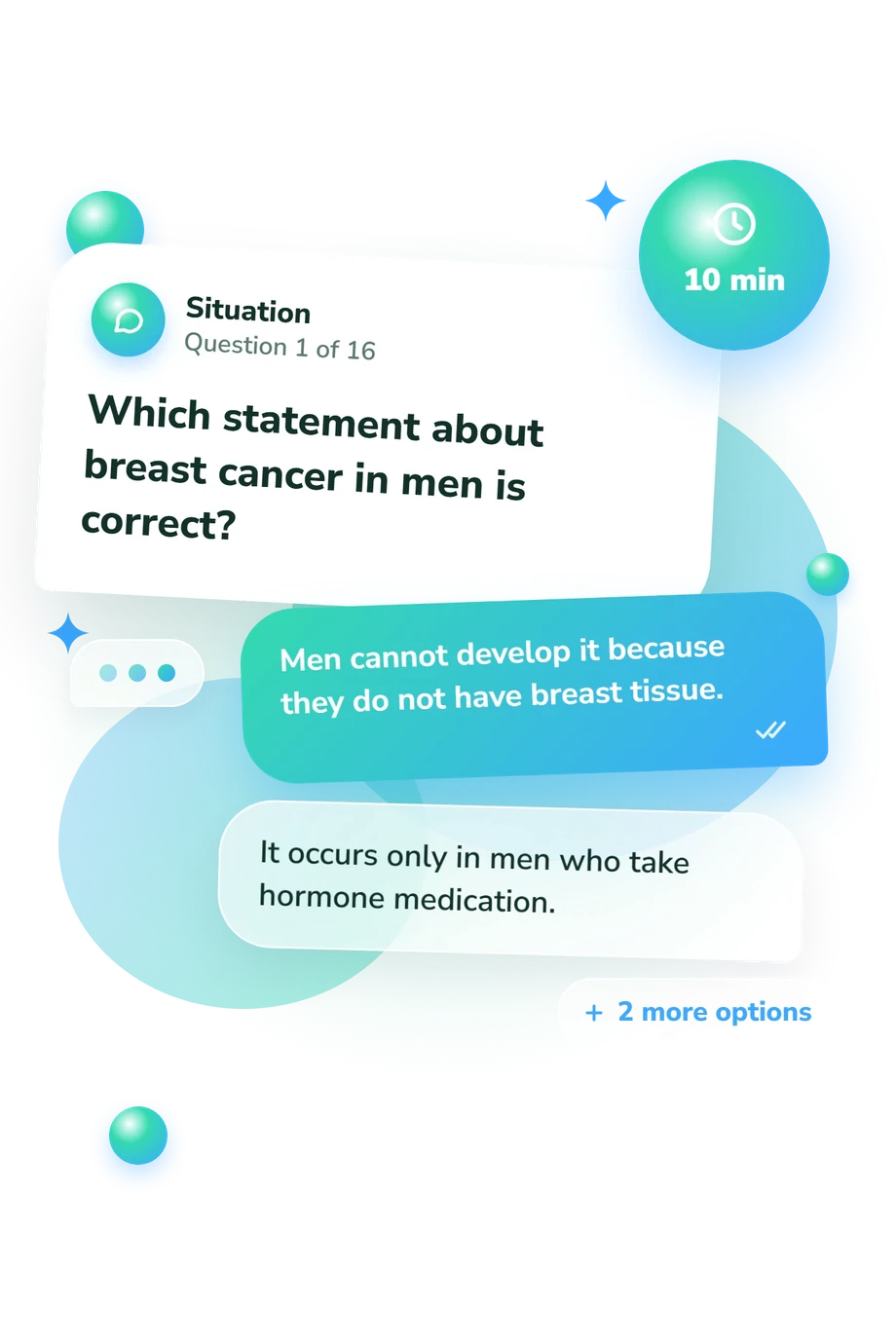
Example Questions From the Test
- Drive him to a clinic without contacting emergency services.
- Call emergency services and follow their instructions.
- Wait to see whether the symptoms resolve after sleep.
- Arrange a routine medical appointment if the symptoms return.
- It contributes fluid that forms part of semen.
- It produces sperm cells.
- It stores urine until urination.
- It filters waste products from the blood.
- Book a routine appointment for the following week.
- Rest overnight and seek care only if swelling appears.
- Seek emergency medical care immediately.
- Try gentle stretching before deciding whether care is needed.
Men Quiz - Description and methodology of the test
People who want to strengthen their understanding of men's health can use the Men Quiz as a focused educational check of everyday knowledge. This quiz about men's health suits readers exploring prevention, sexual and reproductive health, urgent symptoms, emotional wellbeing, and help-seeking. Its overall result shows breadth of awareness across the tested content, rather than topic-level scores or a personal health assessment.
What This Assessment Explores
The questions examine men's health and wellbeing knowledge rather than masculinity. They cover warning signs, prevention, anatomy, sexual health, fertility, sleep, bone health, emotional wellbeing, and help-seeking. The result reflects knowledge of these topics, not personal risk. It emphasizes breadth across everyday decisions.
The tested content brings together these practical topic groups:
- Prevention and screening show how personal factors shape care.
- Symptoms and emergencies test recognition of situations needing prompt attention.
- Sexual and reproductive health covers contraception, infections, fertility, hormones, and erectile difficulties.
- Mental wellbeing and wider health include support-seeking, osteoporosis, sleep apnea, and individual differences.
Men's Health and Wellbeing Knowledge (0-16) uses Foundation to build (0-6), Developing awareness (7-12), and Strong awareness (13-16). A men's health quiz can indicate the overall level of awareness across these subjects.
Methodology and Evidence Base
Each item presents a factual or situational prompt with four answer choices; one response is best supported. Scenarios apply knowledge to chest pressure, suicidal thoughts, sudden testicular pain, and sleep apnea; other items address prevention, anatomy, and risk factors. Responses combine into a displayed total reflecting knowledge across tested content rather than symptoms.
Educational items ask readers to recognize useful information, understand its meaning, and identify an appropriate next step. This permits comparison with health-literacy research, but the questionnaire does not measure a validated instrument's domains.
Mursa and colleagues used the 44-item Health Literacy Questionnaire (HLQ) to examine health literacy among men. This questionnaire is conceptually consistent with that work, but it is not the HLQ or an adaptation. Osborne and colleagues describe the HLQ as multidimensional; Milner and colleagues link health literacy with help-seeking. These studies provide context, not validation.
This online health quiz for men has an educational, unvalidated score with awareness bands. Results may reflect education, attention, wording, and guessing, and cannot rule out a health concern. Use them to guide further learning or professional discussion.
- Mursa, Ruth, Christopher Patterson, Gemma McErlean, and Elizabeth Halcomb. Understanding health literacy in men: a cross-sectional survey. BMC Public Health 24, 1804 (2024). 10.1186/s12889-024-19223-0
- Osborne, Richard H., Roy W. Batterham, Gerald R. Elsworth, Melanie Hawkins, and Rachelle Buchbinder. The grounded psychometric development and initial validation of the Health Literacy Questionnaire (HLQ). BMC Public Health 13, 658 (2013). 10.1186/1471-2458-13-658
- Milner, Allison, Marissa Shields, and Tania King. The Influence of Masculine Norms and Mental Health on Health Literacy Among Men: Evidence From the Ten to Men Study. American Journal of Men's Health 13(5), 1-9 (2019). 10.1177/1557988319873532
Updated: