
Rainbow Quiz
How the Scales are Structured
Who Usually Takes This Test?
See How You Compare
Below is a preview of how scores are typically distributed across each scale.
Example Questions From the Test
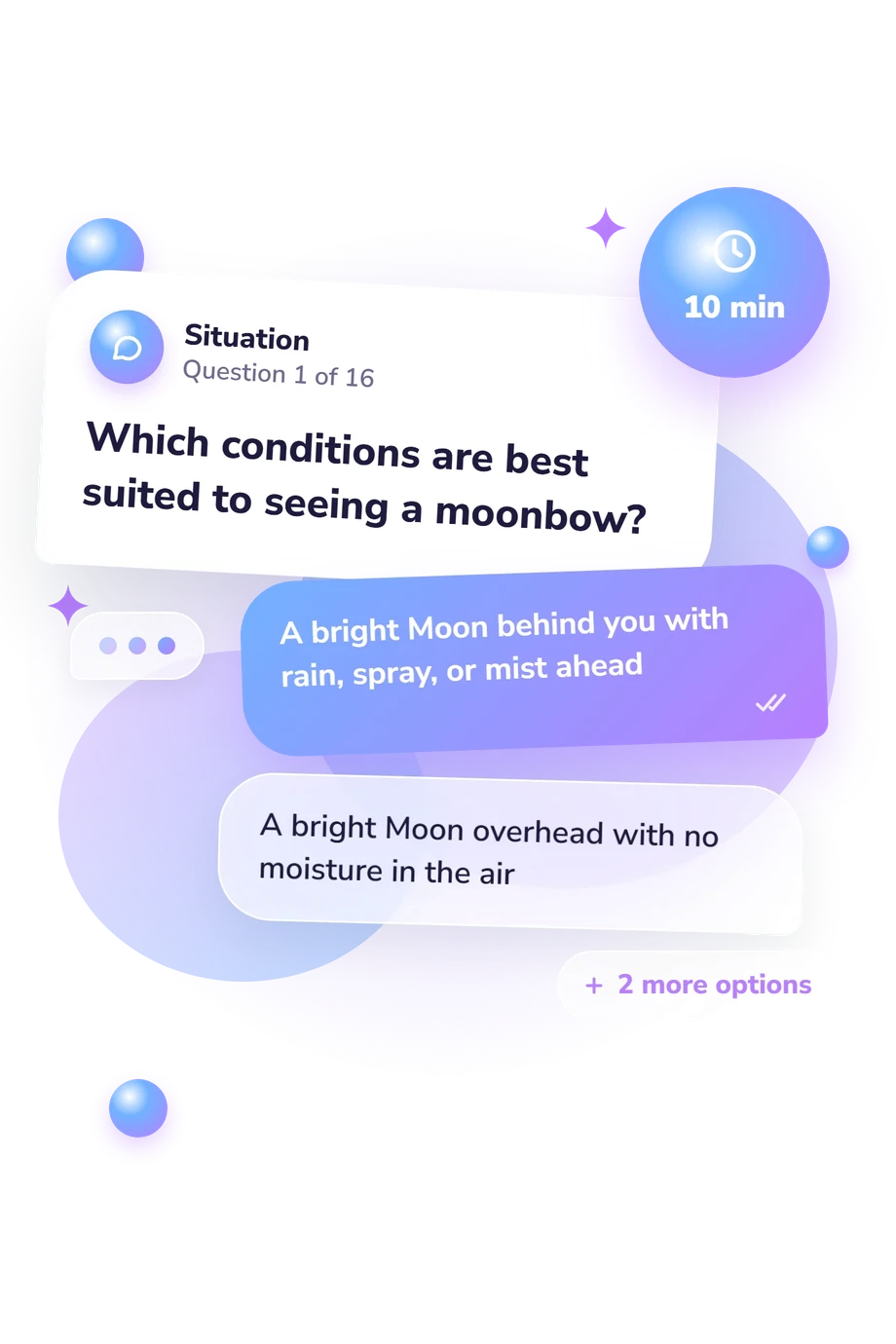
- A bright Moon behind you with rain, spray, or mist ahead
- A bright Moon overhead with no moisture in the air
- A bright Moon ahead of you and mist directly behind you
- A new Moon ahead of you with clear, dry air behind it
- Violet toward red
- Red toward violet
- Green toward red, then blue
- Blue toward yellow, then violet
- Look toward the Sun with the spray behind you
- Stand directly under the spray while looking upward
- Place the spray in your shadow and face sideways from the Sun
- Keep the Sun behind you and view the spray ahead
Rainbow Quiz - Description and methodology of the test
People who want to check how well they understand atmospheric optics can use the rainbow quiz as a focused knowledge exercise. It suits curious learners, students, and anyone who enjoys explaining familiar sky phenomena. The result shows how well you connect color order, viewing geometry, refraction, reflection, polarization, and wave effects. The questions ask readers to apply optical principles to rainbow viewing conditions, arcs, and colors.
What This Assessment Explores
Viewed as a rainbow optics test, the questionnaire asks about moonbows, spray bows, the Sun’s position, and why a rainbow has an apparent rather than fixed location. It also checks primary and secondary bows, their color order and brightness, and the darker region between them.
The result uses one scale, Rainbow Knowledge, from 0-16. Its bands are Foundation to build (0-6), Developing knowledge (7-12), and Strong knowledge (13-16). The score reflects application of core ideas rather than one isolated fact.
The questions cover these themes behind the single displayed result:
- Light paths and color: it reflects refraction, dispersion, reflection, and wavelength-dependent bending.
- Rainbow geometry: it shows how viewing angle, horizon, and observer position shape the arc.
- Atmospheric variations: it covers moonbows, secondary bows, and supernumerary bands.
- Optical observation: it concerns polarization, brightness, interference, and suitably placed droplets.
Methodology and Scientific Basis
Each item uses four answer options and asks the respondent to select the explanation that best fits the described observation. The questions move between practical viewing situations and underlying optics, so performance depends on applying principles rather than recognizing vocabulary alone. The questionnaire reports one displayed result, and no separate subscale scores are shown.
Its scientific frame is conceptual. Lee and Fraser (2001) discuss rainbow formation and observation, while Newton (1704) provides the classical account of refraction, reflection, and color. The questionnaire is also consistent with Fraser (1983) on supernumerary bows and Barta et al. (2003) on rainbow polarization; it is not an adaptation of those publications.
Taken as a rainbow science quiz, it works best when each answer is linked to the physical reason behind it. This educational self-check has no stated population norms or reliability data; guessing, prior study, attention, and current confidence can affect the result. A strong band indicates effective performance on these concepts; a lower band suggests reviewing the underlying rainbow-optics concepts, without defining a fixed limit on learning.
- Lee, Raymond L., Jr., and Alistair B. Fraser. The Rainbow Bridge: Rainbows in Art, Myth, and Science. Pennsylvania State University Press, 2001.
- Newton, Isaac. Opticks: Or, a Treatise of the Reflexions, Refractions, Inflexions and Colours of Light. Also Two Treatises of the Species and Magnitude of Curvilinear Figures. London: Printed for S. Smith and B. Walford, 1704.
- Fraser, Alistair B. “Why Can the Supernumerary Bows Be Seen in a Rain Shower?” Journal of the Optical Society of America 73, no. 12 (1983): 1626-1628. 10.1364/JOSA.73.001626.
- Barta, András, Gábor Horváth, Balázs Bernáth, and Viktor Benno Meyer-Rochow. “Imaging Polarimetry of the Rainbow.” Applied Optics 42, no. 3 (2003): 399-405. 10.1364/AO.42.000399
Updated: