
Counterintelligence Awareness and Reporting Quiz
How the Scales are Structured
Who Usually Takes This Test?
See How You Compare
Below is a preview of how scores are typically distributed across each scale.
Example Questions From the Test
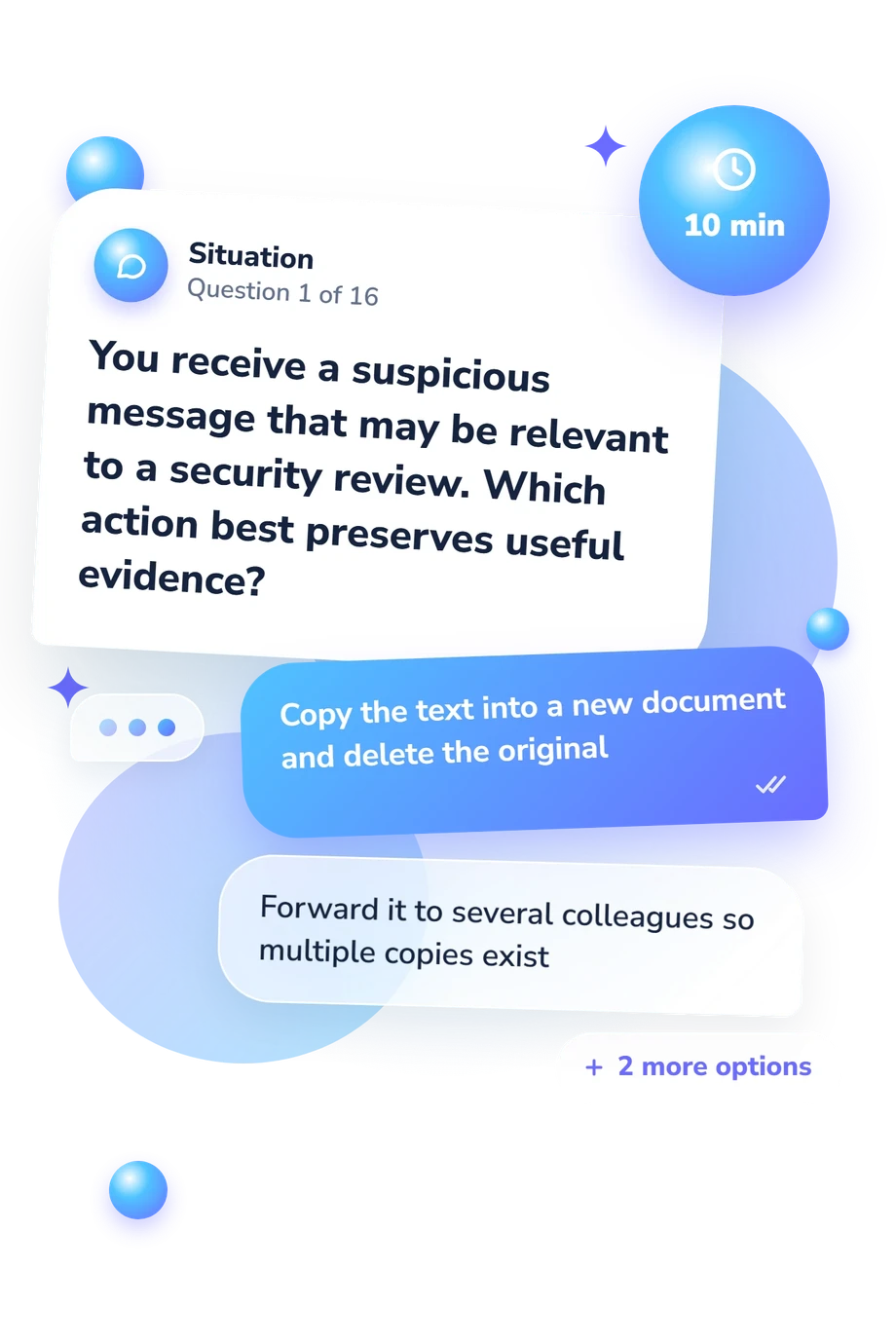
- Copy the text into a new document and delete the original
- Forward it to several colleagues so multiple copies exist
- Retain the original and follow approved instructions for reporting or preserving it
- Reply with questions to generate more evidence before reporting
- Specific observations, dates, communications, people involved, and a clear distinction between facts and assumptions
- A confident theory about who directed the activity and why
- Only details that can already be supported by multiple witnesses
- A shortened summary that omits uncertain or incomplete observations
- To conduct independent investigations into coworkers and visitors
- To recognize, protect against, and report possible foreign intelligence or insider-related activity
- To classify every unusual workplace interaction as hostile activity
- To replace cybersecurity, personnel security, and law-enforcement functions
Counterintelligence Awareness and Reporting Quiz - Description and methodology of the test
For employees and teams who need to examine judgment around suspicious contacts and information handling, the counterintelligence awareness and reporting quiz turns common workplace situations into a focused learning exercise. It shows how observation, preservation, verification, and reporting choices can be applied before intent is known. Results from this counterintelligence awareness quiz highlight practical areas for review.
What This Assessment Explores
Rather than asking respondents to investigate colleagues or prove intent, the assessment checks whether they can notice indicators and choose a proportionate response. It addresses counterintelligence reporting procedures: preserving material, recording facts, separating assumptions from observations, verifying unusual requests, and using the designated channel.
Scenarios cover elicitation, cultivation, access anomalies, exposed information, device concerns, credential requests, and immediate safety situations. They suit readers who want to understand responsibilities without treating an unusual interaction as proof of hostile intent.
The result is Counterintelligence Awareness and Reporting Knowledge (0-16), shown in three bands:
- Foundations to build (0-6) means core practices need review, including evidence preservation and reporting routes.
- Developing awareness (7-12) means you recognize many principles but should practise ambiguous situations and local procedures.
- Strong awareness (13-16) means you grasp general recognition and reporting practices, while current requirements still govern action.
Methodology and Evidence Base
Each item in this counterintelligence awareness assessment presents a workplace scenario with four response options and asks the reader to choose the best action or description. This applied format tests whether respondents can select an appropriate response to those situations.
Scoring uses the selected responses to produce the displayed knowledge result; the questionnaire does not state an individual point-per-answer rule. Its interpretation therefore remains specific to this questionnaire. It is an educational result, not a certification or threat determination.
Content is conceptually consistent with CI Awareness and Reporting Course (CI116.16), DoD Directive 5240.06 (2011), including Change 3 effective in 2020, and Caputo, Danley, and Ratcliff (2024), whose study examined whether skills-based instruction improved employees’ ability to spot and report malicious elicitation attempts. The online questionnaire is conceptually consistent with these sources but is not an adaptation of any one of them.
The displayed bands are educational categories, and the score is not a certification or threat determination. Generalized scenarios make responses sensitive to prior training, interpretation, and current context. For a real incident, follow current organizational instructions and designated channels; immediate danger requires emergency or security action first.
- Center for Development of Security Excellence. Counterintelligence Awareness and Reporting Course: Student Guide. October 2024.
- Caputo, Deanna D., Lura Danley, and Nathaniel J. Ratcliff. “Employee risk recognition and reporting of malicious elicitations: longitudinal improvement with new skills-based training.” Frontiers in Psychology, vol. 15, 2024, article 1410426. 10.3389/fpsyg.2024.1410426.
- Department of Defense. Counterintelligence Awareness and Reporting (CIAR): DoD Directive 5240.06. May 17, 2011; incorporating Change 3, effective August 31, 2020.
Updated: