
Earth Day Quiz Animals
How the Scales are Structured
Who Usually Takes This Test?
See How You Compare
Below is a preview of how scores are typically distributed across each scale.
Example Questions From the Test
- Bycatch
- Habitat succession
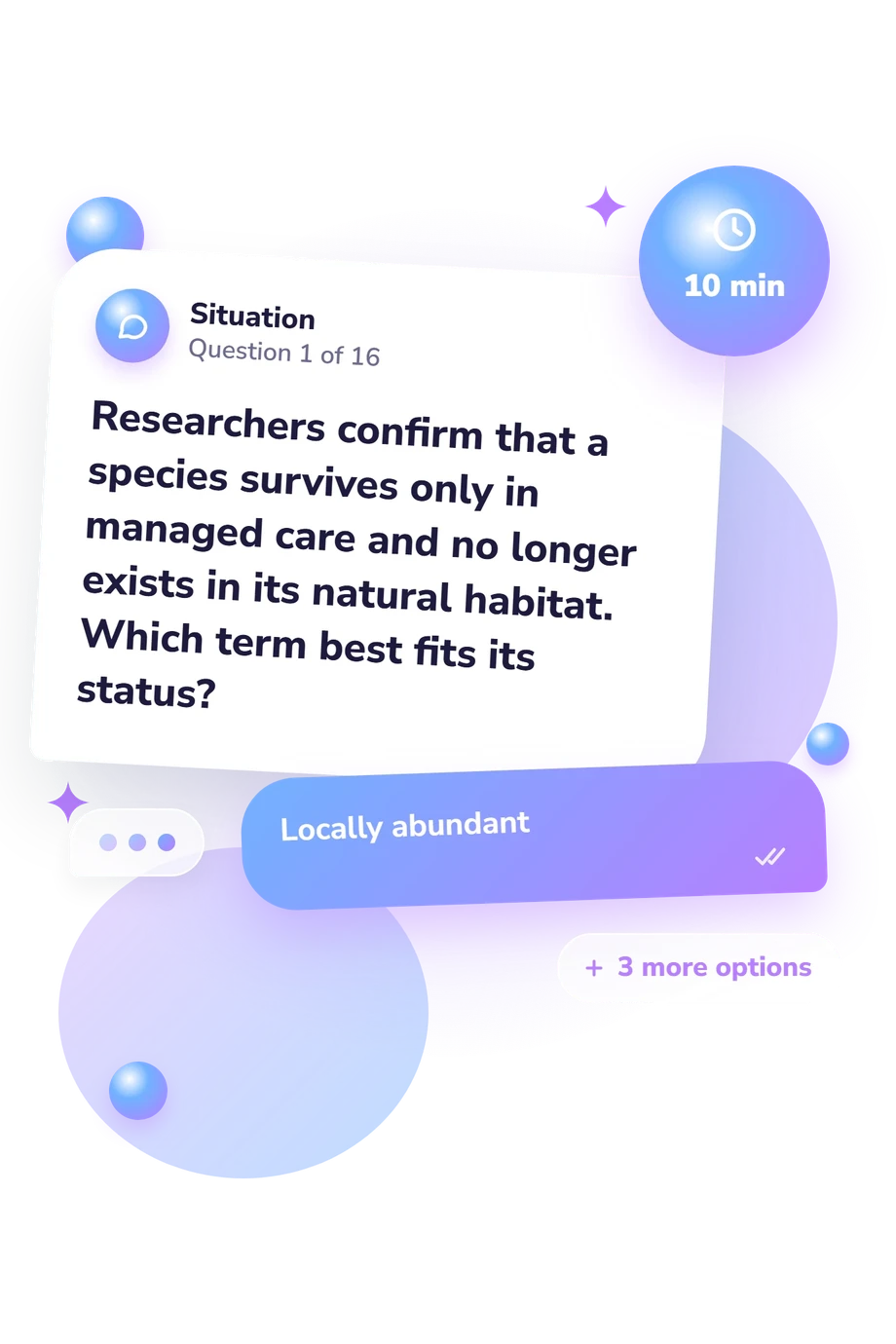
- Captive propagation
- Overgrazing
- Sea urchins require sea otters in order to reproduce.
- Sea otters help protect kelp indirectly by limiting sea urchins.
- Kelp is the primary food source of sea otters.
- Removing predators always increases ecosystem diversity.
- Illegal hunting and trade for their scales and meat
- Competition with polar bears for food
- Capture as agricultural pollinators
- Removal of coral reefs used for nesting
Earth Day Quiz Animals - Description and methodology of the test
People who want a practical introduction to wildlife conservation can use Earth Day Animals Quiz to examine their understanding of the subject. The test turns earth day quiz animals into a focused way to assess conservation knowledge without requiring specialist background. As a wildlife conservation quiz, it suits curious learners, families, and anyone building environmental knowledge through self-reflection.
What This Assessment Explores
Questions cover species status, threats, habitat loss, invasive species, illegal trade, climate pressure, and ecological links. They also ask whether responses fit problems, from reducing light pollution to restoring habitat connectivity.
Examples involving turtles, amphibians, seabirds, sea otters, pangolins, and polar bears make the endangered species quiz an applied exercise, not rote recall.
These themes feed the single displayed scale, which produces the result band:
- Endangered Species Knowledge runs from 0-16: Emerging foundation (0-6) reflects understanding; Developing knowledge (7-12) reflects core ideas; Strong knowledge (13-16) reflects identification of threats and responses. This educational result is not a professional credential.
- Threat and status recognition is a thematic area showing whether you identify extinction risks, trade pressures, habitat problems, and status terms.
- Ecological and conservation reasoning is a thematic area showing whether you connect species interactions, climate limits, evidence, and protective action.
Methodology and Scientific Basis
The questionnaire uses four-option multiple-choice items, with one best answer for each situation. The groups move from definitions and threat recognition to food-web effects, range shifts, citizen-science evidence, and conservation interventions. A correct answer adds one point, and the total is interpreted through the displayed bands, which indicate levels of educational knowledge rather than a continuous measure of expertise.
Player et al.'s EKT-19 is the closest related instrument because it assesses environmental knowledge. The IUCN Red List framework anchors status language, while Shah and Parsons (2019) offer limited context on public engagement with biodiversity. The questionnaire is conceptually consistent with these sources, while its own items apply the concepts in an online format.
Viewed as an environmental knowledge test, the questionnaire can show familiarity with concepts, but performance is influenced by prior study, wording, attention, and the examples a person recognizes. Read the result as a focused learning profile that can identify topics to review; broader conservation competence requires more evidence than one online questionnaire.
- Shah, Alexandra, and E. C. M. Parsons. “Lower public concern for biodiversity than for wilderness, natural places, charismatic megafauna and/or habitats.” Applied Environmental Education & Communication, 18(1), 79-90, 2019. 10.1080/1533015X.2018.1434025
- IUCN. IUCN Red List Categories and Criteria: Version 3.1. Second edition. Gland, Switzerland and Cambridge, UK: IUCN, 2012.
- Player, Lois, Paul H. P. Hanel, Lorraine Whitmarsh, and Punit Shah. “The 19-Item Environmental Knowledge Test (EKT-19): A short, psychometrically robust measure of environmental knowledge.” Heliyon, 9(8), e17862, 2023. 10.1016/j.heliyon.2023.e17862
Updated: