
How to Pick a Wedding Date Quiz
How the Scales are Structured
Who Usually Takes This Test?
See How You Compare
Below is a preview of how scores are typically distributed across each scale.
Example Questions From the Test
- Choose the date that feels more exciting in the moment.
- Revisit your ranked priorities, compare who is affected, and make the trade-off explicitly together.
- Select the attendance-friendly option because convenience is more concrete than atmosphere.
- Discuss which benefit would matter more when remembering the wedding and check that both partners can accept the loss.
- Ask the person directly about the specific date before committing, while recognizing that plans can still change.
- Mention the general month and see whether they raise a concern.
- Ask about several candidate dates and record which ones create firm or likely conflicts.
- Use what you already know about their usual work and family schedule.
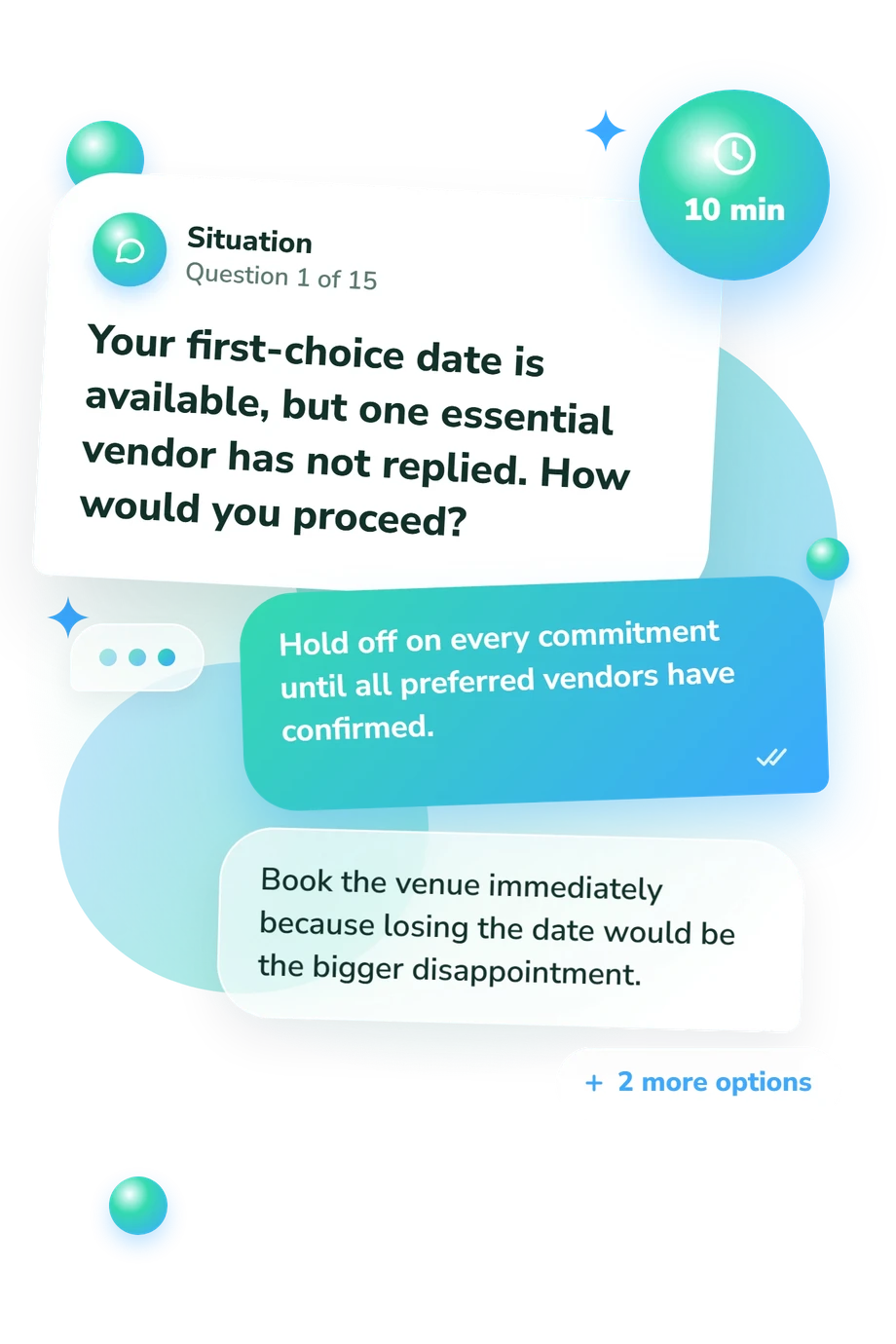
- Hold off on every commitment until all preferred vendors have confirmed.
- Book the venue immediately because losing the date would be the bigger disappointment.
- Check any venue hold deadline, contact viable alternatives, and commit only after understanding the replacement options and financial exposure.
- Request a short hold if possible and set a deadline for the vendor or a substitute decision.
How to Pick a Wedding Date Quiz - Description and methodology of the test
For couples balancing meaningful dates with guest access, contracts, costs, and uncertainty, this assessment offers a structured way to decide together. The How to Pick a Wedding Date Quiz is intended for partners who need to identify which commitments, terms, and backup arrangements require confirmation before choosing. This wedding date quiz turns circular debate into a review of trade-offs and remaining questions.
What This Assessment Explores
Date choices can conceal how partners handle trade-offs and incomplete information. Questions cover guest attendance, family preferences, work uncertainty, weather, vendor terms, travel, meaningful dates, and backups. They suit couples who want wedding date planning to combine emotional priorities with practical checks.
Result is organized into three dimensions:
- Decision and Backup Planning (0-15) shows how you narrow options, confirm commitments, and prepare for disruption. Results are Decision Structure Needed (0-5), Nearly Decision-Ready (6-10), or Resilient Decision Process (11-15).
- Practical Date Research (0-15) shows how thoroughly you investigate availability, total costs, travel demands, local conditions, and calendar conflicts. Results are Research Starting Point (0-5), Useful Groundwork (6-10), or Date-Specific Picture (11-15).
- Priority Alignment (0-15) shows how clearly you and your partner identify essentials, rank preferences, and handle compromise. Results are Priorities Still Forming (0-5), Working Alignment (6-10), or Clear Alignment (11-15).
Methodology and Evidence Base
Each prompt presents a planning situation with four response options. Choices contrast immediate preference, partial checking, and deliberate approaches that define criteria, verify information, weigh trade-offs, or set contingency triggers. This self-report format examines your approach to choosing a wedding date, not expertise. The ranges do not specify points per answer, so contributions cannot be inferred.
The questionnaire is conceptually consistent with Sniezek’s (2005) study of wedding labor and couple negotiation, but it is not an adaptation or validated version of that work. McGraw, Davis, Scott, and Tetlock (2016) link emotionally important choices with value and cost, while Simon (1959) frames decisions under limited information and competing goals. These works provide context, not validation of this questionnaire.
Interpret the displayed bands as prompts for discussion and follow-up. The result can highlight missing facts, trade-offs, or absent backup triggers. Lower results indicate areas needing structure; higher results indicate a more coherent process, not a guaranteed outcome. Current stress, incomplete information, and socially desirable answers can affect scores. Scoring is descriptive, with bands rather than population norms and no standardized interpretation supplied.
- Sniezek, Tamara. (2005). Is It Our Day or the Bride's Day? The Division of Wedding Labor and Its Meaning for Couples. Qualitative Sociology, 28(3), 215-234. 10.1007/s11133-005-6368-7
- McGraw, A. Peter, Derick F. Davis, Sydney E. Scott, and Philip E. Tetlock. (2016). The Price of Not Putting a Price on Love. Judgment and Decision Making, 11(1), 40-47. 10.1017/S1930297500007579
- Simon, Herbert A. (1959). Theories of Decision-Making in Economics and Behavioral Science. The American Economic Review, 49(3), 253-283.
Updated: