
Spanish Clothing Quiz
How the Scales are Structured
Who Usually Takes This Test?
See How You Compare
Below is a preview of how scores are typically distributed across each scale.
Example Questions From the Test
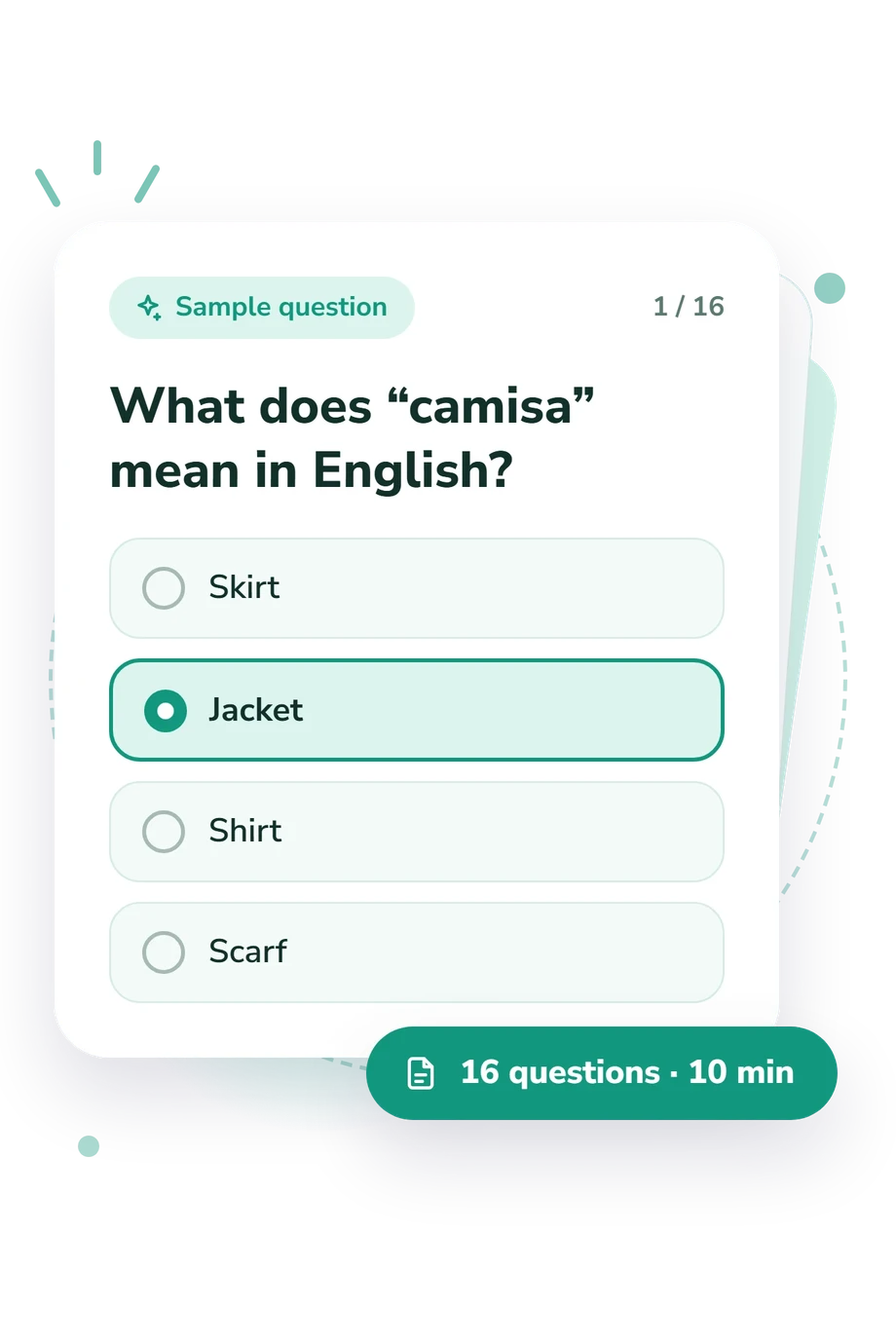
- Skirt
- Jacket
- Shirt
- Scarf
- A wool sweater
- A sun hat
- A raincoat
- A pair of boots
- Socks
- Shorts
- Gloves
- Trousers or pants
Spanish Clothing Quiz - Description and methodology of the test
Whether you are preparing for travel, revising beginner Spanish, or checking everyday vocabulary, this assessment connects familiar garments with their Spanish names and practical contexts. The Spanish Clothing Quiz suits learners who want a focused snapshot rather than a broad language profile. Its result indicates overall clothing-vocabulary knowledge and whether broad review may be useful. This Spanish clothing vocabulary quiz checks terms used in shopping, travel, and daily conversation.
What This Assessment Explores
Recognition is tested through direct translations and brief situations rather than extended writing or speaking. This Spanish clothing vocabulary test concentrates on whether familiar terms can be linked to their meanings and use. Items refer to garments, footwear, accessories, weather, dressing, swimming, packing, and asking for a size, so the result reflects practical lexical recognition.
The result is reported on the Spanish Clothing Knowledge scale, scored from 0-16, with three bands:
- Foundation (0-6) indicates that some clothing terms are recognized but everyday garments, footwear, and accessories may need review.
- Developing (7-12) shows that many common terms are understood in context although some gaps remain.
- Strong (13-16) indicates reliable recognition of common clothing vocabulary across direct and practical questions.
These bands describe performance on the vocabulary sampled here. They do not measure pronunciation, grammar, listening comprehension, or spoken production.
Methodology and Scientific Basis
Each item presents four answer choices. Some ask for an English equivalent, while others place a Spanish term in a short sentence or everyday situation. This format checks word recognition and limited contextual interpretation, not full language proficiency.
The questionnaire produces one displayed overall result, but its point allocation or weighting is not documented. This Spanish clothing knowledge test works best as a focused self-check of the terms represented in its items, with guessing, recent study, and familiarity with shopping or travel affecting performance.
Its evidence base is conceptually consistent with Khong and Kabilan (2024), whose work addresses vocabulary knowledge, and with O-WSVLT, which examines online L2 Spanish vocabulary through meaning recall. This questionnaire is not presented as an adaptation of either instrument. The CEFR Companion Volume provides a broader language-learning framework, but this result does not assign a CEFR level.
No norms or reliability estimates are reported for this questionnaire, so interpret the result descriptively. Use the score to track learning and judge whether broad review may be useful, while remembering that performance reflects recognition of the clothing terms represented in these items rather than overall Spanish ability.
- Hou Keat Khong and Muhammad Kamarul Kabilan (2024). Development of an instrument for measuring Spanish vocabulary knowledge. Porta Linguarum: An International Journal of Foreign Language Teaching and Learning, 41, 79-95. 10.30827/portalin.vi41.25406
- Pablo Robles-García, Stuart McLean, Jeffrey Stewart, Ji-young Shin, and Claudia Helena Sánchez-Gutiérrez (2024). The Development and Initial Validation of O-WSVLT, a Meaning-Recall Online L2 Spanish Vocabulary Levels Test. Language Assessment Quarterly, 21(2), 181-205. 10.1080/15434303.2024.2311724
- Council of Europe (2020). Common European Framework of Reference for Languages: Learning, Teaching, Assessment - Companion Volume. Council of Europe Publishing, Strasbourg.
Updated: