
Skins Character Quiz
How the Scales are Structured
Who Usually Takes This Test?
See How You Compare
Below is a preview of how scores are typically distributed across each scale.
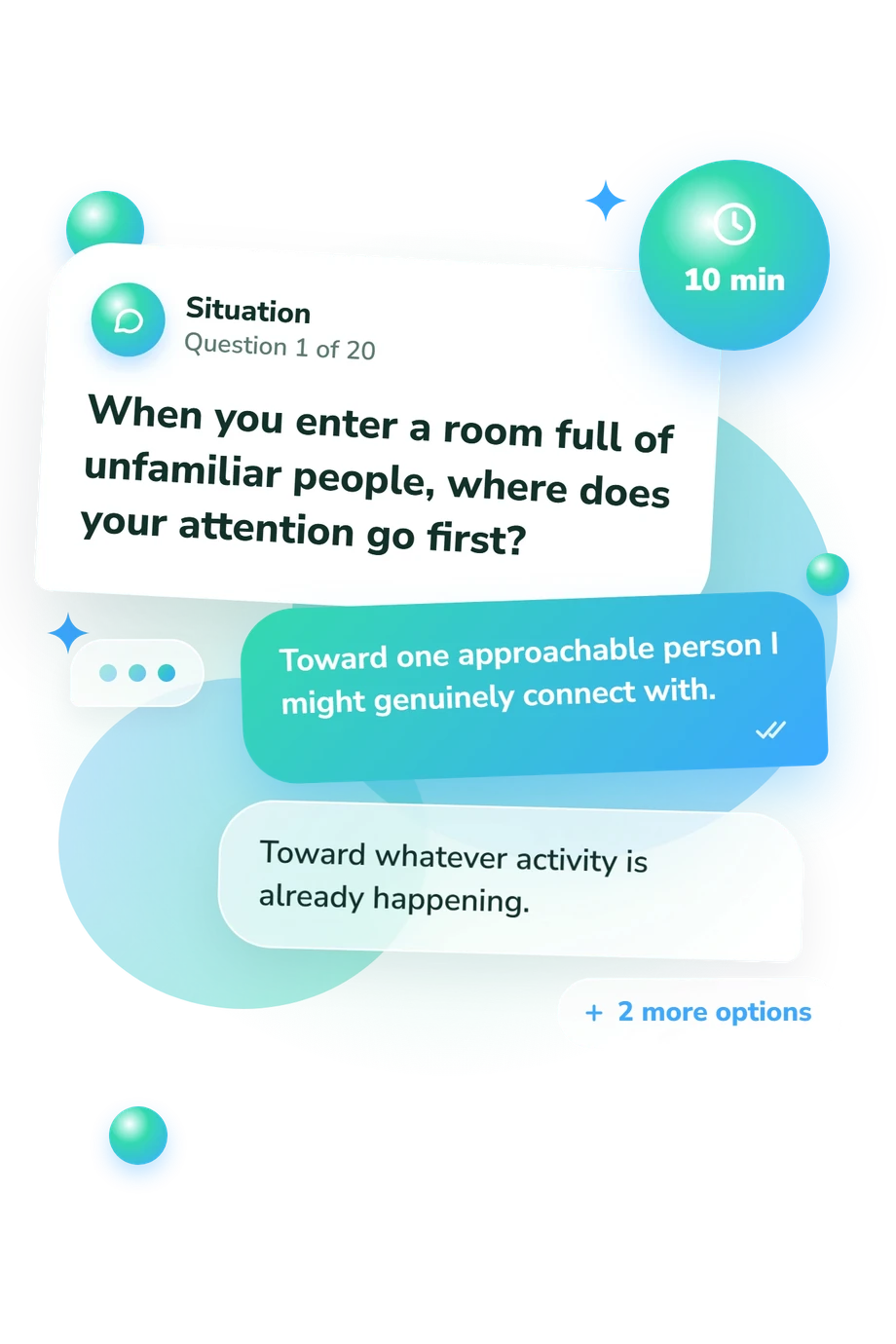
Example Questions From the Test
- Help them identify someone who is better placed to step in.
- Check what they need before deciding how much I can change.
- Drop the plan and show up, even if I have no idea what to say.
- Stay on the phone and work out a practical compromise.
- I name what is happening and ask everyone to slow down.
- I step away until I know what I actually want.
- I remain outwardly composed while deciding my next move alone.
- I confide in one person before doing anything else.
- Steady organization that keeps things running.
- One-to-one warmth within the larger gathering.
- Unfiltered enthusiasm that gives everyone permission to join in.
- Playful energy that helps the group loosen up.
Skins Character Quiz - Description and methodology of the test
Fans who want to compare social situations with the world of Skins can use the Skins Character Quiz as a playful tool. Readers can use results from the Which Skins Character Are You Quiz to compare communication, loyalty, privacy, spontaneity, and social influence through fictional affinity rather than psychological assessment. The result offers a nuanced starting point for reflection by showing how social styles may overlap in a fictional profile.
What This Assessment Explores
Questions cover attention, emotional pressure, support, privacy, spontaneity, and group influence. A Skins character match reflects the overall pattern rather than one answer. These five character-affinity scales describe facets of fictional resemblance in the profile:
- Cassie Ainsworth Affinity 0-12 reflects dreamy perception and indirect expression: Different wavelength 0-4; Gentle resonance 5-8; Strong Cassie affinity 9-12.
- Chris Miles Affinity 0-12 reflects spontaneous warmth and loyal joy: Different wavelength 0-4; Playful spark 5-8; Strong Chris affinity 9-12.
- Effy Stonem Affinity 0-12 reflects guarded autonomy and emotional intensity: Different wavelength 0-4; Quiet intensity 5-8; Strong Effy affinity 9-12.
- Sid Jenkins Affinity 0-12 reflects earnest loyalty and hesitant reflection: Different wavelength 0-4; Relatable Sid energy 5-8; Strong Sid affinity 9-12.
- Tony Stonem Affinity 0-12 reflects composure and social strategy: Different wavelength 0-4; Some strategic spark 5-8; Strong Tony affinity 9-12.
Methodology and Evidence Base
Each item presents a social or emotional situation with four contrasting responses. Choices are not right or wrong; they show ways of noticing, communicating, supporting, protecting privacy, taking initiative, or adapting when plans change.
Interpretation of the Skins character results follows the displayed scoring logic: the highest-scoring outcome is the strongest affinity, and every outcome within one point of the highest score is included in the blended result. The labels describe fictional resemblance, not a character’s full behavior or consequences.
Hoffner and Buchanan (2005) provide the closest conceptual anchor. The questionnaire is conceptually consistent with their work on perceived similarity and wishful identification, but it is not an adaptation of that study. Cohen (2001) frames identification as an audience’s psychological connection with a media character, while Huang, Fung, and Sun (2024) connect audience-character similarity with identification across narrative contexts.
The displayed ranges and labels are the test’s descriptive affinity bands; they organize fictional profile outcomes rather than reporting population norms. Self-report results can shift with current mood, self-awareness, or imagined situations, so treat the profile as a snapshot of your responses.
- Hoffner, Cynthia A., and Martha Buchanan. (2005). Young Adults' Wishful Identification With Television Characters: The Role of Perceived Similarity and Character Attributes. Media Psychology, 7(4), 325-351. 10.1207/S1532785XMEP0704_2
- Huang, Kate Y., Helene H. Fung, and Peifeng Sun. (2024). The Effect of Audience-Character Similarity on Identification With Narrative Characters: A Meta-Analysis. Current Psychology, 43(8), 7026-7043. 10.1007/s12144-023-04842-4
- Cohen, Jonathan. (2001). Defining Identification: A Theoretical Look at the Identification of Audiences With Media Characters. Mass Communication and Society, 4(3), 245-264. 10.1207/S15327825MCS0403_01
Updated: