
Pearl Harbor Quiz
How the Scales are Structured
Who Usually Takes This Test?
See How You Compare
Below is a preview of how scores are typically distributed across each scale.
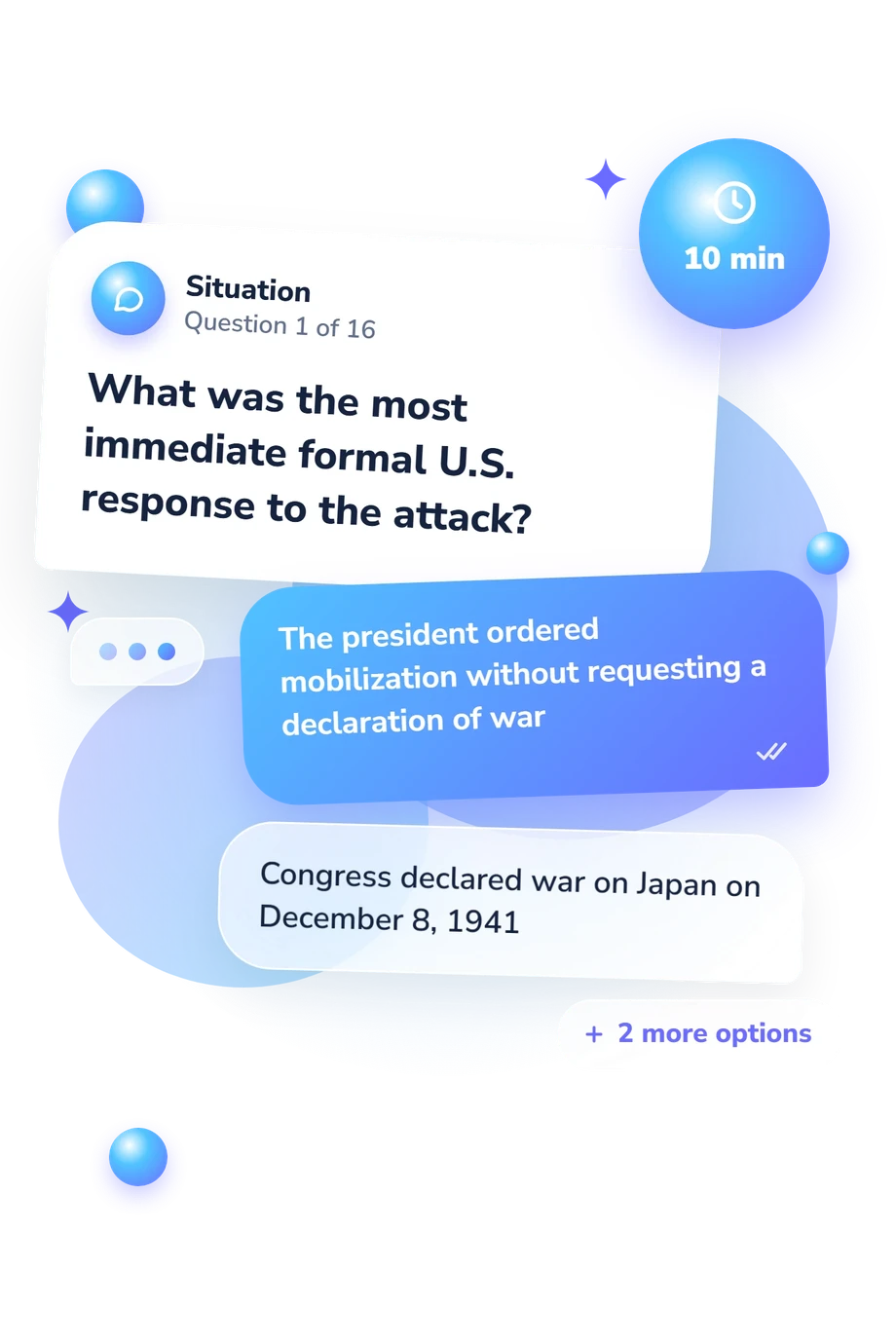
Example Questions From the Test
- June 6, 1944
- September 1, 1939
- December 7, 1941
- December 8, 1941
- Winston Churchill
- Harry S. Truman
- Franklin D. Roosevelt
- Douglas MacArthur
- Oahu
- Maui
- Hawaii Island
- Kauai
Pearl Harbor Quiz - Description and methodology of the test
Readers who want a focused way to check their understanding of the December 7, 1941 attack can use Pearl Harbor Quiz to connect factual recall with military context and historical consequence. It suits learners, history enthusiasts, and anyone revisiting the event through a quiz about Pearl Harbor history. The result points to areas for closer review rather than reducing the subject to a date or famous image.
What This Assessment Explores
The questionnaire connects the attack's date and location with military aims, U.S. response, and later consequences. It also asks whether claims follow from evidence or go beyond it. As a test of Pearl Harbor knowledge, it gives learners a focused view of historical understanding.
The questions revisit several recurring themes rather than producing separate subscores:
- Chronology and geography help you place the attack, Oahu, key dates, and U.S. entry into the war.
- Military strategy and response clarify Japan’s aims, warning failures, carrier absence, and surviving facilities.
- Historical context and evidence connect incarceration, Roosevelt’s language, and photographs with claims supported by the record.
Pearl Harbor Knowledge ranges from 0-16: Foundations to Build (0-6) means core facts need reinforcement; Developing Knowledge (7-12) shows a solid grasp with details to refine; Strong Knowledge (13-16) reflects broad command of facts, context, and significance.
Methodology and Evidence Base
Each item presents four-option multiple choice. Some ask for a date, place, person, or force; others interpret warning, strategy, consequence, or photographic evidence. Together, these Pearl Harbor-related quiz questions combine factual recall with historical reasoning without requiring an essay.
The displayed result uses that scale and its supplied performance bands. It indicates performance on this question set rather than a separate score for each thematic group.
The historical frame is conceptually consistent with Prange, Goldstein, and Dillon (1981), who examine planning, execution, and consequences; Wohlstetter (1962), who analyzes warning and decision; and Roosevelt's December 8, 1941 address, which records the immediate political response. The questionnaire is conceptually consistent with these works, not an adaptation of them; they provide historical context, while the online result stays tied to the selected questions and stated bands.
Scores can vary with prior study, attention to wording, memory, and willingness to distinguish supported conclusions from incomplete claims. A strong result therefore reflects the selected items, while source-based reading can deepen understanding of why an answer fits the historical record.
- Gordon W. Prange, Donald M. Goldstein, and Katherine V. Dillon. At Dawn We Slept: The Untold Story of Pearl Harbor. New York: McGraw-Hill, 1981.
- Roberta Wohlstetter. Pearl Harbor: Warning and Decision. Stanford: Stanford University Press, 1962. Digital edition, 2022. 10.1515/9781503620698.
- Franklin D. Roosevelt. Joint Address to Congress Leading to a Declaration of War Against Japan. December 8, 1941. National Archives.
Updated: