
Excretory System Quiz
How the Scales are Structured
Who Usually Takes This Test?
See How You Compare
Below is a preview of how scores are typically distributed across each scale.
Example Questions From the Test
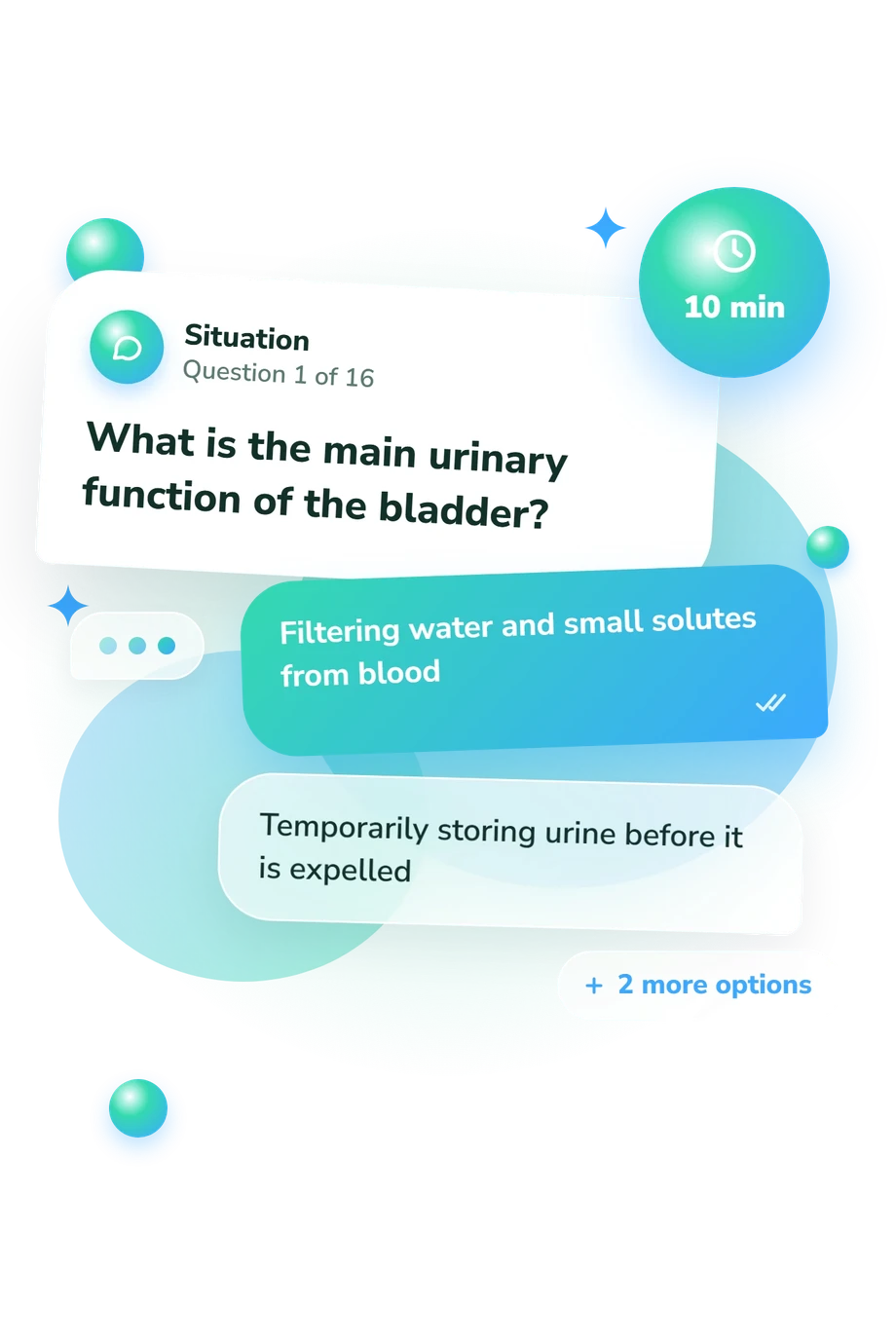
- Filtering water and small solutes from blood
- Temporarily storing urine before it is expelled
- Adjusting blood pH by secreting hydrogen ions
- Carrying urine from each kidney toward the pelvis
- Filtering blood, regulating its composition, and forming urine
- Storing urine until it can leave the body
- Producing digestive enzymes for the small intestine
- Exchanging oxygen and carbon dioxide with the blood
- Ureter
- Urethra
- Renal vein
- Collecting duct
Excretory System Quiz - Description and methodology of the test
Students and lifelong learners who want to check their biology knowledge can use this assessment to review how the kidneys and related organs maintain internal balance. The excretory system quiz focuses on functional understanding rather than memorizing isolated labels, and its result shows how well you connect anatomy with physiological processes. As an excretory system test, it can help identify topics to revisit before coursework or revision.
What This Assessment Explores
Across urine formation and waste removal, the assessment checks whether you can connect structures with their roles. It covers the urinary tract, nephron transport, filtration, reabsorption, secretion, hormonal regulation, and contributions from the liver and lungs. An excretory quiz suits learners reviewing biology through applied situations rather than labels alone.
The result uses the Excretory System Knowledge scale, 0-16. Its displayed bands are Foundation to build (0-6), Developing knowledge (7-12), and Strong knowledge (13-16). These describe demonstrated educational knowledge, not medical status.
The single Excretory System Knowledge result represents these thematic areas, not separate scores:
- Kidney anatomy represents the ability to trace blood and urine through relevant pathways.
- Nephron processes represent understanding of filtration, reabsorption, secretion, and concentration.
- Hormonal regulation represents links between ADH, aldosterone, water, and salt balance.
- Other excretory organs represent liver and lung roles in metabolic-waste removal.
Methodology and Scientific Basis
Each item uses a direct multiple-choice stem with four answer options, asking you to identify a structure, select a physiological process, trace a pathway, or predict a consequence of altered regulation. The questions therefore test recognition and application, not only definition recall. Several items also ask you to distinguish normal transport from blockage or altered hormone levels.
As an educational excretory system assessment, it examines the system as a whole in an online format. Its content is conceptually consistent with Betts et al. (2022) and with Hall and Hall’s treatment of renal physiology, including filtration, tubular handling, hormonal control, and the excretory roles of other organs.
The item format is consistent with general multiple-choice conventions discussed by Haladyna et al. (2002), particularly focused stems and answer choices that distinguish related concepts. The score summarizes responses as a single knowledge total and applies the displayed educational bands. Performance may vary with prior study, guessing, and attention, so the result is best read as a current snapshot of knowledge and a guide to targeted review.
- Betts, J. Gordon, Kelly A. Young, James A. Wise, Eddie Johnson, Brandon Poe, Dean H. Kruse, Oksana Korol, Jody E. Johnson, Mark Womble, and Peter DeSaix. Anatomy and Physiology 2e. Houston, TX: OpenStax, 2022.
- Hall, John E., and Michael E. Hall. Guyton and Hall Textbook of Medical Physiology. 15th ed. Philadelphia, PA: Elsevier, 2025. ISBN 978-0-443-11101-3.
- Haladyna, Thomas M., Steven M. Downing, and Michael C. Rodriguez. A Review of Multiple-Choice Item-Writing Guidelines for Classroom Assessment. Applied Measurement in Education, 15(3), 309-334, 2002. 10.1207/S15324818AME1503_5
Updated: