
Last Words Quiz
How the Scales are Structured
Who Usually Takes This Test?
See How You Compare
Below is a preview of how scores are typically distributed across each scale.
Example Questions From the Test
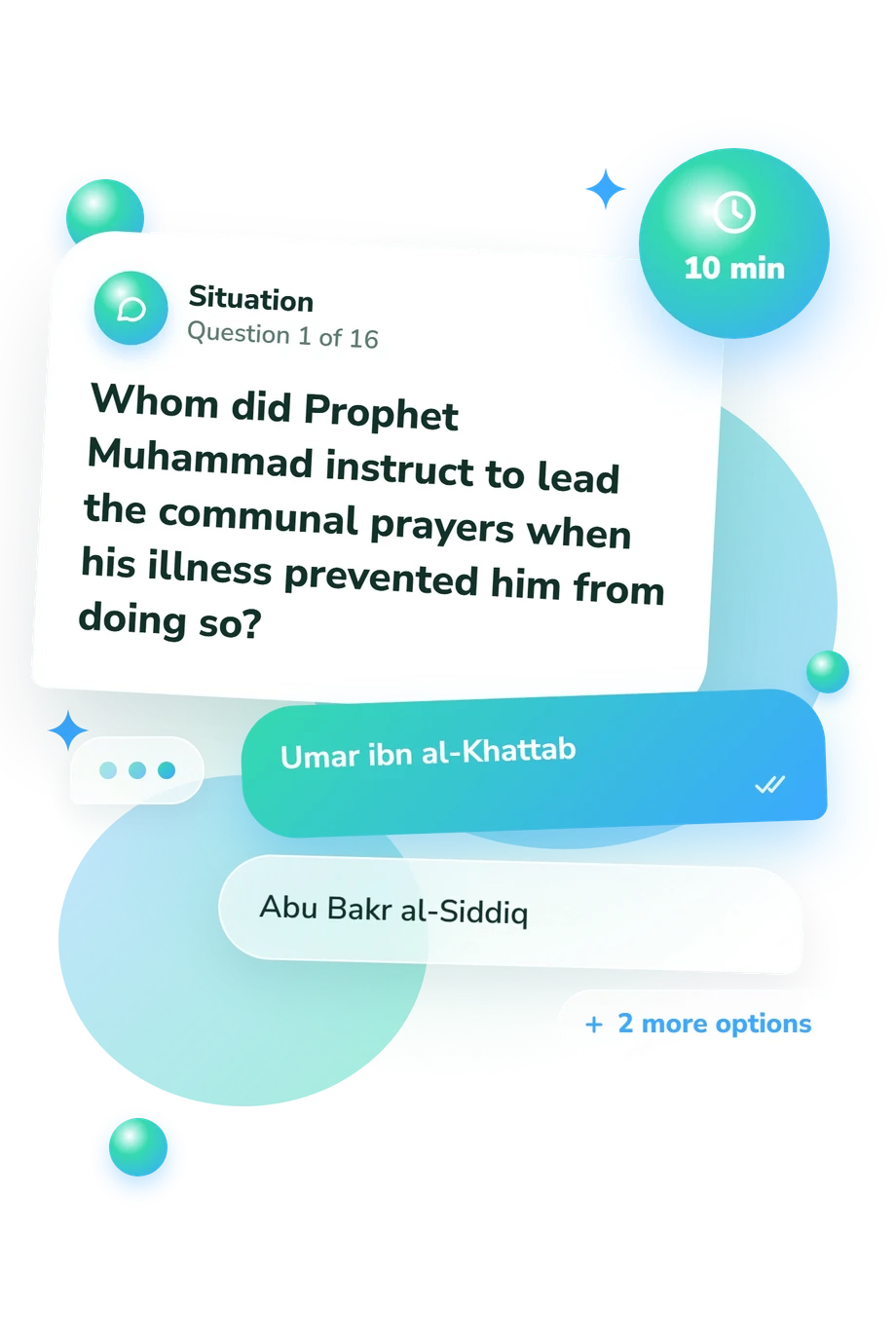
- Umar ibn al-Khattab
- Abu Bakr al-Siddiq
- Ali ibn Abi Talib
- Usama ibn Zayd
- Safiyyah bint Abd al-Muttalib
- Fatimah bint Muhammad
- Umm Salama
- Asma bint Abi Bakr
- 8 AH / 630 CE
- 9 AH / 631 CE
- 10 AH / 631 CE
- 11 AH / 632 CE
Last Words Quiz - Description and methodology of the test
Learners, students, and readers exploring Islamic history may use the last words quiz to compare remembered quotations with the contexts in which they are reported. This quiz about famous last words offers a focused way to review who said what, when events occurred, and how public counsel, family conversations, and private utterances differ, helping readers approach familiar claims with greater care.
What This Assessment Explores
The questions examine the final illness, death, and burial: key people, reported phrases, dates, locations, and the distinction between public counsel, family conversations, and a private utterance. They also ask readers to judge quotations through narration and context, making this a test of Muhammad’s final words as well as factual recall.
These thematic groups contribute to the result:
- Final-illness reports connect phrases with their context.
- Family and companion accounts identify narrators.
- Chronology and burial details test sequence and place.
- Context judgment separates counsel from private speech.
The result uses one knowledge scale, Prophet Muhammad’s Last Words Knowledge, scored 0-16. Results are shown as Foundations to Build (0-6), Developing Knowledge (7-12), or Strong Knowledge (13-16), reflecting familiarity with selected reports rather than certainty about every account.
Methodology and Evidence Base
Each item offers four answer options. The topics combine recall of dates, locations, people, and reported phrases with source-sensitive interpretation, especially the difference between public exhortation and a final private utterance. As a last words assessment, it measures recognition and contextual discrimination rather than free-form historical writing.
Evidence is anchored first in Sahih al-Bukhari, which supplies widely cited reports about the final illness and last moments. Al-Tabari supports chronology and communal response, while Shoemaker’s study provides historical context for evaluating reports about a prophet’s death. The questionnaire is conceptually consistent with these works, not an adaptation of any one of them. The documented scoring converts responses into one knowledge result, and no norm-referenced interpretation is provided.
Performance can vary with prior education, memory, translation choices, and response bias, including a tendency to choose a familiar answer rather than the best-supported one. Option wording may also steer recognition, while unfamiliar terminology can reduce recall; reading the score alongside the specific reports and contexts it tests gives a more useful interpretation.
- Al-Bukhari, Muhammad ibn Ismail. The Translation of the Meanings of Sahih al-Bukhari: Arabic-English. Translated by Muhammad Muhsin Khan. 9 vols. Riyadh: Darussalam, 1997.
- Al-Tabari, Abu Ja'far Muhammad ibn Jarir. The History of al-Tabari, Vol. 9: The Last Years of the Prophet: The Formation of the State, A.D. 630-632/A.H. 8-11. Translated by Ismail K. Poonawala. Albany: State University of New York Press, 1990.
- Shoemaker, Stephen J. The Death of a Prophet: The End of Muhammad's Life and the Beginnings of Islam. Philadelphia: University of Pennsylvania Press, 2011. 10.9783/9780812205138
Updated: